

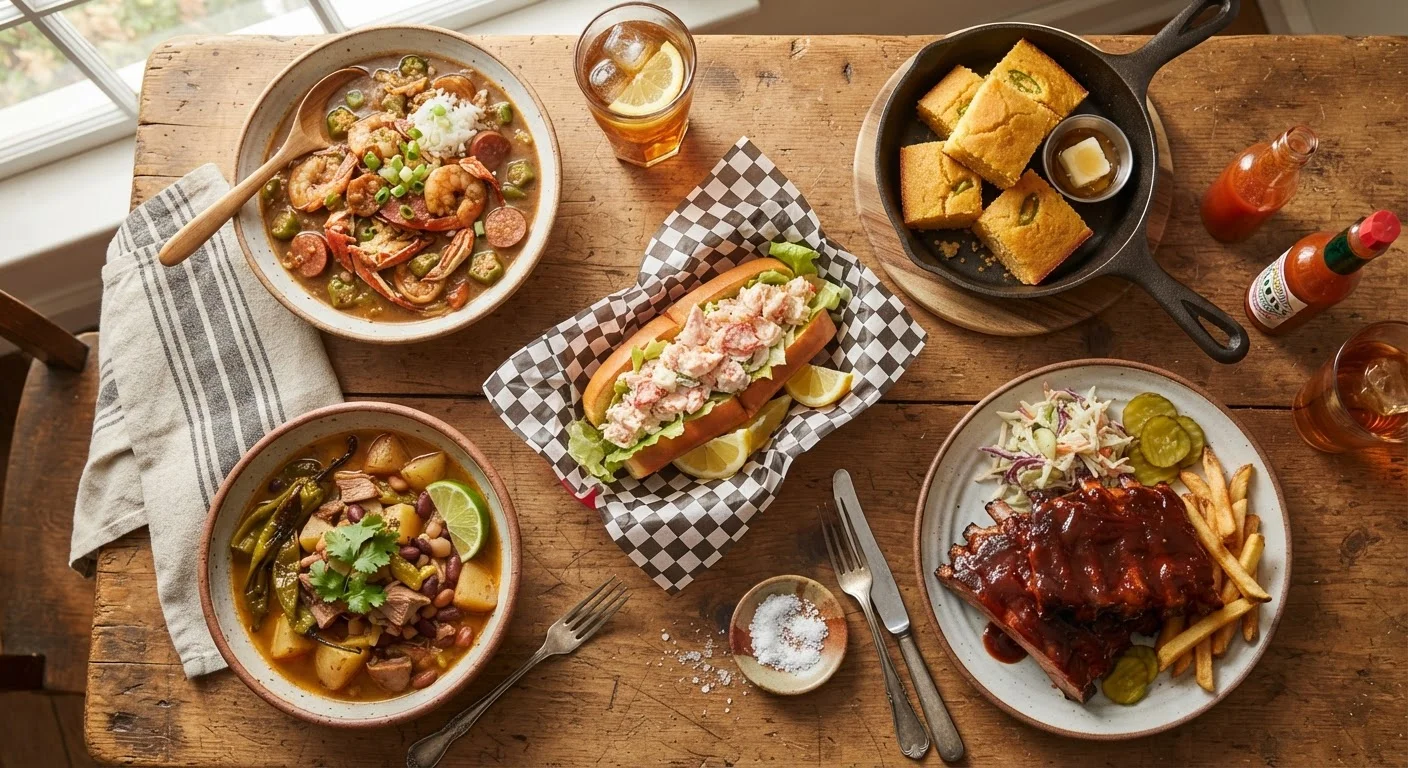
Start here
Why Regional Food Traditions Still Matter
Explore the South
The South: Soul Food, Low Country, and Barbecue Country
Head Southwest
The Southwest and Tex-Mex Belt
Go North and Midwest
New England, the Mid-Atlantic, and the Midwest
Put it into practice
How to Eat Regionally on Any Budget
Why Regional Food Traditions Still Matter
American food is often flattened into a single story - burgers, pizza, and fast food. But the actual culinary map of the United States is richly varied, shaped by Indigenous foodways, immigrant communities, trade routes, climate, and the land itself. Understanding these traditions makes you a smarter, more adventurous diner wherever you travel.
Regional cuisines are living records of history. The rice dishes of coastal South Carolina trace back to West African agricultural knowledge. The green chile stews of New Mexico reflect centuries of Pueblo, Spanish, and mestizo cooking. Immigrant communities have long reshaped American food, and regional cuisines are where that transformation is most visible and delicious.
Regional cuisine
A food tradition shaped by a specific geographic area's history, climate, available ingredients, and cultural communities over generations.
Low Country cooking
A coastal Southern food tradition from South Carolina and Georgia, built around rice, shellfish, and West African culinary heritage.
Tex-Mex
A distinct American regional cuisine that developed along the Texas-Mexico border, blending Mexican culinary roots with ranching culture and local ingredients.
Foodway
The full set of practices, beliefs, and traditions surrounding how a community grows, prepares, and shares food - broader than just recipes.
Dry rub
A blend of spices applied directly to meat before smoking or cooking, used widely in Southern barbecue traditions, particularly in Memphis-style ribs.
Post oak
A type of wood commonly used in Central Texas barbecue smoking that imparts a specific mild, clean smoke flavor to beef brisket.
The South: Soul Food, Low Country, and Barbecue Country
The American South is not one food culture - it's several layered together. Soul food is a tradition born from the ingenuity of enslaved African Americans, turning undervalued cuts of pork, field greens, and cornmeal into deeply satisfying cooking. Dishes like fried chicken, collard greens, and black-eyed peas carry this history.
Low Country cuisine, concentrated around coastal South Carolina and Georgia, centers on rice and shellfish. Shrimp and grits - once everyday fishermen's breakfast food - is now the dish most visitors encounter first. Rice is foundational here in a way it isn't elsewhere in the South, a direct legacy of West African rice-farming traditions.
Then there's barbecue, and every state argues its version is definitive. Carolina barbecue is typically pork-focused with a vinegar-based sauce. Memphis barbecue emphasizes slow-smoked ribs with a dry rub or sweet tomato sauce. Texas barbecue, meanwhile, centers on beef brisket smoked over post oak wood - a tradition tied to the cattle industry and German and Czech immigrant butcher culture. Each style reflects its region's history, not just preference.
The Southwest and Tex-Mex Belt
Tex-Mex is a fully American regional cuisine that developed along the Texas-Mexico border. Its hallmarks include beef-heavy dishes, yellow processed cheese, wheat-flour tortillas, and chili con carne. While it draws on Mexican culinary roots, it evolved independently and is distinct from the regional cuisines of interior Mexico. When you order nachos or a beef fajita at a Texas roadside restaurant, you're eating Tex-Mex - and that's worth understanding and appreciating on its own terms.
New Mexican cuisine is a separate tradition entirely. It pivots on the Hatch green chile pepper and the question every New Mexican diner will ask you: red or green (referring to which chile sauce you want). This cuisine blends Pueblo Indigenous, Spanish colonial, and Mexican influences into something found nowhere else. If you're traveling through the region, the context behind the American Southwest helps explain why the food tastes so distinct from what you'll find in neighboring states.
California and the Pacific Coast add another layer - Asian-influenced cooking, farm-to-table culture, and a thriving street food scene. Street food in American cities reflects these regional influences clearly: LA's taco trucks pull from both Mexican and Salvadoran traditions rooted in actual immigrant communities.
New England, the Mid-Atlantic, and the Midwest
New England cuisine is defined by the sea and the cold. Clam chowder, lobster rolls, steamers, and cod have fed this coastline for centuries. Boston baked beans and brown bread connect to early colonial cooking. These are not trendy dishes - they're durable traditions tied to what the land and ocean reliably provided.
The Mid-Atlantic brings more urban complexity. New York City's food culture is itself a layered map of immigrant communities - Jewish deli tradition, Italian-American cooking, West Indian bakeries, and now a staggering array of global cuisines. Maryland is synonymous with blue crab, served steamed and heavily seasoned with Old Bay. Philadelphia's cheesesteak is less about the recipe and more about the cultural identity of a city.
Midwestern food gets underestimated. Comfort food here - hot dish, pasties in Michigan's Upper Peninsula, Czech kolaches in Nebraska, and the Friday night fish fry of Wisconsin - reflects Scandinavian, German, Czech, and Polish immigrant waves. Comfort food means something different in every region, and the Midwest makes that point clearly.
How to Eat Regionally on Any Budget
The most authentic regional food is rarely the most expensive. Barbecue joints, taco trucks, fish shacks, and neighborhood diners tend to deliver more genuine regional character than upscale restaurants built around the same ingredients. Prioritize locally owned spots that have served the same community for years.
Ask One Simple Question First
When dining somewhere unfamiliar, ask your server: 'What is this place known for?' That single question cuts through the menu and often lands you at the most regional, most house-proud dish. Staff at locally owned spots are usually glad to guide you - they know the kitchen's strengths better than any review site.
If you're new to a region's cuisine, start with the dishes locals call their own. Ask your server what the restaurant is known for or what's made from scratch that day. Curiosity and politeness open more doors than any travel app. For more strategies on approaching unfamiliar cuisines with confidence, see our guide to exploring unfamiliar cuisines.
Regional food traditions also change over time, shaped by migration, economics, and cultural exchange. Understanding how dining trends spread across America helps explain why a dish that originated in one place shows up - sometimes transformed - across the country.
Frequently Asked Questions
Regional cuisine refers to food traditions shaped by a specific area's geography, climate, cultural history, and available ingredients. These traditions develop over generations and often differ significantly from one part of the country to another - even within the same broad region.
No. Tex-Mex is a distinct American regional cuisine that evolved along the Texas-Mexico border, blending Mexican culinary roots with cattle-ranching culture and locally available ingredients. Dishes like beef fajitas, yellow-cheese nachos, and chili con carne are hallmarks of Tex-Mex that differ from interior Mexican traditions.
Low Country cuisine comes from the coastal lowlands of South Carolina and Georgia. It centers on rice, shellfish - particularly shrimp and oysters - and the culinary contributions of enslaved West Africans who brought rice-growing expertise to the region. Shrimp and grits is perhaps its most recognized dish.
Authenticity tends to live in smaller, locally owned spots rather than chains. Look for family-run diners, roadside stands, fish shacks, barbecue joints, and neighborhood restaurants that have served the same community for years.
New England cuisine leans heavily on seafood like lobster, clams, and cod, plus chowders and baked beans rooted in colonial-era cooking. Mid-Atlantic food incorporates a more diverse immigrant influence - think Philly cheesesteaks, Maryland blue crab, and the Jewish deli tradition of New York City.
Absolutely. Many American cities have restaurants representing multiple regional traditions. Food halls, ethnic neighborhoods, and specialty grocers can all offer entry points into regional American cooking without leaving your metro area.
The content on this site is provided for informational purposes only and should not be considered a substitute for professional advice. While we strive to provide accurate and up-to-date information, we make no guarantees regarding its completeness or accuracy. Always consult a qualified professional for advice specific to your circumstances before making any decisions.