

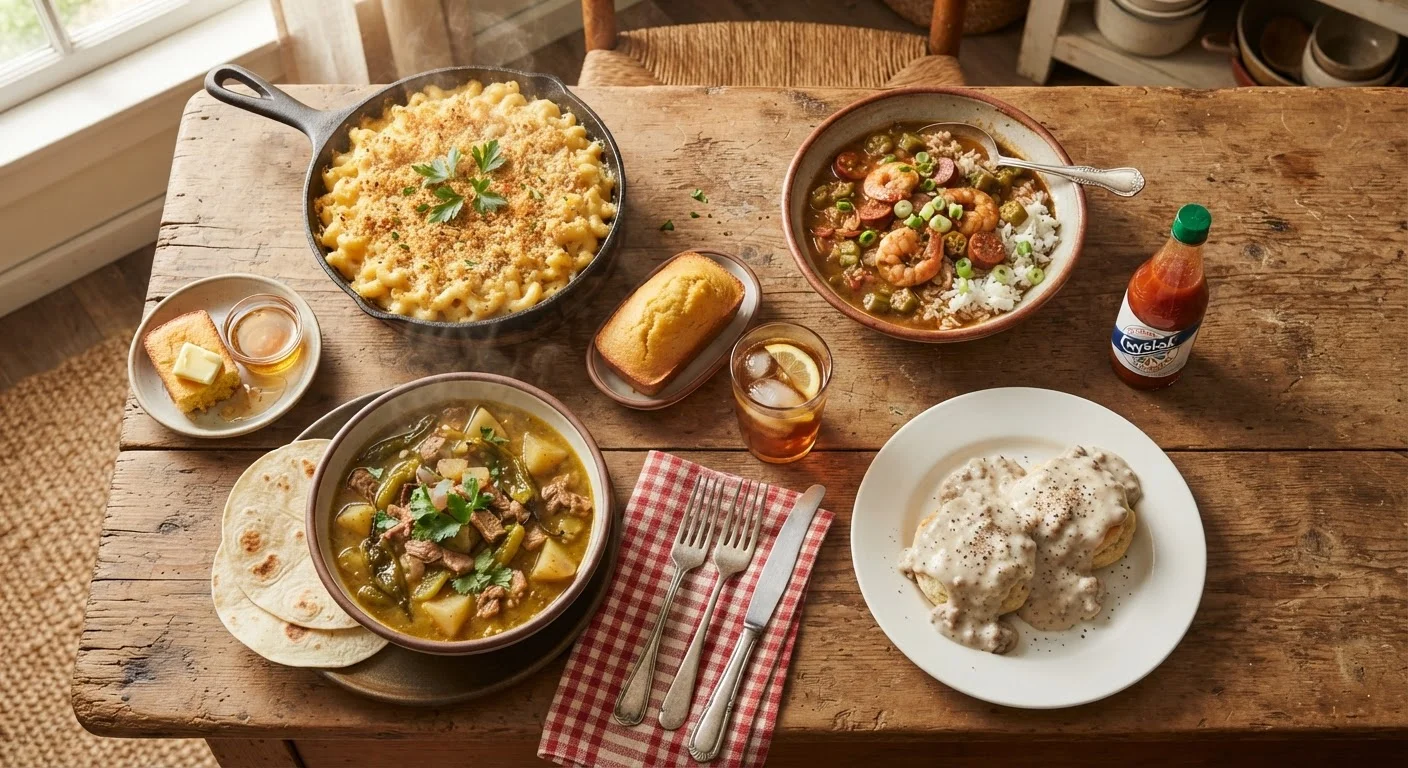
Why Comfort Food Looks Different Depending on Where You Grew Up
Comfort food is a feeling before it's a recipe. It's the warmth of familiarity, the smell of something cooking that you associate with safety or love or home. But ask an American from Albuquerque and one from Pittsburgh what that dish actually is, and you may get answers with nothing in common except the emotion they produce.
That gap is fascinating rather than surprising. American comfort food is shaped by climate, by the crops and livestock that were historically available, by the communities - Indigenous, immigrant, and regional - that developed cooking traditions in a specific place. Food trends spread unevenly across America, and comfort food, more than almost any other category, resists homogenization. It's the last thing people are willing to negotiate on.
Below are six regional comfort dishes that illustrate just how wide the range really is - and what each one tells us about the community that loves it.
Mac and Cheese: The Midwest's Hug in a Bowl
Ask most Americans to name a comfort food and macaroni and cheese lands near the top of the list - especially in the Midwest. Whether baked with a breadcrumb crust in an Ohio kitchen or stirred stovetop in a Minnesota apartment, this dish carries deep emotional weight rooted in postwar home cooking and school cafeteria nostalgia.
The Midwest's version leans creamy and unpretentious, often made with sharp cheddar and a roux-based sauce. It's a dish that scales effortlessly - equally at home as a weeknight dinner or a church potluck contribution. That communal quality is part of what gives it staying power across generations.
Few dishes carry more nostalgic weight than a bubbling pan of homemade mac and cheese.
Green Chile Stew: New Mexico's Answer to Everything
In New Mexico, green chile isn't a condiment - it's a food group. Green chile stew, made with roasted Hatch or Pueblo chiles, pork or beef, potatoes, and broth, is the dish New Mexicans reach for when life feels heavy. It's smoky, warming, and intensely local - the chiles are often hand-selected and frozen in bulk after the fall harvest.
This dish reflects the deep cultural layering of New Mexico's Indigenous Pueblo, Spanish colonial, and Mexican culinary traditions. You won't find it on many menus outside the Southwest, which is precisely why it remains so personally meaningful to those who grew up eating it. For many families, the recipe is passed down verbally, not written.
In New Mexico, green chile stew is less a recipe than a living cultural inheritance.
Biscuits and Gravy: The Pacific Northwest and Appalachian South
Biscuits and gravy occupies a fascinating dual geography. It's a morning staple across Appalachian communities in West Virginia, Kentucky, and Tennessee - flour biscuits smothered in milk-based sausage gravy, a calorie-dense meal built for hard physical labor. But the dish also became deeply embedded in Pacific Northwest diner culture, carried westward by Appalachian migrants during the 20th century.
The same dish in two very different landscapes tells a story about how comfort food travels with people. It adapts slightly - Pacific Northwest versions sometimes use local breakfast sausage with different spice blends - but the emotional core remains identical: warmth, satiety, and a sense that someone took care of you.
Comfort food often migrates with the people who love it, taking root in new places without losing its soul.
Gumbo: Louisiana's One-Pot Story
Gumbo is one of the most layered dishes in American food history. A thick, dark stew built on a slow-cooked roux, okra, the "holy trinity" of onion, celery, and bell pepper, and proteins ranging from shrimp and crab to chicken and andouille sausage, gumbo is inseparable from Louisiana identity. It draws on West African, Native American Choctaw, French Creole, and Spanish culinary traditions - all in a single pot.
For Louisiana families, gumbo is the dish that appears at funerals, holidays, and any gathering that calls for meaning. The immigrant and cultural roots that shaped gumbo are a microcosm of how much of American comfort food was built: through necessity, creativity, and the blending of worlds.
Gumbo encodes centuries of cultural history in every spoonful.
Fry Bread: Comfort With a Complicated History
Fry bread - puffy, golden dough cooked in hot oil - is widely eaten as a comfort food across many Native American communities in the Southwest, Plains, and beyond. It's often served sweet with honey and powdered sugar, or savory as the base of an "Indian taco." But fry bread also carries a painful history: it emerged from the rations - lard, flour, salt, sugar - distributed to forcibly relocated Native communities in the 19th century.
For many Indigenous people, fry bread is a complicated symbol - a food born from trauma that became an act of cultural reclamation and identity. It's a reminder that comfort food isn't always a simple story, and that understanding why a community reaches for a dish can be as meaningful as understanding how it's made.
Some comfort foods carry history that is painful and proud at the same time.
Clam Chowder: New England's Cold-Weather Ritual
On a gray November afternoon in coastal Massachusetts or Maine, a bowl of New England clam chowder - creamy, thick with potatoes and chopped clams - is more than a meal. It's a ritual tied to geography and season. The dish reflects the fishing communities that have shaped the region's economy and culture for centuries.
Chowder debates run deep in New England. Should it use salt pork or bacon? How thick should the base be? These aren't trivial questions to locals - they're part of a food identity that distinguishes one town from the next. That fierce specificity is exactly what makes regional comfort food so culturally rich. To learn more about how these distinctions play out across the country, explore America's regional food traditions.
In coastal New England, a bowl of chowder is an act of belonging as much as nourishment.
The Shared Thread Running Through All of It
As different as green chile stew and clam chowder are, they share an underlying logic: they were built from what was locally available, refined over generations, and became emotionally significant because they were there during important moments. That's the architecture of every comfort food, regardless of region.
Comfort Food Isn't Static
What counts as comfort food shifts across generations within the same region. A second-generation Vietnamese-American family in Houston may find deep comfort in pho; a third-generation Italian-American in Chicago may reach for baked ziti. Regional comfort food overlaps with ethnic heritage, family history, and personal memory - which means it's always more personal than any map can fully capture.
It's also worth noting that regional boundaries have always been porous. Shared meals and food traditions have long been how Americans transmit culture across community lines. A dish that began as deeply regional - think barbecue, think gumbo - can travel, adapt, and become beloved well beyond its origin. For a deeper look at how that process works, see our piece on the distinctions between soul food and Southern cuisine, two traditions that are often conflated but carry distinct histories.
The next time you reach for whatever dish makes you feel better, consider what it says about where you come from - and what it might mean to someone who grew up reaching for something entirely different.
The content on this site is provided for informational purposes only and should not be considered a substitute for professional advice. While we strive to provide accurate and up-to-date information, we make no guarantees regarding its completeness or accuracy. Always consult a qualified professional for advice specific to your circumstances before making any decisions.