

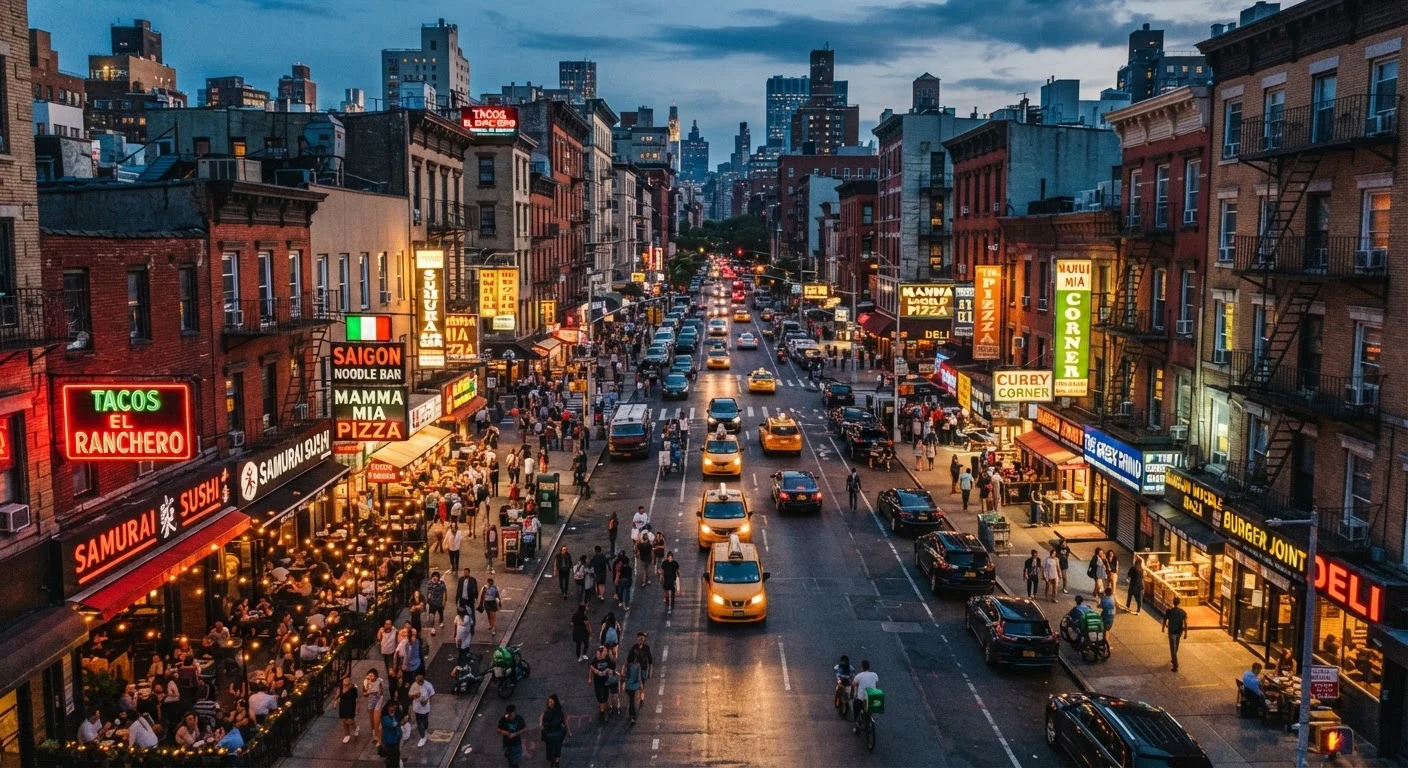
Where Trends Are Born
American dining trends rarely appear from nowhere. Most originate in a predictable cluster of conditions: a high density of restaurants competing for attention, a culturally diverse population introducing new ingredients, and a critical mass of food-curious diners willing to spend on novelty. Cities like New York, Los Angeles, Chicago, and Houston have historically served as these incubators.
Immigrant neighborhoods play an outsized role in this process. A dish that's been a community staple for decades - birria, pho, jerk chicken - often only achieves mainstream traction once it migrates into a higher-rent dining corridor and attracts coverage. As explored in our piece on how immigrant communities reshaped American staples, this pattern has driven some of the country's most beloved foods.
Chefs also act as translators, reframing unfamiliar flavors in ways that ease adoption. A Korean-Mexican fusion taco truck, for instance, works partly because it packages unfamiliar ingredients inside a familiar format.
The Social Media Accelerant
Before the smartphone era, a trend might take three to five years to move from a Manhattan bistro to a Kansas City menu. Today that timeline can collapse to a few weeks. Short-form video platforms reward visual food content - a perfectly pulled cheese pull or a vivid orange birria broth reads instantly across demographic lines.
When a dish goes viral, search for the community restaurant that's been making it authentically for years - you'll almost always find better flavor and lower prices before the trend fully arrives.
Original community purveyors have refined their recipes over time and haven't yet repriced for a mainstream audience, offering diners the best value window.
Pay attention to which dishes start appearing on mainstream chain menus - by that point, the trend has peaked, and independent restaurants in your own city are likely already onto the next thing.
National chains typically adopt a trend only once it has broad familiarity and low risk, making chain adoption a reliable lagging indicator of trend maturity.
This compression has a paradox built into it: trends peak faster and fade faster. A dish that trends on social media in January may feel dated by summer. That volatility creates both opportunity and noise for diners trying to discover genuinely good food versus algorithmically amplified novelty.
For a deeper look at the mechanics, see our guide on who actually sets food trends, which traces the full pipeline from chef's kitchen to grocery aisle.
How Trends Move Geographically
Researchers who study restaurant diffusion often describe a coastal-to-interior flow, where trends originate in gateway cities and ripple outward along economic corridors - college towns, state capitals, and metro areas with a significant professional class tend to receive trends before smaller rural markets.
But the flow isn't strictly coastal-to-heartland anymore. Regional cuisines push back. Texas barbecue, Nashville hot chicken, and New Mexican green chile stew have all traveled eastward and northward with significant cultural force. The fierce regionalism of American barbecue illustrates how deeply rooted local food identities can resist and even reverse the typical trend current.
Migration patterns also matter. When populations shift - as seen during the post-pandemic movement from coastal metros to Sun Belt cities - they carry food preferences with them, seeding demand in new markets and accelerating the spread of cuisines that would otherwise take longer to arrive.
Economic Filters and Access Gaps
Not every trend lands everywhere, and economics explains most of the gaps. A restaurant concept built around an expensive imported ingredient or labor-intensive preparation will diffuse slowly into markets where dining budgets are tighter. Trends often arrive in a given community in a diluted or adapted form - the technique stays, the premium components get swapped out.
Access is a structural issue as well. Communities categorized as food deserts - where fresh groceries are scarce - are also less likely to attract the independent restaurant investment that carries new culinary ideas. The result is an uneven national dining landscape that mirrors broader economic inequality.
Street food occasionally short-circuits this dynamic. Lower overhead allows vendors to bring flavors into neighborhoods that full-service restaurants never reach, as seen in the street food economies of American cities.
What This Means for Everyday Diners
Understanding how trends travel gives diners a practical edge. If a cuisine is just beginning to appear in your city's trendier neighborhoods, the more established versions - often in immigrant-run spots that have been cooking that food for years - are typically more authentic and more affordable. Seek those out before the trend fully crests and prices rise.
It also helps to think regionally. The regional food traditions of America are a reminder that the most interesting dining isn't always what's trending nationally - it's what's been quietly excellent in a specific place for generations.
Finally, a measure of skepticism toward viral food content is healthy. Social amplification tells you what's photogenic and shareable, not necessarily what's delicious or worth your dining budget. Use trends as a compass for discovery, but let your own palate - and some genuine local knowledge - be the final judge.
Dining out smarter means treating the food landscape as a dynamic, living map rather than a static menu. Trends are the signals; your job is to read them wisely.
The content on this site is provided for informational purposes only and should not be considered a substitute for professional advice. While we strive to provide accurate and up-to-date information, we make no guarantees regarding its completeness or accuracy. Always consult a qualified professional for advice specific to your circumstances before making any decisions.