

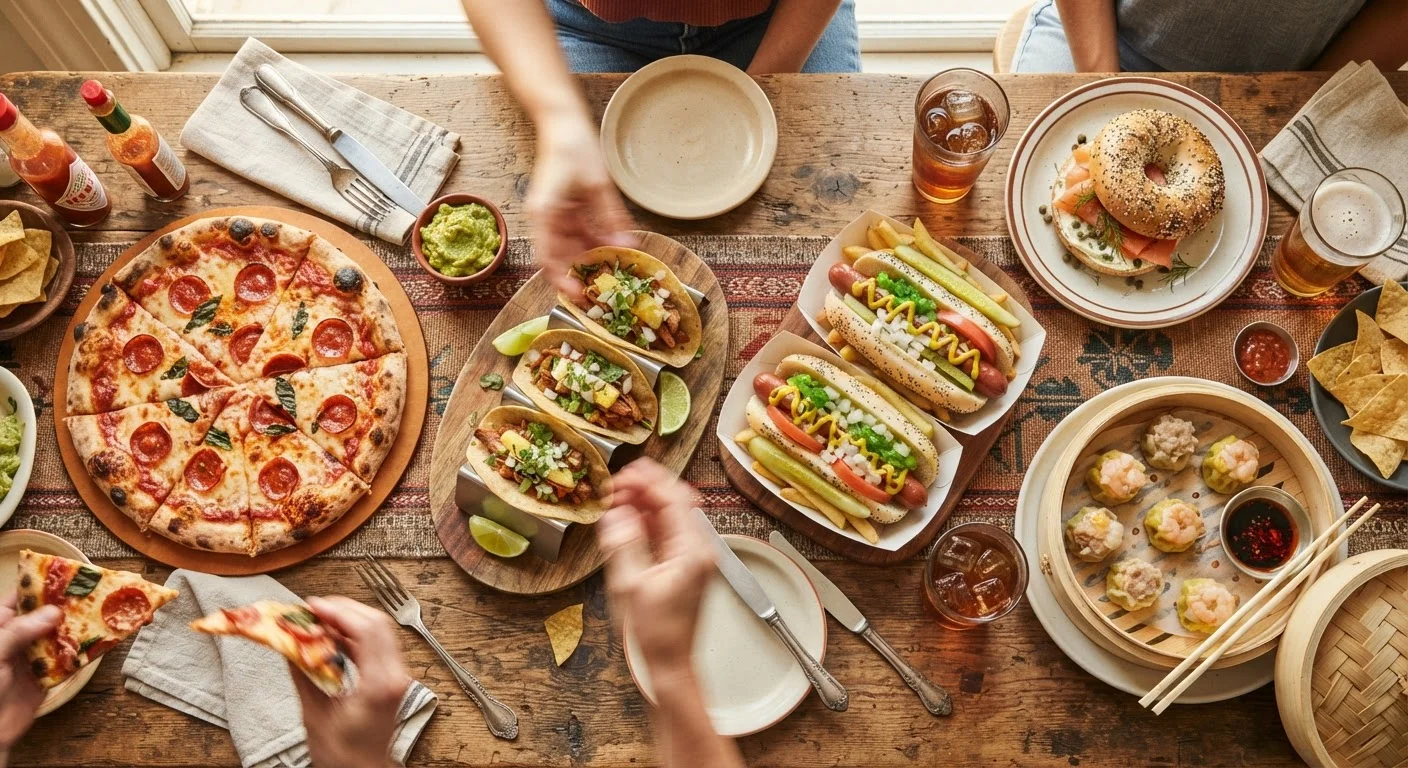
America Eats What Immigrants Built
Look at any American table - at a family dinner, a street fair, or a fast-casual lunch counter - and you're looking at the cumulative work of generations of immigrant cooks, bakers, and street vendors. Many foods that feel deeply, unquestionably American were brought here by people navigating new lives in a new country, carrying their culinary traditions as both comfort and livelihood.
The story of American food is not one of invention from scratch. It's one of continuous transformation: recipes adjusted to different ingredients, different kitchens, different customers. That process produced dishes that are now woven into everyday American life in ways that can make their origins easy to overlook. The six examples below trace those journeys - and remind us that every iconic dish has a human story behind it.
For a broader look at how food culture moves and shifts across the country, see our piece on how American dining trends actually spread.
Adaptation Is Not the Same as Erasure
When immigrant communities adapt their food traditions for a new context, that process reflects practicality and ingenuity - not a loss of authenticity. Original forms often continue to exist alongside adapted versions within immigrant communities. Both the adapted version and the traditional one carry cultural value, and understanding the difference helps diners appreciate the full picture of what they're eating.
Six Dishes That Crossed Borders and Became American Icons
Pizza: Neapolitan Roots, American Reinvention
When Italian immigrants - primarily from Naples and southern Italy - arrived in large numbers in the late 19th and early 20th centuries, they brought flatbread baking traditions with them. The pizza sold from street carts in Lower Manhattan was thinner and simpler than what most Americans eat today.
Over decades, pizzerias adapted to American tastes and ingredient availability. Larger pies, thicker crusts, more cheese, and abundant toppings became the norm. New York's foldable slice and Chicago's deep-dish style each reflect local culture and immigrant community preferences layered over the original Neapolitan form. Today, pizza is one of the most consumed foods in the United States - a transformation driven almost entirely by immigrant innovation.
Pizza's journey from Neapolitan street food to American institution was built on generations of immigrant adaptation.
The Hot Dog: A German Sausage Reinvented for the Ballpark
The hot dog has deep roots in German and Austrian sausage-making traditions. German immigrants brought frankfurters and wieners - named after Frankfurt and Vienna respectively - to American cities in the 19th century. Butchers in cities like New York, Chicago, and Cincinnati sold them from pushcarts, often tucking them into rolls for easy eating on the go.
The roll itself was an adaptation credited to practical necessity: it kept hands clean and made the sausage portable. Baseball stadiums popularized the hot dog further, cementing it as quintessential American fare. The regional variations that followed - the Chicago-style dog loaded with toppings, the Coney Island style with chili - reflect further layers of local reinvention built atop that immigrant foundation.
The simple act of serving a sausage in a roll transformed a German butcher's product into a national icon.
Tacos: From Mexican Regional Food to American Everyday Staple
Tacos have ancient origins in Mexican indigenous food culture, long predating European contact. Mexican immigrants and migrant workers brought taco traditions into the American Southwest throughout the 19th and 20th centuries, where the dish slowly spread beyond Mexican-American communities.
The adaptation process was significant. Hard-shell tacos - largely unfamiliar in traditional Mexican cooking - became popular in the United States as an accessible, shelf-stable format. Tex-Mex cuisine, which blends northern Mexican and Texan ranching traditions, created its own distinctive taco identity. Today, tacos span a wide spectrum in American dining, from fast-food chains to upscale restaurants, and regional styles like the birria taco continue reshaping expectations. For a closer look at how dishes like these travel through food culture, see how food trends actually spread.
Tacos arrived as a regional Mexican staple and were reshaped by adaptation into one of America's most versatile foods.
Bagels: Eastern European Jewish Baking Becomes a Breakfast Staple
The bagel originated in Jewish communities in Poland and Central Europe, where boiling dough before baking was a traditional technique that created a dense, chewy texture. Ashkenazi Jewish immigrants brought bagels to New York City's Lower East Side in the late 19th century, where they were sold by street vendors from baskets and hand-pulled for decades.
By the mid-20th century, mechanized production made bagels more widely available. Cream cheese - a separately developed American product - became the standard pairing, and smoked salmon elevated the combination into a culturally recognizable meal. What was once a niche food sold within a specific immigrant neighborhood is now found in grocery stores, coffee shops, and airport terminals across the country.
The bagel's spread from a Lower East Side immigrant staple to a national breakfast food is a study in cultural reach.
Dumplings: A Global Form That Found Multiple American Homes
Dumplings - filled dough in its many forms - appear across dozens of culinary traditions: Chinese jiaozi, Polish pierogi, Italian ravioli, and more. Multiple immigrant waves brought their own dumpling traditions to American cities, and each took root in distinct communities before gradually reaching wider audiences.
Pierogi became comfort food staples in Polish-American communities in cities like Pittsburgh and Chicago. Chinese dumplings spread through Chinatowns and eventually into mainstream restaurant menus and frozen food aisles. Each form adapted slightly to available ingredients and local palates. The dumpling's universal appeal - portable, filling, adaptable - made it a natural fit for American food culture across ethnic lines. You can explore more of these regional food identities in our guide to American regional cuisines.
Dumplings arrived in America through many immigrant traditions simultaneously, each finding its own loyal community.
Sushi: Japanese Precision Adapted for American Appetite
Traditional Japanese sushi - particularly the Edo-style nigiri developed in Tokyo - was built on restraint: fresh fish, seasoned rice, minimal additions. When Japanese immigrants and restaurateurs brought sushi to the United States, they faced a market with different ingredient access, different palate expectations, and unfamiliarity with raw fish.
Adaptations followed. The California roll - developed in North America in the 1960s and 1970s - replaced raw fish with cooked crab (or imitation crab) and added avocado, making sushi approachable for hesitant diners. Once consumers grew comfortable, demand for more traditional preparations followed. Sushi is now one of the fastest-growing restaurant categories in the United States, having traveled from a niche Japanese immigrant food to a mainstream dining experience through a deliberate process of cultural bridge-building.
The California roll was a deliberate bridge - a way to make Japanese culinary tradition accessible to American diners.
The Ongoing Story of American Food
These six dishes are a starting point, not a complete list. Every wave of immigration adds new ingredients, techniques, and flavor profiles to the American table. Ethiopian injera, Vietnamese bánh mì, Salvadoran pupusas - foods that may feel unfamiliar to some Americans today are already establishing footholds in cities across the country, following a pattern as old as immigration itself.
Understanding where food comes from - and who brought it - is one way to engage more thoughtfully with what we eat and where we spend our dining dollars. It connects a meal to a larger human story. For more on how street food reflects these same dynamics in real time, see our look at street food across American cities. And if you're curious about the regional food identities that immigrant communities helped shape, the first-timer's map to American regional cuisines is a useful companion.
The content on this site is provided for informational purposes only and should not be considered a substitute for professional advice. While we strive to provide accurate and up-to-date information, we make no guarantees regarding its completeness or accuracy. Always consult a qualified professional for advice specific to your circumstances before making any decisions.