

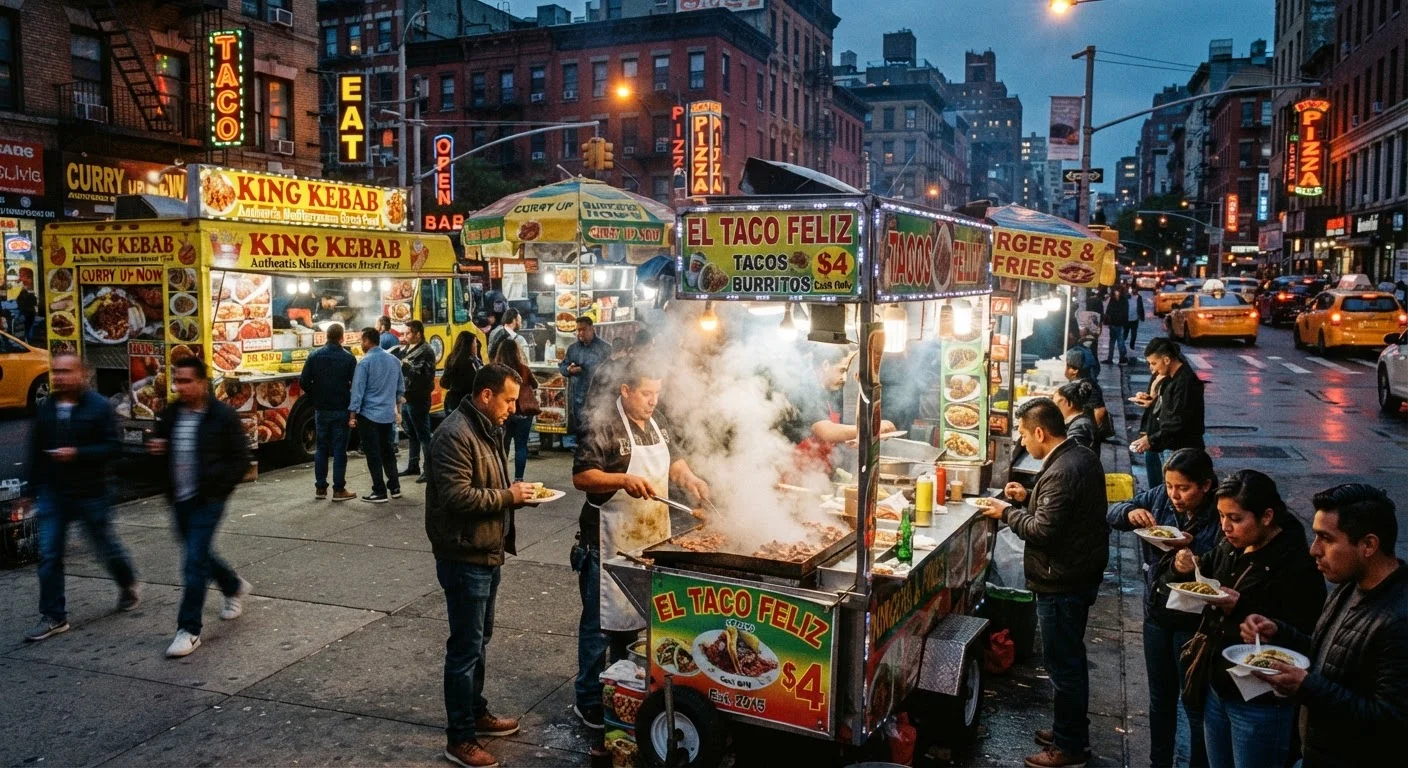
Why Street Food Looks Different in Every City
American street food isn't a single tradition - it's dozens of them, layered on top of each other across decades of migration, economics, and local appetite. Walk a few blocks in New York City and you'll pass a halal cart, a pretzel stand, and an arepa truck. In Los Angeles, taco trucks anchor neighborhoods as reliably as corner stores. In Chicago, you'll find tamale vendors working train platforms in winter. None of this is random.
What vendors sell is shaped by three overlapping forces: the communities that settled in a given city, the regulatory environment those vendors navigate, and what nearby workers and residents actually want to eat quickly and affordably. The result is a living, edible map of each city's cultural geography. As you'll find in our overview of American regional cuisines, food is one of the clearest windows into local identity.
| Largest taco truck concentration | Los Angeles, California |
| NYC halal cart origins | Primarily Bangladeshi and Egyptian immigrant entrepreneurs, 1990s |
| Philadelphia cheesesteak origins | 1930s, working-class South Philadelphia |
| Key driver of street food variety | Immigration patterns, local regulation, and workforce demand |
| NYC vending permit system | Capped supply; permits can trade for tens of thousands of dollars |
| Portland, OR model | Food cart pod clusters with lower entry barriers than traditional permits |
Key Cities and Their Street Food Signatures
Certain foods have become inseparable from specific cities, and the backstory matters as much as the flavor.
New York City: Halal Carts and Hot Dogs
NYC's halal cart boom began in the 1990s, driven largely by Bangladeshi and Egyptian immigrants who found cart vending a viable entry point into business ownership with relatively modest startup costs. Today, chicken-and-rice platters with white sauce have become as iconic to the city as the original pushcart hot dog. The hot dog itself, widely popularized through Central European immigrant communities in the late 19th century, is a reminder that New York's street food has always been a story of newcomers feeding neighbors.
Los Angeles: The Taco Truck
Los Angeles has the largest concentration of taco trucks in the country, a network rooted in the city's deep Mexican-American communities. Many trucks began as lunch routes for construction workers before expanding into full neighborhood fixtures. Today, some trucks specialize in regional Mexican styles - Oaxacan tlayudas, Jalisco-style birria - reflecting how specific immigrant communities have shaped the menu. Immigrant communities have long reshaped American food, and LA's taco scene is one of the most vivid examples.
New Orleans: Snowballs and Street Snacks
In New Orleans, street food culture is deeply tied to public celebration. Snowball stands - selling shaved ice with flavor syrups - are a summer institution that traces back to the mid-20th century. Boiled peanuts, pralines sold by hand, and hot sausage sandwiches reflect both Southern tradition and Creole culture, foods designed to be eaten standing up during festivals, second lines, and street gatherings.
Philadelphia and Chicago: Sandwiches as Street Food
Both cities have elevated the handheld sandwich to a street-food staple. Chicago's Italian beef sandwich and Polish sausage at sports venues and corner stands reflect the city's meatpacking heritage and its waves of Southern and Eastern European immigration. Philadelphia's cheesesteak, while now sold in sit-down restaurants, originated as a working-class street lunch in the 1930s.
The Economics and Regulations Behind the Cart
Street vending has never been a simple path. Vendors in most American cities must navigate permitting systems, zoning rules, and in some cases, restrictions on where they can operate - often within a set distance from brick-and-mortar restaurants. These regulations have historically made vending more difficult for lower-income vendors, many of whom are immigrants or people of color.
Cities vary significantly in how they manage this. New York City has long had a capped number of mobile food vending permits, creating a secondary market where permits change hands for tens of thousands of dollars. Other cities like Portland, Oregon, have cultivated food cart pod cultures that operate more like fixed outdoor markets with lower barriers to entry. Understanding these dynamics is essential context for why some cities have thriving street food ecosystems while others remain sparse. For more on the economics of outdoor food culture, see how farmers markets shifted from fringe to mainstream.
Street food also plays a role in addressing food access. In some neighborhoods where grocery options are limited - an issue explored in depth in our piece on food deserts in America - vendors may represent one of the more consistent sources of prepared meals for residents.
Food cart pod
A cluster of stationary food carts operating together in a designated outdoor area, common in cities like Portland, Oregon. Pods function like small outdoor food courts with shared seating.
Mobile food vending permit
A government-issued license required to sell food from a cart or truck on public streets. Requirements, costs, and caps vary significantly by city.
Halal cart
A street food cart serving meat prepared according to Islamic dietary law. In New York City, halal carts are closely associated with chicken-and-rice dishes introduced by immigrant vendors in the 1990s.
Zoning restriction
A local regulation that limits where specific businesses, including food vendors, can operate. In street food contexts, these rules often prevent carts from setting up near competing brick-and-mortar restaurants.
The content on this site is provided for informational purposes only and should not be considered a substitute for professional advice. While we strive to provide accurate and up-to-date information, we make no guarantees regarding its completeness or accuracy. Always consult a qualified professional for advice specific to your circumstances before making any decisions.