

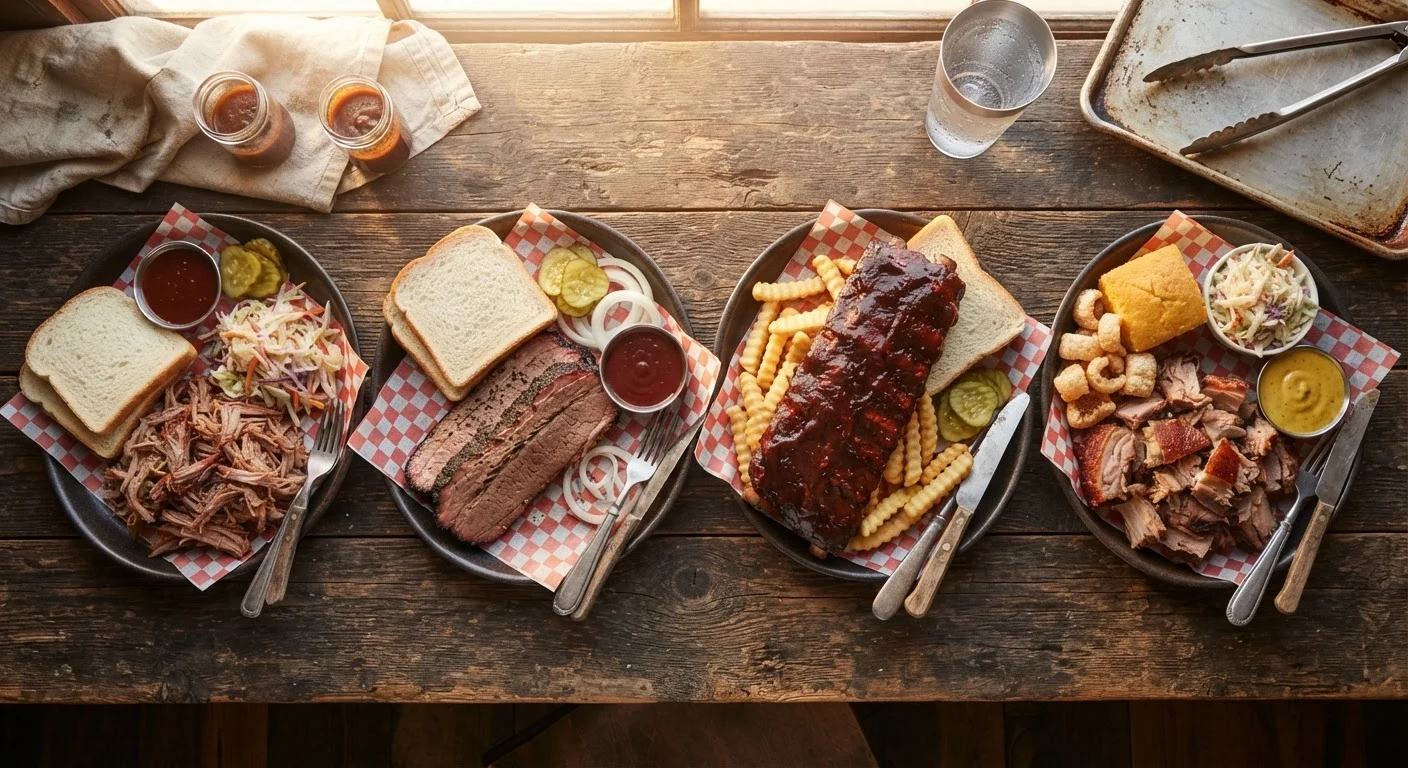
What 'Barbecue' Actually Means Depends on Your Zip Code
Ask someone in eastern North Carolina what they want for lunch and they might say "barbecue" - meaning a specific dish of slow-smoked whole hog dressed in vinegar and pepper. Ask the same question in Kansas City and the answer might involve a rack of ribs glazed in thick, sweet tomato sauce. In Texas, it almost certainly means brisket. These aren't small differences in preference. They reflect entirely separate culinary lineages that developed over centuries.
The disagreement isn't just about flavor. It's about what the word itself means. In some Southern regions, "going to a barbecue" describes attending a gathering where a whole pig is cooked over a pit. In others, "barbecue" is a verb - something you do to food on a weekend afternoon. This semantic slippage is a clue that something deeper is going on: each region has built its own food vocabulary around a tradition it considers locally owned.
The Word 'Barbecue' Has Contested Origins
The etymology of "barbecue" is genuinely debated. The most widely cited theory traces it to the Taíno word "barbacoa," referring to a wooden framework used for cooking or sleeping. Spanish colonizers adopted the term, and it eventually entered English. Some scholars note alternative possible origins, but the Indigenous Caribbean root remains the most broadly accepted explanation among food historians.
The Four Major Traditions and What Shaped Them
Food historians generally identify four primary American barbecue regions, each with distinct meat preferences, cooking techniques, and sauce philosophies.
The Carolinas: Pork and Vinegar
Carolina barbecue is arguably the oldest continuous tradition in the country. Whole-hog cooking reflects the hog-heavy agricultural economy of the colonial South, and the thin vinegar-based sauce predates the widespread availability of tomatoes as a condiment. South Carolina's mustard-based variation traces to 18th-century German immigrant communities in the state's midlands - a reminder that immigration patterns shaped flavor profiles just as much as local ingredients did. Soul food and Southern cooking share some of this same history, though they carry distinct cultural meanings.
Texas: Beef Country
Central Texas barbecue centers on brisket, a reflection of the state's cattle-ranching economy and the influence of German and Czech butchers who settled the Hill Country in the 19th century. These immigrants smoked unsold meat cuts as a preservation method, and the technique evolved into a regional art form. The result is a style that often considers sauce optional - the meat is meant to speak for itself.
Memphis: The Rib Capital
Memphis-style pork ribs are served either "dry" (rubbed with spices and eaten without sauce) or "wet" (sauced before and after cooking). The city's position on the Mississippi River made it a hub for pork processing, and its African American culinary community - drawing on traditions carried from the Deep South - helped define the style that Memphis now claims as its own.
Kansas City: The Melting Pot
Kansas City sits at a crossroads, and its barbecue reflects that geography. Almost any meat is fair game - beef, pork, chicken, lamb - all typically served with a thick, sweet, tomato-and-molasses sauce. The style traces in large part to Henry Perry, an African American pitmaster who is widely credited with founding Kansas City's barbecue culture in the early 20th century.
Why These Differences Run So Deep
Regional barbecue isn't just a culinary curiosity. It's a window into how American food culture actually forms - through geography, migration, agriculture, and the labor of communities whose contributions are often underacknowledged. The influence of African American pitmasters is central to nearly every major barbecue tradition, yet that history was frequently overlooked in earlier food writing. A more complete understanding of barbecue requires acknowledging those roots honestly.
4+
Distinct major regional barbecue traditions in the U.S.
Food historians and culinary scholars widely recognize at least four primary American barbecue regions, each with internally distinct sub-styles.
~18th century
Earliest documented Carolina whole-hog traditions
Historical records and food historians place the roots of Carolina pit-cooked whole hog in the colonial-era South, making it one of America's oldest continuous cooking traditions.
Billions
Pounds of pork barbecued annually in the U.S.
Pork remains the dominant protein in American barbecue overall, though beef brisket dominates in Texas, reflecting the outsized cultural and economic scale of the tradition nationwide.
The intensity of regional identity around barbecue also explains why the concept of "authentic" barbecue is so contested. As the authenticity debate in food shows, claims of ownership over a dish are rarely simple. When a national chain opens a "Carolina-style" restaurant in Phoenix, locals from North Carolina often bristle - not out of pettiness, but because a technique and sauce profile developed over generations carries meaning that's hard to transplant.
For anyone exploring American food more broadly, understanding barbecue regionalism is a useful foundation. It illustrates how the same basic impulse - cook meat slowly over fire - can produce radically different results when filtered through distinct histories. American regional cuisines are full of similar contrasts, and barbecue is one of the clearest examples of how place shapes plate.
What This Means for How You Eat and Explore
Understanding barbecue's regional logic makes you a more informed eater - whether you're traveling, ordering at a restaurant, or simply trying to understand why your coworker from Memphis grimaces when you call Kansas City ribs "the real thing." The disagreements are affectionate as often as they are fierce, and they're an invitation to explore.
When you encounter a regional style new to you, it helps to approach it on its own terms rather than measuring it against a familiar benchmark. A vinegar-sauced pulled pork sandwich from eastern North Carolina isn't a "lesser" version of what you know - it's operating by a completely different set of values. The same principle applies to comfort food traditions across America: the regional variation is the point, not a problem to resolve.
Food trends do eventually cross regional lines - a topic explored in depth when looking at how American dining trends spread - but barbecue has proven unusually resistant to homogenization. That resistance is a feature, not a bug. It means that wherever you travel in this country, there's a genuine local tradition waiting to be discovered, debated, and eaten.
Frequently Asked Questions
The four most recognized regional styles are the Carolinas (vinegar- or mustard-based, whole hog or pork shoulder), Texas (beef-forward, especially brisket), Memphis (dry-rubbed or sauced ribs and pulled pork), and Kansas City (thick, sweet tomato-based sauce on a wide range of meats). Each has internal sub-variations as well.
Regional differences reflect the livestock raised locally, the cultural groups who settled each area, the availability of certain woods for smoking, and centuries of cooking tradition passed down through families and communities. Barbecue evolved in isolation before national food media connected these traditions.
Beef brisket is the centerpiece of Central Texas-style barbecue, reflecting the state's cattle ranching heritage. However, Texas also has East Texas traditions that include more pork and saucier preparations, showing that even within a state, styles can vary significantly.
Carolina barbecue is defined by its use of pork and its vinegar-based sauces, which predate the tomato-based sauces common elsewhere. Eastern North Carolina uses a thin vinegar-and-pepper sauce on whole hog, while the Piedmont region favors pork shoulder with a slightly sweeter "Lexington-style" dip. South Carolina's signature is a mustard-based sauce rooted in German immigrant influences.
Regional pride in barbecue is intense, and many locals consider their own tradition the definitive version. That said, most serious barbecue enthusiasts acknowledge and respect the differences - the debate is as much cultural as culinary, and it's part of what makes American barbecue culture so rich.
Barbecue's roots trace to Indigenous cooking techniques adopted by European colonizers, and were shaped profoundly by enslaved African Americans who developed and refined pit-cooking methods on Southern plantations. The food's history is inseparable from the history of race, labor, and migration in America.
The content on this site is provided for informational purposes only and should not be considered a substitute for professional advice. While we strive to provide accurate and up-to-date information, we make no guarantees regarding its completeness or accuracy. Always consult a qualified professional for advice specific to your circumstances before making any decisions.