

What Unit Price Actually Tells You
Every time you pick up two different-sized packages of the same product and wonder which one costs less per use, you're asking exactly what unit pricing is designed to answer. The unit price reduces any product down to a shared, apples-to-apples denominator - cost per ounce, cost per sheet, cost per serving - so the comparison is immediate and fair.
Without it, you're comparing numbers that aren't really comparable. A 16-oz jar of peanut butter priced at $3.49 and a 28-oz jar at $5.79 look very different at face value. But divide each by its weight and the math tells a clearer story: roughly 22 cents per ounce versus about 21 cents per ounce. The bigger jar wins - but only barely, and only if you know to check.
This is why unit pricing exists: to surface information that total pricing deliberately obscures. Retailers set package sizes strategically. Unit pricing cuts through that.
Unit Price vs. Serving Size: Not the Same Thing
Unit price is based on a standardized physical measurement (weight, volume, count) - not the manufacturer's suggested serving size. A serving size is defined by the brand and can vary significantly between similar products. For true cost comparison, always use the unit price on the shelf tag, not the per-serving math on the nutrition label.
How to Read a Shelf Tag Correctly
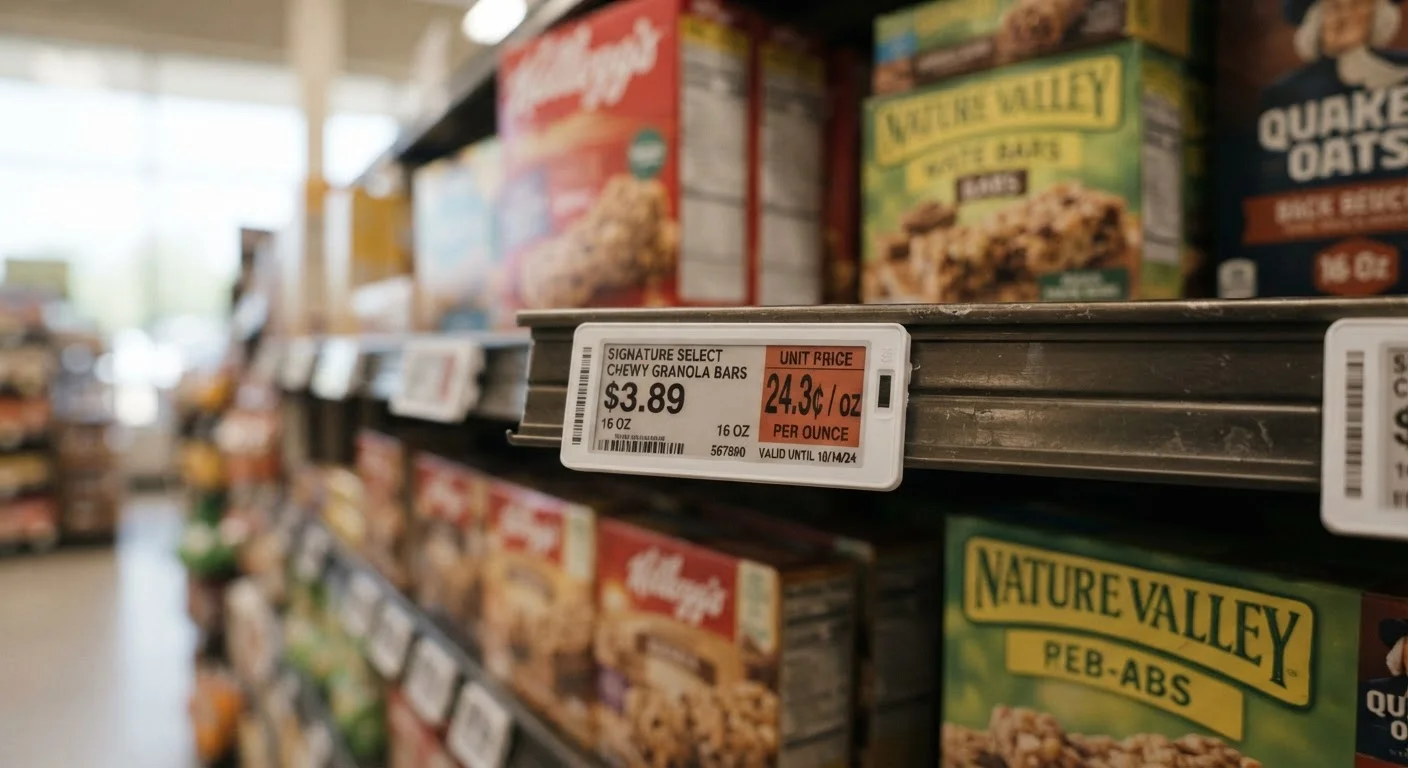
A standard shelf tag has two price figures: the total price (large, prominent) and the unit price (small, often in a shaded box or corner). The unit price is almost always the more useful number for comparison shopping.
Here's what to look for:
- The unit price value - a dollar or cent amount (e.g., $0.18 or 18¢)
- The unit of measure - per oz, per lb, per 100 ct, per sq ft, etc.
- Consistency between items - both items you're comparing must use the same unit of measure for the comparison to be valid
One common trap: some tags switch between units without warning. A paper towel might be priced per sheet on one tag and per roll on another. When that happens, you'll need to normalize the units manually - or pick the tag that gives you the most granular breakdown.
For a deeper look at how shelf pricing can mislead even careful shoppers, see why price tags have gotten harder to trust.
When Bigger Isn't Cheaper Per Unit
The popular assumption is that bulk or larger sizes always deliver a lower unit price. That's often true - but not reliably enough to skip the check.
Several situations flip the script:
- Promotional pricing on smaller sizes: A sale on the 12-oz size can push its unit price below the standard 32-oz version.
- Premium packaging on large sizes: Some products charge a quiet premium on the jumbo size - a pricing strategy some researchers have called a "size surcharge."
- Multipacks with added margin: A six-pack of individual items isn't always priced at six times the single-unit cost - sometimes it's priced higher per unit than buying individually.
The only reliable method is to actually read both unit prices and compare. Assumptions about size and value are exactly what some pricing strategies depend on. For context on how retailers design these situations intentionally, retail pricing psychology is worth understanding.
~32
U.S. states with unit pricing regulations
According to consumer advocacy research, roughly 32 states have some form of unit pricing law, though coverage and enforcement vary widely.
5-20%
Potential overspend without unit price comparison
Consumer research has consistently found that shoppers who ignore unit pricing often pay meaningfully more per unit than those who compare labels before choosing.
Unit Pricing in a Shifting Retail Landscape
Unit pricing becomes even more valuable as retail pricing grows more complex. Dynamic pricing - where shelf or online prices adjust based on demand, time of day, or browsing behavior - can make the total price a moving target. Understanding dynamic pricing in retail helps put unit pricing in a broader context: it's one stable tool in an environment where many price signals are deliberately unstable.
Similarly, "sale" labels don't automatically mean a lower unit price. A product marked down from an inflated anchor price may still carry a higher unit cost than an unmarked competitor. Unit pricing sidesteps the psychology of sale signage entirely - you're comparing math, not marketing. See why sale price doesn't always mean saving money for more on how promotional pricing works in practice.
For shoppers who want to go further with this skill at the grocery store specifically, unit pricing strategies for grocery shopping covers practical techniques week to week.
Frequently Asked Questions
It's typically printed in smaller text in a corner of the shelf label, often in a different color or box from the total price. Look for a price followed by a unit like "per oz," "per lb," or "per ct." Not every store formats tags the same way, but the unit of measure is almost always labeled.
Usually, yes - but not always. A larger package with a lower unit price is only a better deal if you'll actually use all of it before it expires or goes to waste. Factor in storage, spoilage, and your actual consumption when making the call.
Unit pricing laws vary by state. Some states require it broadly; others have narrow rules or none at all. Online grocery platforms generally display unit pricing voluntarily, though formatting differs widely by retailer.
Yes. Unit pricing appears on cleaning products, paper goods, personal care items, and more - anywhere a product comes in multiple sizes or quantities. The same comparison logic applies regardless of category.
Yes. When a product is on sale, the unit price should reflect the reduced total price. However, not all digital or temporary tags update accurately, so it's worth doing a quick mental check if something looks off.
The content on this site is provided for informational purposes only and should not be considered a substitute for professional advice. While we strive to provide accurate and up-to-date information, we make no guarantees regarding its completeness or accuracy. Always consult a qualified professional for advice specific to your circumstances before making any decisions.