

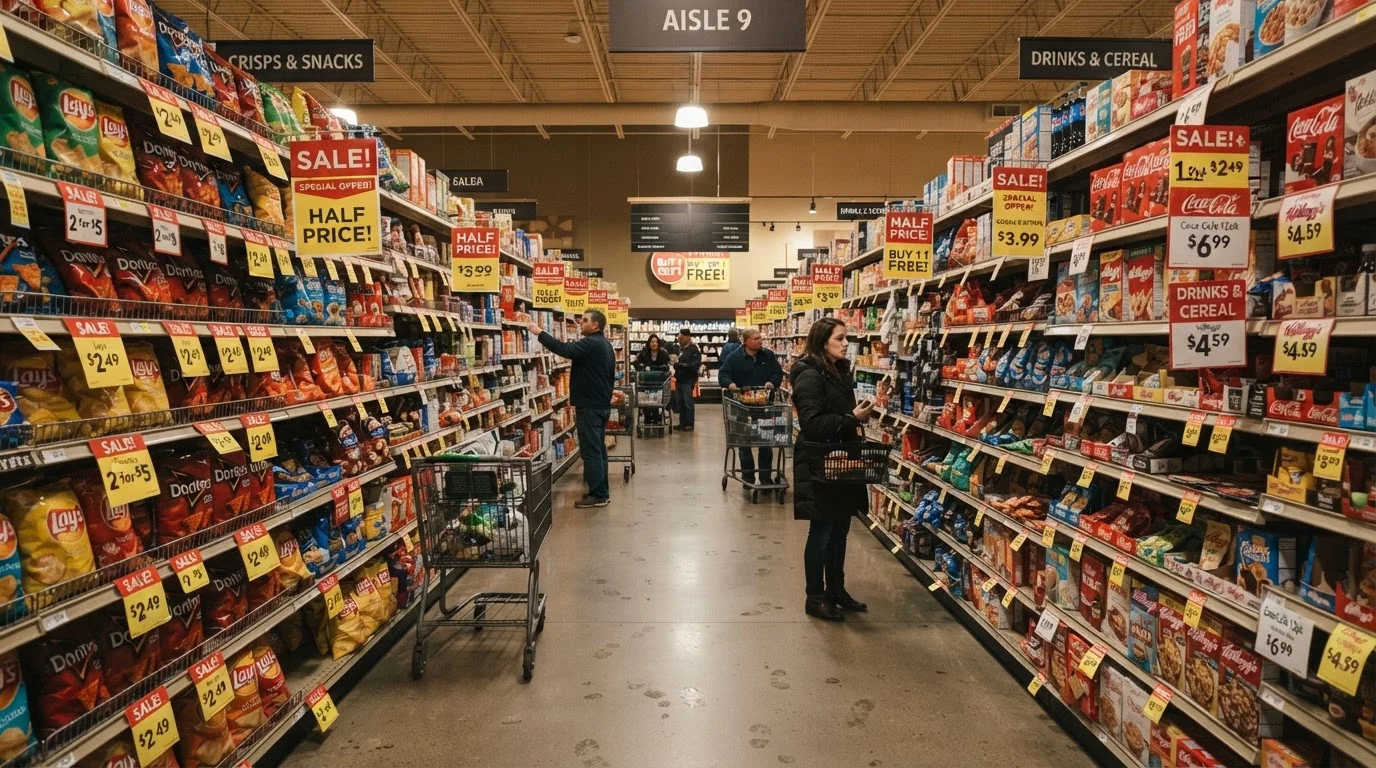
The .99 Trick: Why Charm Pricing Still Works
Walk through any store and you'll see prices like $4.99, $19.99, or $149.99. This is charm pricing, and it's one of the most researched techniques in retail. The mechanism is straightforward: because we read numbers left to right, the first digit dominates our initial impression. $9.99 feels meaningfully cheaper than $10.00, even though the difference is a single penny.
Research in behavioral economics refers to this as the left-digit effect. Studies have consistently found that prices ending in 9 outperform round-number prices in conversion - meaning more shoppers complete a purchase. Retailers aren't using .99 pricing out of tradition; they're using it because it works at scale.
One practical counter: round up prices mentally before comparing. If you train yourself to read $9.99 as $10, you're working with a more accurate number.
Round Up Before You Compare
When comparing prices, mentally round each number to the nearest dollar before evaluating. This neutralizes charm pricing and gives you a more accurate sense of what you're actually spending. It takes a few extra seconds but removes the .99 distortion from your math.
Anchor Prices and the Illusion of a Deal
When a price tag shows a crossed-out figure above the current price, that original number is functioning as an anchor. Your brain latches onto that first number and uses it as a benchmark - making every subsequent price feel relative to it. A $60 jacket discounted to $40 feels like a win. The same $40 jacket with no anchor price feels like it just costs $40.
The problem is that anchor prices aren't always reliable. Reference pricing - where the 'original' price was inflated or never actually charged - has drawn regulatory attention from the FTC and state attorneys general. Even when anchors are accurate, they shape your evaluation of whether something is worth buying before you've assessed the product itself.
Sale prices don't always mean real savings - understanding how anchor pricing works is a prerequisite to evaluating any discount honestly.
Left-digit effect
Prices ending in 9 measurably increase purchase rates
Multiple peer-reviewed studies in behavioral economics have documented the left-digit effect, showing consumers consistently underestimate prices that end in 9.
~34%
Consumers who check unit prices regularly
According to consumer behavior surveys, a minority of shoppers consistently use unit price labels to compare products, despite their wide availability in U.S. grocery stores.
Decoy effect
A third option shifts choice toward higher-priced items
The asymmetric dominance effect - documented by behavioral economist Dan Ariely and others - shows that adding a decoy option reliably increases selection of the target (higher-priced) option.
Decoy Pricing: The Third Option That Changes Everything
Imagine a coffee shop offering a small for $3, a medium for $6.50, and a large for $7. The medium is doing something specific: making the large look like an obvious deal. This is decoy pricing, also called the asymmetric dominance effect. The decoy isn't meant to sell - it's designed to reframe one of the other options as clearly superior.
You'll see this in subscription tiers, streaming packages, and anywhere consumers choose between multiple versions of something. The presence of a poorly-valued middle option consistently shifts choices toward the higher-priced option, because the large now appears rational rather than indulgent.
Awareness alone shifts the calculus: ask yourself whether you'd want the larger option if the middle option didn't exist. If the answer is no, the decoy may be working on you.
Bundling, Unit Pricing, and the Hidden Cost Problem
Product bundling - selling multiple items together at a combined price - can represent genuine value, but it also makes individual cost comparisons harder. When a retailer sells three items for $15, you may not stop to consider whether you actually need all three, or whether buying just one would cost $4.50 elsewhere.
Bundling is particularly effective because it shifts the mental frame from is this item worth it? to is this bundle a good deal? Those are different questions, and the second one is harder to answer quickly.
The most reliable antidote is the unit price - the per-unit or per-ounce cost displayed on most retail shelf tags. Unit pricing cuts through bundle math and gives you a standardized basis for comparison, regardless of package size or bundling structure.
Pricing psychology is inseparable from the broader retail environment. Understanding what drives overspending - from store layout to visual cues - gives you a fuller picture of how purchase decisions get shaped before you ever reach the register. And with dynamic pricing increasingly common in retail, the number on the tag may change even while you're shopping.
Frequently Asked Questions
This is called charm pricing, and it works because the human brain reads numbers from left to right. A price of $9.99 registers closer to $9 than $10 due to what researchers call the left-digit effect. Retailers have used this for decades because it measurably influences purchase rates.
Anchor pricing involves displaying a higher 'original' or 'compare at' price alongside a lower current price. Your brain uses that first number as a reference point, making the sale price feel like a better deal - regardless of whether the original price was ever genuinely charged. See also: <a href="/smart-shopping/consumer-basics/why-sale-price-doesnt-always-mean-youre-saving-money">why sale prices aren't always real savings</a>.
A decoy is a product option priced or configured to make another option look more attractive by comparison. For example, a medium-size option priced just slightly less than a large makes the large seem like obvious value - even if you didn't need that much product.
Awareness helps, but it doesn't make you immune. These tactics work on automatic cognitive processes. Knowing them gives you a pause point to slow down and evaluate, but you still need to actively apply that knowledge in the moment of purchase.
Some are. The FTC and state consumer protection agencies have rules against deceptive reference pricing - where a 'was' price was never actually charged. However, tactics like charm pricing or decoy products are legal and widely used. Enforcement of deceptive pricing varies by state.
Use the unit price shown on shelf tags - this gives you cost per ounce, per count, or per unit, making true comparisons possible. <a href="/smart-shopping/consumer-basics/unit-price-the-shelf-tag-number-most-shoppers-overlook">Unit pricing</a> is one of the most underused tools available to shoppers.
The content on this site is provided for informational purposes only and should not be considered a substitute for professional advice. While we strive to provide accurate and up-to-date information, we make no guarantees regarding its completeness or accuracy. Always consult a qualified professional for advice specific to your circumstances before making any decisions.