

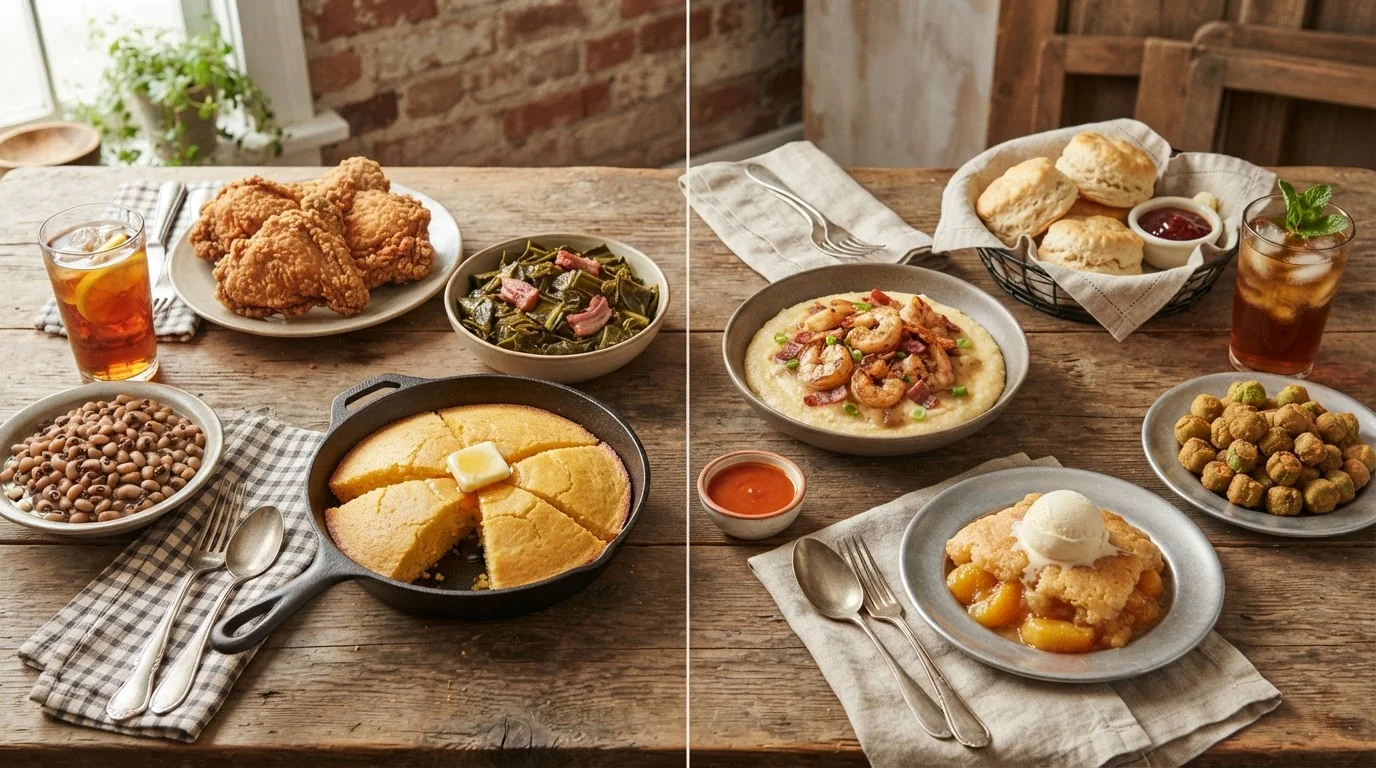
Option A
Soul Food
A cuisine born of resilience, community, and African American cultural identity.
Best for: Understanding the culinary traditions forged by enslaved African Americans and carried forward through generations of Black culture.
Option B
Southern Cuisine
A broad regional tradition drawing from multiple cultural tributaries.
Best for: Exploring the wide, diverse foodways of the American South, shaped by Indigenous, European, African, and Appalachian influences.
Two Traditions, One Geography
Drive through any Southern state and you'll encounter both soul food restaurants and Southern-style diners sometimes within blocks of each other. The dishes can look similar - fried chicken, greens, cornbread - and the ingredients frequently overlap. But treating soul food and Southern cuisine as synonyms is a meaningful mistake, one that flattens a complex history and obscures distinct cultural contributions.
Soul food is a specific culinary tradition rooted in the experience of enslaved African Americans. Southern cuisine, by contrast, is a broad regional category that encompasses multiple distinct traditions shaped by Indigenous peoples, European settlers, Appalachian communities, and African Americans alike. One is a subset with a precise cultural identity; the other is a regional umbrella. Understanding the difference helps us eat - and think - more clearly about American food culture. As you explore the wider landscape of American regional eating, our guide to American regional cuisines offers useful context for placing both traditions on the map.
The Origins of Soul Food
Soul food's roots lie in survival and ingenuity. Enslaved people on Southern plantations were typically given the parts of the animal that enslavers discarded - pig intestines (chitlins), trotters, ears, and necks. They also cultivated and cooked crops tied to West African foodways, including okra, black-eyed peas, and collard greens. From these constrained circumstances, they built a cuisine of remarkable depth and flavor.
After emancipation, these cooking traditions traveled with African Americans - through the Great Migration, into Northern cities, into church kitchens and family Sunday dinners. The term "soul food" itself became widely used in the 1960s, when it was embraced as a marker of Black cultural pride and identity. The food carried history on every plate.
| Criterion | Soul Food | Southern Cuisine |
|---|---|---|
| Cultural origin | African American history and tradition | Multiple regional and ethnic traditions |
| Geographic scope | Originated in the South; spread nationwide | Tied to the American South as a region |
| Signature dishes | Chitlins, oxtails, candied yams, black-eyed peas | Shrimp and grits, biscuits, boudin, country ham |
| Key influences | West African foodways, necessity, ingenuity | Indigenous, European, African, Appalachian |
| Cultural meaning | Marker of Black identity and resilience | Broad regional pride and identity |
| Breadth | Specific, defined tradition | Wide umbrella with many sub-traditions |
Soul food is also deeply communal in character. Dishes like mac and cheese, candied yams, and cornbread dressing are tied to celebrations, funerals, church gatherings, and family reunions - they carry emotional and social meaning that goes beyond nutrition. For more on how Americans use food to express comfort and belonging, see our piece on comfort food across America.
What Southern Cuisine Actually Covers
Southern cuisine is a much wider category - more a geographic designation than a unified culinary tradition. It spans Cajun and Creole cooking from Louisiana, Lowcountry cuisine from coastal South Carolina and Georgia, barbecue traditions that vary dramatically by state (explored in depth in our article on America's regional barbecue divide), Appalachian foodways rooted in Scots-Irish and Cherokee traditions, and the plantation-era cooking that has historically been called "Southern" in cookbooks and restaurants.
That last category is where confusion most often arises. The elaborate hospitality cooking historically associated with the antebellum South - biscuits, country ham, peach preserves, shrimp and grits - was largely prepared by enslaved and later Black domestic workers. Crediting that labor and lineage matters. Southern cuisine at its most honest is a mosaic, not a monolith.
Where They Overlap - and Where They Diverge
The overlap is real. Both cuisines use pork heavily, rely on corn in many forms, and share a love of slow-cooked vegetables. Fried chicken appears in both contexts, as does cornbread. But the preparations, seasonings, and meanings can differ. Soul food's collard greens are often cooked low and slow with smoked meat; an Appalachian preparation might involve a pot likker broth with different seasoning traditions. Cajun cuisine brings French technique and a distinct spice palette that has little overlap with either.
The divergence becomes clearest at the cultural level. Soul food is inseparable from African American identity and history. Calling any Southern dish "soul food" - regardless of who made it or what tradition it comes from - risks erasing that specificity. This parallels similar distinctions in other American food traditions; our piece on Tex-Mex vs. interior Mexican cuisine explores how conflating two related-but-distinct traditions misrepresents both.
When dining out, these labels carry real meaning. A soul food restaurant is making a specific cultural statement. A Southern-style restaurant may be drawing from a much broader, more eclectic tradition. Knowing the difference makes you a more informed and respectful diner - and a more curious one. For more on how dining philosophies shape the restaurant experience, see our comparison of farm-to-table vs. fast casual dining.
The content on this site is provided for informational purposes only and should not be considered a substitute for professional advice. While we strive to provide accurate and up-to-date information, we make no guarantees regarding its completeness or accuracy. Always consult a qualified professional for advice specific to your circumstances before making any decisions.