

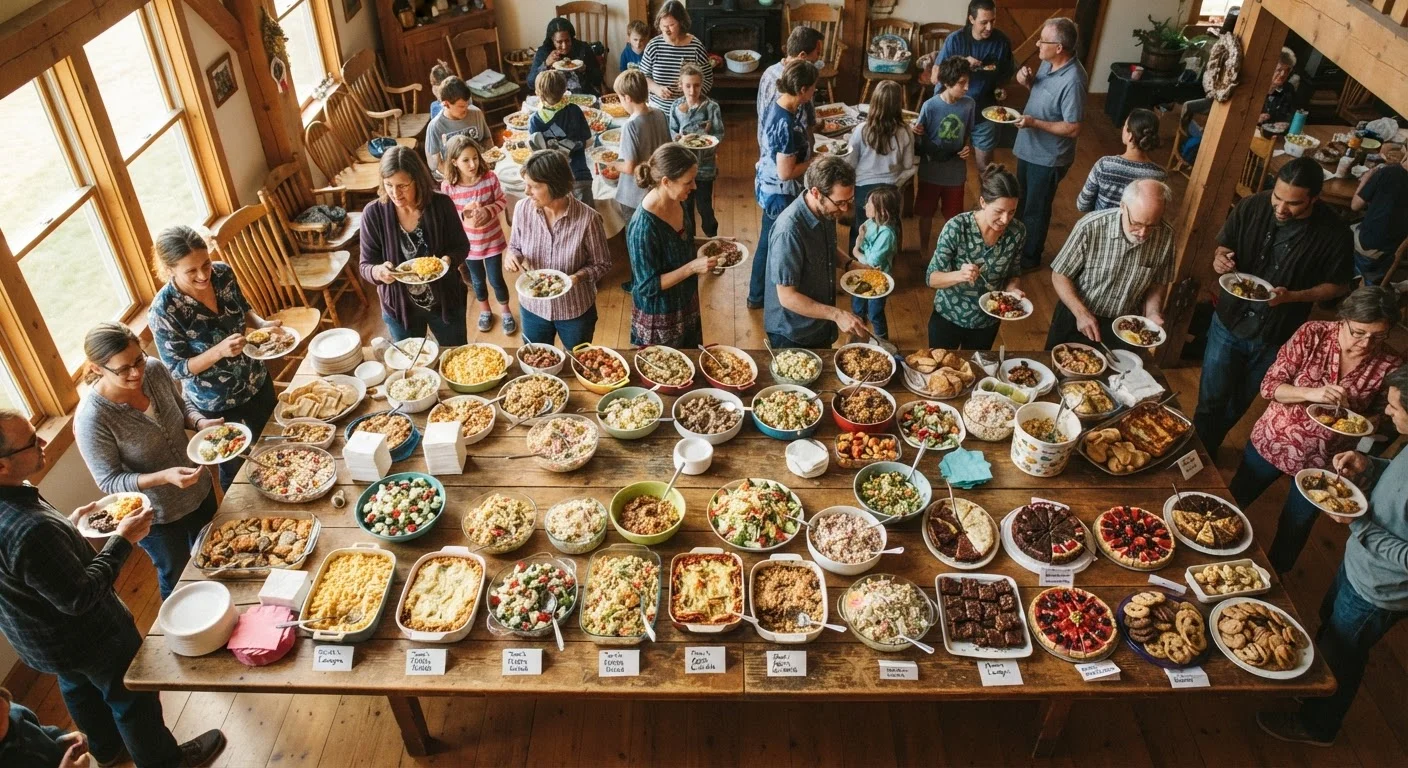
More Than a Casual Dinner
Ask most Americans what a potluck is, and they will describe the mechanics easily enough: everyone brings a dish, you fill a plate from the spread, and you eat together. But that description undersells what is actually happening. A potluck is a small, functioning social contract. By showing up with food, each person signals that they are willing to contribute to something shared - and that they trust others to do the same.
That dynamic sets the potluck apart from virtually every other American dining format. At a restaurant, money mediates the experience. At a dinner party, one host carries the creative and financial weight. At a potluck, the table belongs to everyone at once. Food historians and sociologists have long noted that communal eating rituals like this one do double duty: they feed people physically while reinforcing the invisible bonds that hold a group together.
The potluck also sits in interesting contrast to more individualized American food habits. Consider how fast food became woven into daily American life - a story of convenience, speed, and eating alone or on the move. The potluck runs in the opposite direction: it is slow, cooperative, and deliberately communal.
A Brief History of the Shared Table
The word itself is older than the United States. In 16th-century England, "pot luck" described whatever meal a host could offer from whatever happened to be cooking - no special preparation, no ceremony. Hospitality was the point, not the food. That spirit of making-do together crossed the Atlantic and took root in colonial and frontier communities where pooling resources was often a matter of survival, not mere etiquette.
By the 19th and early 20th centuries, American religious congregations - particularly Protestant churches in the Midwest and South - began holding organized "church suppers" where members each brought a dish to feed the group after services. These gatherings required coordination: someone had to ensure there were enough main dishes and not only desserts. Sign-up sheets, dish assignments, and potluck "rules" emerged organically from that practical need.
Immigrant communities added their own layer. As waves of newcomers arrived and formed mutual aid societies, cultural clubs, and neighborhood associations, their communal meals became spaces where heritage food survived and adapted. A table at an Italian-American social hall in 1930 or a church basement in a Scandinavian immigrant community told the story of a people trying to stay connected to home while building something new. That pattern continues today, as immigrant communities continually reshape American food culture through exactly this kind of shared cooking.
~330M
Americans who share at least one communal meal tradition
The U.S. Census Bureau estimates the total U.S. population at over 330 million, virtually all of whom participate in some form of shared or communal eating across cultural, religious, or family contexts.
1 in 3
American adults who attend a workplace potluck annually
Workplace food-sharing events, including potlucks and covered-dish lunches, are among the most common forms of organized communal eating outside family settings, according to workplace culture surveys.
What the Dish You Bring Says About You
At any potluck, the food on the table functions as a kind of autobiography. The grandmother who brings her tamales is carrying forward a family recipe and a cultural identity. The neighbor who bakes a pie from scratch is communicating care and effort. The colleague who brings a store-bought rotisserie chicken is communicating something too - perhaps honesty about their cooking skills, perhaps time constraints, perhaps a different set of values about what hospitality requires.
None of these choices is wrong, but all of them are legible. Potlucks make visible the invisible: what people value, what they are proud of, and how they understand their role in a group. This is why the question "what are you bringing?" can carry so much social weight. It is also why potlucks tend to produce a kind of culinary diversity that no single host could plan. A shared table draws on as many kitchens and traditions as there are people attending.
This accidental pluralism mirrors something true about American food culture broadly. Just as comfort food takes radically different forms depending on where you grew up, a potluck table in New Orleans looks nothing like one in rural Minnesota - and both are authentically American.
The Potluck as a Measure of Community Health
Sociologists who study social cohesion sometimes look at communal eating as a proxy for how connected a community actually is. A neighborhood where people share meals regularly tends to be one where people also check on each other during emergencies, share information, and look out for common interests. The potluck, in this reading, is not just a nice tradition - it is a small, repeatable exercise in building the social infrastructure that communities depend on.
That makes the potluck's persistence meaningful. The Sunday family dinner has declined significantly as American schedules have fragmented. Formal dinner parties require resources and planning that feel out of reach for many households. The potluck survives precisely because it distributes the burden. It does not require a large home, an impressive kitchen, or culinary expertise. It requires only that you show up with something to offer.
Understanding what Americans eat - and how those eating habits spread and shift - means paying attention to moments like these. As explored in our look at how dining trends travel across the country, food is never just food. It moves through communities because it carries meaning, memory, and the desire to belong. The potluck is one of the most direct expressions of that truth: a meal built not around a menu, but around the act of showing up for each other.
Frequently Asked Questions
The word 'potluck' originally referred to whatever a household happened to have in the pot for an unexpected guest. By the early 20th century, organized communal meals - especially church suppers and grange hall dinners - formalized the concept into the shared-dish gathering Americans recognize today.
Potlucks build community by distributing both the effort and the reward of a shared meal. They signal trust and reciprocity - you contribute something, and others do the same. This cooperative structure makes belonging feel tangible and mutual.
Because each person brings food tied to their own background, a single potluck table can hold dishes rooted in dozens of culinary traditions. This makes the potluck a live, edible expression of America's multicultural makeup.
There is no single correct format. Common approaches include assigning dish categories (appetizer, main, side, dessert) to avoid imbalance, or simply asking guests to bring a dish that feeds six to eight people. The key is enough coordination to ensure variety without over-engineering the spontaneity that makes potlucks appealing.
A dinner party centralizes effort in one host who plans, cooks, and serves everything. A potluck decentralizes that labor across all attendees, shifting the dynamic from host-and-guests to a community of co-contributors. This changes the social texture of the meal significantly.
Yes. Potlucks remain common in workplaces, houses of worship, neighborhoods, and holiday gatherings. The format has also adapted to new contexts, including apartment building events, community gardens, and online neighborhood groups that coordinate in-person shared meals.
The content on this site is provided for informational purposes only and should not be considered a substitute for professional advice. While we strive to provide accurate and up-to-date information, we make no guarantees regarding its completeness or accuracy. Always consult a qualified professional for advice specific to your circumstances before making any decisions.