

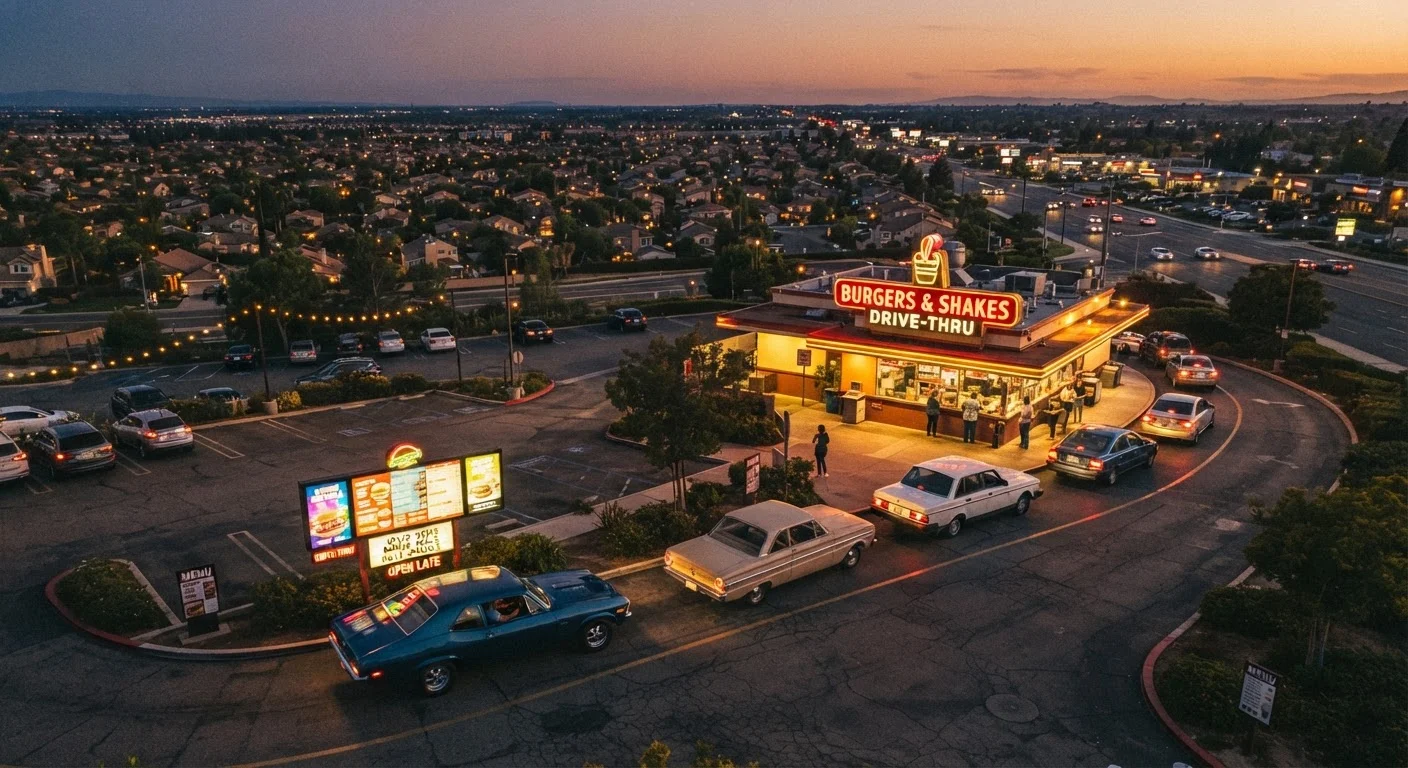
Where It All Started: The Origins of Fast Food Culture
Fast food didn't arrive fully formed in the 1950s. Its roots stretch back to roadside diners, automat restaurants, and the hot dog carts of early 20th-century cities. But the postwar boom - with its returning veterans, growing families, and surging car ownership - created the conditions for something entirely new.
Drive-in restaurants emerged first, where carhops brought food directly to your window. The assembly-line kitchen model, pioneered in California in the late 1940s, changed everything. By dramatically cutting wait times and standardizing portions, this approach allowed a handful of operators to serve hundreds of customers per hour. Speed wasn't just a convenience - it was the product.
The timing was not accidental. The Interstate Highway System, authorized in 1956, knit together a nation of drivers. Suburbs expanded. Commutes lengthened. The sit-down family dinner became harder to schedule. Into that gap stepped fast food, offering something reliable at the side of the road - wherever that road happened to be. As food trends spread across regions, the standardized fast food model traveled with infrastructure itself.
The Drive-Through as an American Institution
The drive-through window - distinct from the earlier drive-in - became widespread in the 1970s, when a combination of oil crises, busy two-income households, and shifting labor patterns made staying in your car feel like a genuine solution. By the early 1980s, drive-throughs were accounting for more than half of many chains' total sales.
What the drive-through actually sold, beyond a burger and fries, was a frictionless transaction. No parking struggle. No toddler meltdown in a booth. No tipping. For many American families stretched thin on time and money, that represented real value.
~70%
Fast food sales via drive-through
Industry analysts have consistently estimated that drive-through orders account for the majority of fast food revenue at most major chains in the U.S.
200,000+
Fast food locations in the U.S.
The U.S. restaurant industry trade data shows the fast food segment encompasses hundreds of thousands of locations across the country.
1 in 3
Americans eating fast food daily
Centers for Disease Control and Prevention survey data has found roughly one in three American adults consumes fast food on any given day.
The drive-through also embedded fast food into daily rituals in ways a sit-down restaurant never could. The morning coffee run, the after-school treat, the late-night snack on a long drive - these aren't just purchases. They're recurring moments in a life's rhythm. That repetition is what transforms a commercial transaction into something that feels cultural.
Today's drive-throughs are being redesigned for mobile ordering, multiple lanes, and faster throughput - reflecting the same underlying pressure that created them decades ago. The format evolves, but the cultural logic stays constant.
Fast Food and the American Road Trip
Ask Americans what they eat on a road trip, and fast food comes up again and again - not always as a guilty confession, but often as a fond association. The familiar logo on a highway exit sign carries real meaning: clean restrooms, a known menu, and a predictable price, regardless of what state you're in.
This consistency is, in part, what makes fast food a useful lens for understanding American identity. A country that spans thousands of miles and dozens of distinct regional food cultures still finds common ground in standardized formats. That's a remarkable thing - and worth examining without dismissing it as mere corporate homogenization.
Regional menus complicate that picture in interesting ways. Chains have long adapted offerings to local tastes - green chile in New Mexico, biscuit variations in the South, fresh seafood options in coastal markets. Fast food isn't monolithic; it absorbs geography even as it flattens some of it. Compare that to the deeply rooted regional sensibility explored in comfort food traditions across America, and you can see how the two coexist rather than cancel each other out.
Nostalgia, Memory, and the Golden Arches Effect
Food memory is powerful, and fast food is exceptionally good at creating it. For many Americans now in their 30s, 40s, and 50s, a specific fast food meal is tied to a specific childhood moment - a birthday, a Little League win, a Friday afternoon. Those associations don't fade easily.
Researchers who study food and memory note that early, emotionally charged eating experiences shape flavor preferences and brand loyalty in ways that persist across decades. Fast food companies have long understood this intuitively, designing kids' meal programs and playgrounds not just to please children but to create durable attachment.
When eating fast food on the road, check regional menu variations before you order - chains often adapt offerings to local tastes that aren't advertised nationally.
Regional menu items reflect genuine local ingredient availability and preference, and trying them gives a more accurate taste of the place you're traveling through.
If you're monitoring what your family eats, most chains now make full nutrition information available on their apps before you reach the window - use the ordering screen as a planning moment, not just a transaction.
Nutritional transparency has improved significantly, and pre-ordering through apps gives you more time to weigh options without the pressure of the drive-through line.
That nostalgia operates culturally as well as personally. Fast food restaurants have appeared in American films, television, and music so consistently that they function as shared cultural shorthand - a location that needs no explanation, a meal that any audience understands. This embeddedness contrasts sharply with the communal rituals described in the potluck tradition, where shared food builds belonging through active participation rather than passive consumption.
Fast Food in Context: What It Reveals About American Life
Fast food's durability isn't simply about taste or price. It's about how well it fits the pressures of American working life - long commutes, irregular hours, childcare demands, and the persistent sense that there's never quite enough time. Understanding it requires taking those pressures seriously rather than reducing the whole phenomenon to poor choices or corporate manipulation.
At the same time, fast food exists within a broader, more varied food culture. The growth of farmers markets, described in detail in the rise of the farmers market, and the enduring relevance of immigrant food traditions explored in iconic immigrant-influenced American dishes all share space in the same national food landscape. Americans don't choose between these worlds - they navigate all of them, sometimes in the same week.
Drive-throughs, in that light, are not a departure from American food culture. They are part of it - as revealing, in their way, as a Sunday roast or a state fair corn dog. The consumer trends that shape what Americans order, how they order it, and what they're willing to pay keep shifting. But the drive-through lane, glowing at the end of an exit ramp, remains one of the most reliably American things you'll see on any road.
The content on this site is provided for informational purposes only and should not be considered a substitute for professional advice. While we strive to provide accurate and up-to-date information, we make no guarantees regarding its completeness or accuracy. Always consult a qualified professional for advice specific to your circumstances before making any decisions.