

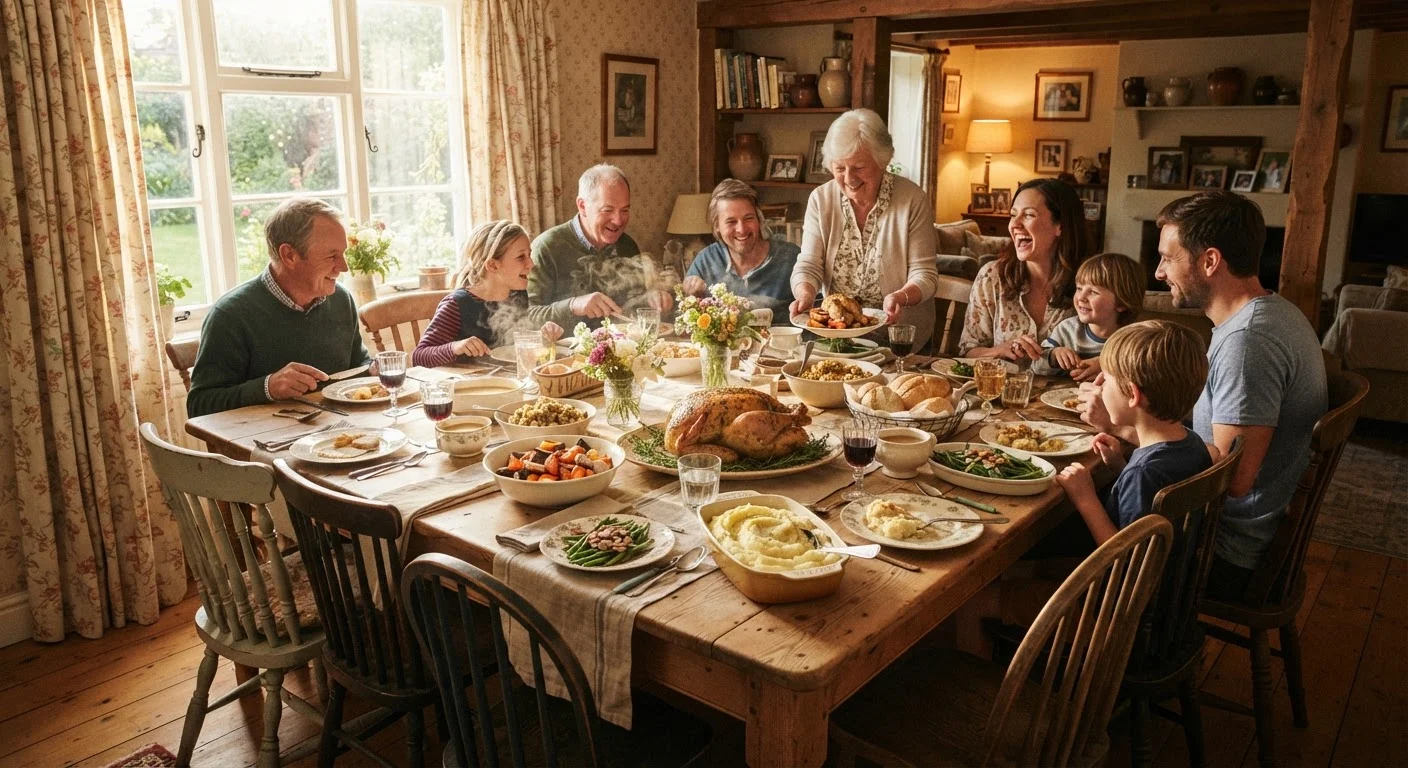
Where Sunday Dinner Came From
For much of American history, Sunday dinner wasn't a lifestyle choice - it was a structural fact of life. Agricultural communities worked six days a week, and Sunday, shaped by Christian observance, was set aside for rest and worship. With the whole family home and no fields to tend, a larger, more deliberate meal became natural. The cook - historically but not exclusively women - had rare daytime hours to braise a roast low and slow, bake a pie from scratch, or tend to a pot of beans.
Immigrant communities layered their own traditions onto this framework. Italian-American families built the legend of Sunday gravy: a meat-enriched tomato sauce that simmers all morning, filling the house with anticipation before the meal. African American Sunday dinners in the South developed into elaborate spreads - fried chicken, collard greens, cornbread, sweet potato pie - that served both as celebration and as an assertion of dignity and community during eras of severe hardship. These tables were more than food. They were culture in edible form.
The tradition isn't uniquely American, of course, but it took on particular American shapes. As the country urbanized and immigrant communities established roots, the Sunday meal became a weekly checkpoint - a time to maintain ties to heritage while adapting to new circumstances. You can trace similar dynamics in how immigrant communities transformed homeland recipes into American staples.
What the Table Actually Did
Sunday dinner was never just about nutrition. It was functional in ways that are easy to underestimate from a modern vantage point. The table enforced communication - eye contact, turn-taking, the navigation of disagreement in a contained and structured setting. Children absorbed family history through stories told over second helpings. Elders passed down recipes that carried information about geography, economy, and identity that no cookbook fully captured.
“Family dinners are more than just a meal - they're a crucible in which family culture is formed, stories are passed down, and children learn to navigate conversation and conflict in a safe setting.”
— Anne Fishel, Co-founder of The Family Dinner Project and clinical psychologist
Researchers at institutions including Harvard and the University of Minnesota have documented associations between regular family meals and positive outcomes in children - stronger academic performance, better communication skills, and lower rates of certain risky behaviors. These studies identify correlations, not guaranteed cause-and-effect; a family that eats together regularly may share other characteristics that contribute to those outcomes. But the signal is consistent enough to be taken seriously.
Sunday dinner also served as a social safety net. Extended family networks - grandparents, aunts, cousins - were woven into the weekly rhythm. Elderly relatives weren't left isolated; neighbors in hardship were folded in. The meal created low-stakes accountability. You could see if someone was struggling without having to formally ask.
The Forces That Eroded the Tradition
The decline of Sunday dinner didn't happen overnight, and no single cause drove it. Several structural shifts worked together across the latter half of the 20th century.
- Two-income households: As more families relied on two working adults, the uneven burden of Sunday cooking became harder to sustain. When the labor was invisible or assumed, it was also unsustainable.
- Geographic mobility: Americans began moving for work in greater numbers, scattering families across time zones. The weekly gathering became a logistical problem.
- The rise of convenience food: The expansion of fast food into everyday American routines reflected broader cultural shifts toward speed and individual schedules over shared ones.
- Changing leisure patterns: Sunday afternoon sports programming, youth travel leagues, and the explosion of individual screen entertainment all competed for the same hours.
The result is a measurable change. Survey data from organizations like the Pew Research Center has shown that shared family dinners have declined since the mid-20th century, though the picture is uneven - some communities and households have maintained the practice strongly.
Reviving the Ritual Without the Overwhelm
You don't need a four-course spread to restore Sunday dinner's function. A simple roast chicken, a big pot of soup, or even a collaborative takeout spread can anchor the gathering. The consistency of showing up together at the table matters more than the complexity of what's on it. Rotate cooking duties to share the labor and give everyone a stake in the tradition.
What's Actually at Stake
Framing Sunday dinner's decline purely as nostalgia misses the point. What's at stake is less a particular menu and more a set of practices that the meal made possible: regular face-to-face time, intergenerational exchange, the transmission of culinary knowledge, and a structured pause in an otherwise fragmented week.
Those things don't vanish when Sunday dinner does - but they require more deliberate effort to recreate. The potluck tradition offers a window into how Americans build community through shared food rituals, and many families have found that loosening Sunday dinner's format - making it collaborative, rotating the host, blending takeout with home cooking - actually strengthens participation. Similarly, holiday meals like Thanksgiving carry much of this weight in compressed form, as explored in how the Thanksgiving table has shifted across generations.
Sunday dinner's opposite number - the solitary meal - has grown more common, and solo dining has genuine rewards of its own. But there's something distinct about meals designed for togetherness that solo eating doesn't replicate.
The ritual isn't disappearing so much as it's shapeshifting. Families who recognize its value are finding ways to preserve its core - the intentional gathering, the shared food, the unhurried time - even when the form looks nothing like what their grandparents knew.
Frequently Asked Questions
Sunday was historically a day of rest in predominantly Christian communities, freeing families from field work or factory shifts. This made it the one day when everyone could gather without the pressure of weekday obligations, and when a cook had time to prepare something more elaborate.
Common centerpieces include roast chicken, pot roast, baked ham, or meatloaf, typically served with potatoes, green vegetables, and bread. Regional and cultural traditions vary widely - Southern Sunday dinners often feature fried chicken and cornbread, while Italian-American households may center on a long-simmered Sunday gravy with pasta.
Surveys suggest shared family dinners have declined overall since the mid-20th century. However, the practice persists strongly in many communities, and some families have consciously revived it. The form has shifted - it may now include takeout, smaller groups, or video calls - but the intent remains.
Research from institutions including Harvard University has found associations between frequent family dinners and positive outcomes for children, including stronger communication skills and lower rates of risky behavior. These studies observe correlations; they do not prove that meals alone cause these outcomes.
Start small - a simple roast, a one-pot meal, or even a shared takeout spread. Consistency matters more than complexity. Assigning each person a dish or task helps distribute effort and builds investment in the ritual over time.
The content on this site is provided for informational purposes only and should not be considered a substitute for professional advice. While we strive to provide accurate and up-to-date information, we make no guarantees regarding its completeness or accuracy. Always consult a qualified professional for advice specific to your circumstances before making any decisions.