

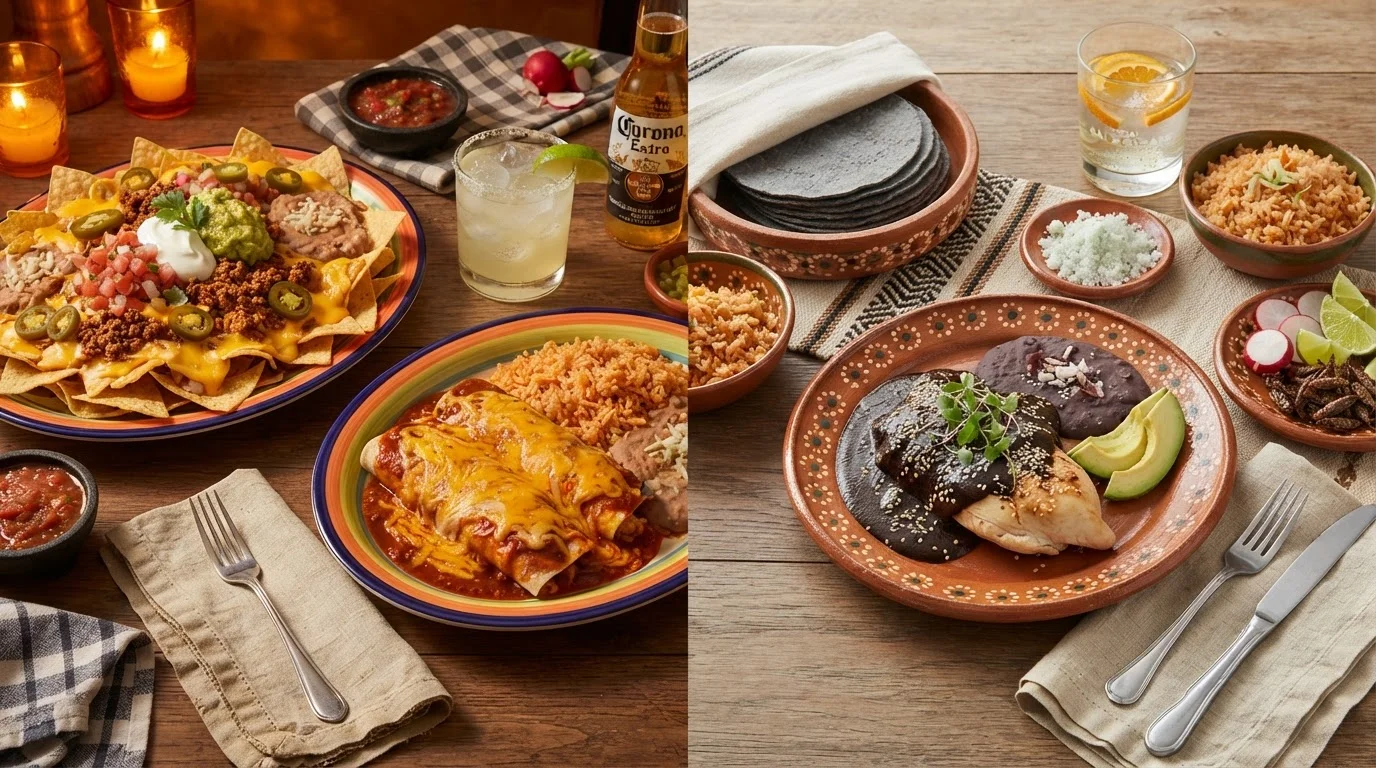
Option A
Tex-Mex
A bold American-born hybrid with deep border roots.
Best for: Diners who love hearty, cheese-forward, crowd-pleasing dishes with a Southwestern flair.
Option B
Interior Mexican Cuisine
A regionally diverse, centuries-old culinary tradition.
Best for: Food explorers seeking complex, ingredient-driven cooking tied to specific Mexican regions and histories.
Where Each Tradition Comes From
Tex-Mex is a genuinely American-born cuisine, not a corruption of something else. It evolved over generations along the Texas-Mexico border, shaped by the cooking of Tejanos - Texans of Mexican descent - who blended their culinary heritage with available local ingredients, cattle ranching culture, and Anglo-American tastes. By the time it entered mainstream American restaurant culture in the mid-20th century, it had developed its own identity: abundant yellow cheese, flour tortillas, beef-heavy fillings, and rich, cumin-forward seasonings.
Interior Mexican cuisine, by contrast, refers to the regional cooking traditions found throughout Mexico's heartland and southern states - places like Oaxaca, Puebla, Veracruz, Jalisco, and the Yucatán Peninsula. These traditions predate colonization and carry layers of pre-Columbian, indigenous, Spanish, and even French culinary influence. The result is not a single cuisine at all, but a mosaic of highly localized food cultures, each with its own signature dishes, chile varieties, and cooking techniques.
As regional American food cultures show, geography and history shape what ends up on the plate - and that's precisely what separates Tex-Mex from what's cooked south of the border.
Key Differences on the Plate
The most visible difference between the two traditions involves a handful of core ingredients.
| Criterion | Tex-Mex | Interior Mexican Cuisine |
|---|---|---|
| Origin | Texas-Mexico border, U.S. | Regional Mexican states |
| Primary tortilla | Flour tortilla | Corn tortilla (masa) |
| Cheese style | Melted yellow cheese | Fresh cheeses (cotija, queso fresco) |
| Dominant protein | Beef | Pork, chicken, seafood |
| Chile complexity | Limited varieties, often powdered | Dozens of distinct dried chile types |
| Sauce profile | Cumin-forward, chili gravies | Moles, adobos, pipians, recados |
| Regional variation | Relatively consistent | Extremely diverse by state |
Yellow processed cheese - melted generously over enchiladas, nachos, and burritos - is a Tex-Mex hallmark. In most of Mexico's interior, fresh cheeses like queso fresco, cotija, or Oaxacan string cheese are far more common. Similarly, the flour tortilla, which is essential to Tex-Mex, is predominantly a northern Mexican product. Corn tortillas, made from masa (nixtamalized corn dough), form the backbone of most interior Mexican cooking.
Beef also takes center stage in Tex-Mex, a direct reflection of Texas ranching culture. In many interior Mexican regions, pork, chicken, and seafood are the dominant proteins, often prepared through slow cooking methods - braising, pit-roasting, or long simmering in complex sauces called moles or adobos.
Chile use is another key divergence. Tex-Mex typically relies on a narrow set of dried or powdered chiles, while interior Mexican cooking may incorporate dozens of distinct chile varieties - anchos, mulatos, chipotles, pasillas, guajillos - each contributing specific flavors and heat levels to a dish.
The "Authentic" Question
One of the most persistent misconceptions about Tex-Mex is that it's simply a watered-down or inaccurate version of Mexican food. That framing misses the point entirely. Tex-Mex is its own cuisine with its own history - one that deserves to be understood on its own terms rather than measured against interior Mexican cooking as if there were a single standard to fall short of.
As our look at how "authentic" works on menus explores, the word tends to flatten nuance rather than clarify it. Interior Mexican cuisine is itself wildly varied - a mole from Oaxaca shares almost nothing with a lime-marinated fish taco from Veracruz. There is no single "authentic" Mexican food, only specific regional traditions with their own integrity.
This distinction matters for diners making restaurant choices. A Tex-Mex restaurant and a restaurant focused on Oaxacan or Poblano cooking are both legitimate - they're simply telling different stories. The more you understand those stories, the more rewarding your dining experience becomes. This parallels how soul food and Southern cooking share geography but diverge meaningfully in history and practice.
Regional Mexican Food in the U.S. Is Growing
American diners have increasing access to restaurants specializing in specific regional Mexican cuisines - Oaxacan, Yucatecan, and Poblano restaurants are becoming more common in many U.S. cities. Seeking them out offers a useful contrast to Tex-Mex and a more nuanced picture of Mexico's culinary range. When in doubt, ask restaurant staff about a dish's regional origin - most are happy to share the story behind the food.
The content on this site is provided for informational purposes only and should not be considered a substitute for professional advice. While we strive to provide accurate and up-to-date information, we make no guarantees regarding its completeness or accuracy. Always consult a qualified professional for advice specific to your circumstances before making any decisions.