

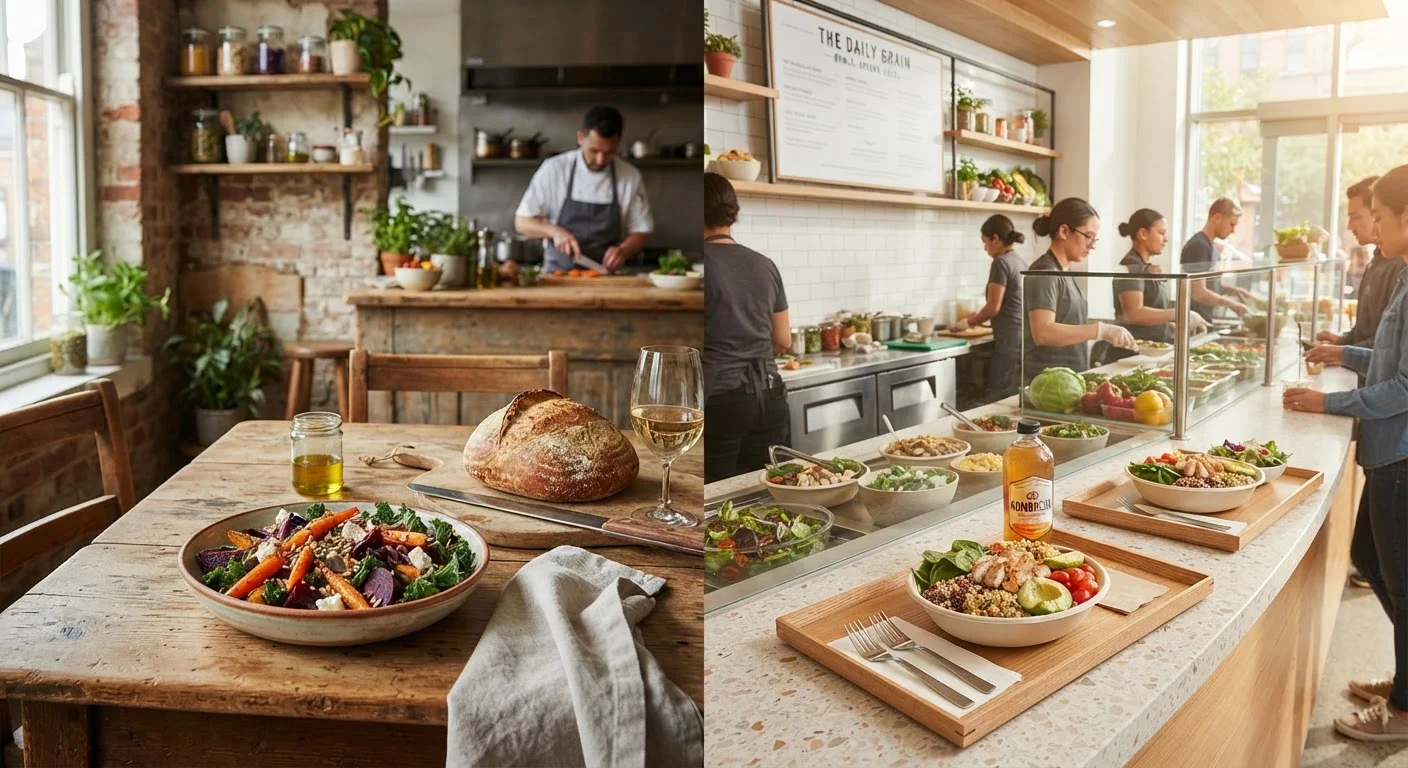
Option A
Farm-to-Table
The intentional, ingredient-driven dining experience.
Best for: Diners who prioritize sourcing transparency, seasonal menus, and a slower, more engaged meal.
Option B
Fast Casual
The streamlined, everyday dining solution.
Best for: Diners who want a reliably satisfying, affordable meal without a long time commitment.
What Each Dining Philosophy Actually Means
The term farm-to-table refers to restaurants that source ingredients directly from farms - often local or regional - and build their menus around what's seasonally available. The goal is a shorter, more transparent supply chain: fewer stops between harvest and plate. Staff at these restaurants can often tell you which farm grew the lettuces in your salad or where the pork belly was raised.
Fast casual, by contrast, is a restaurant category defined by counter service, faster preparation, and price points that typically fall between fast food and full-service dining. Think assembly-line grain bowls, build-your-own burritos, or customizable sandwiches. The emphasis is on speed, consistency, and accessibility rather than ingredient origin or seasonal variation.
These aren't just different types of menus - they represent fundamentally different promises to the diner. Farm-to-table says: we've thought carefully about where this food came from. Fast casual says: we'll get you fed well, quickly, at a fair price. Both are legitimate, and both serve real needs - but they rarely serve the same diner at the same moment.
It's worth noting that the language around restaurant concepts can be slippery. As our editorial team explores in why menu terminology is more complicated than it sounds, marketing language doesn't always match the reality on the plate.
Sourcing, Menus, and the Kitchen Philosophy Behind Each
Farm-to-table kitchens typically work with a rotating cast of local producers - farmers, ranchers, fishers, and small-batch makers. This creates menus that change with the seasons, which means you might see asparagus risotto in spring and butternut squash soup in fall. That variability is intentional: it reflects what's actually available and often at peak quality. The tradeoff is that your favorite dish may not be there on your next visit.
Fast-casual menus are built for standardization. Ingredients are sourced through supply chains designed to deliver consistent product at scale, which keeps prices stable and meals predictable. A bowl you order in one city should taste essentially the same in another. This model has evolved over time - many fast-casual operators have responded to consumer interest in fresher food by sourcing better-quality proteins or offering more vegetables - but the core structure prioritizes repeatability over seasonality.
| Criterion | Farm-to-Table | Fast Casual |
|---|---|---|
| Ingredient sourcing | Local/regional farms, direct relationships | Centralized supply chains, standardized suppliers |
| Menu variability | Seasonal, changes regularly | Fixed menu, consistent year-round |
| Typical meal cost (per person) | $40-$75+ | $10-$18 |
| Service style | Full table service | Counter ordering, self-seat |
| Meal pacing | Slow, multi-course friendly | Fast, designed for quick turnover |
| Transparency about food origins | High - often listed on menu | Variable - sometimes minimal |
| Consistency across visits | Lower - menus shift seasonally | High - standardized recipes |
| Best suited for | Special occasions, slow meals | Weekday meals, frequent dining |
The gap between these two approaches is also reflected in staffing. Farm-to-table kitchens often employ cooks trained to adapt to changing ingredients and make more decisions in real time. Fast-casual operations tend to rely on more standardized prep processes, which makes training more uniform and turnover easier to manage - an operational necessity at higher volume.
Price, Experience, and What You're Actually Paying For
Farm-to-table dining almost always costs more. Sourcing from small, local farms typically means paying market rates rather than commodity pricing. Smaller batch sizes, more skilled kitchen labor, and a full-service dining room all add to the bill. A farm-to-table dinner for two in most U.S. cities can easily run $80-$150 before drinks, depending on the region and restaurant.
Fast-casual meals are priced for frequency. A complete meal - entrée, drink, perhaps a side - usually lands between $10 and $18. That accessibility is part of the design; these restaurants are built to be visited multiple times per week without straining a household budget. For practical strategies on eating out without overspending, eating out on a budget without sacrificing the experience offers a useful framework.
Beyond price, the dining experience itself differs substantially. Farm-to-table restaurants typically involve table service, a paced meal structure, and an environment designed for lingering. Fast casual is engineered for throughput - you order at a counter, pick up your food, and the space is designed for turnover. Neither experience is lesser; they simply answer different questions about how you want to spend your time and money on a given day.
If you're curious how restaurant seating formats shape your experience even further, bar seating vs. table seating explores another dimension of the dining environment.
How to Choose - and When to Mix Both Into Your Routine
Smart diners don't pick one philosophy and stick to it exclusively. Most people benefit from having both in their rotation. Farm-to-table dining works well for occasions when you want to slow down, explore a chef's vision, or support local food producers in your region. The connection to local agriculture is real - and if you're curious about that broader food culture shift, the rise of farmers markets offers useful context on how local food systems have grown.
Fast casual earns its place for everyday practicality. When you need to eat well on a deadline or keep weekly food costs manageable, a well-run fast-casual spot is a genuine asset. The key is knowing what each format does well - and not expecting one to perform like the other.
A few questions worth asking before you sit down anywhere: Does the menu tell you where ingredients come from, and does that matter to you today? How much time do you have? What's your budget for this meal specifically? Answering those honestly will steer you toward the right room almost every time.
Neither dining philosophy has a monopoly on good food. Both continue to evolve - and the more you understand what each is trying to accomplish, the better positioned you'll be to spend your dining dollars with intention.
The content on this site is provided for informational purposes only and should not be considered a substitute for professional advice. While we strive to provide accurate and up-to-date information, we make no guarantees regarding its completeness or accuracy. Always consult a qualified professional for advice specific to your circumstances before making any decisions.