

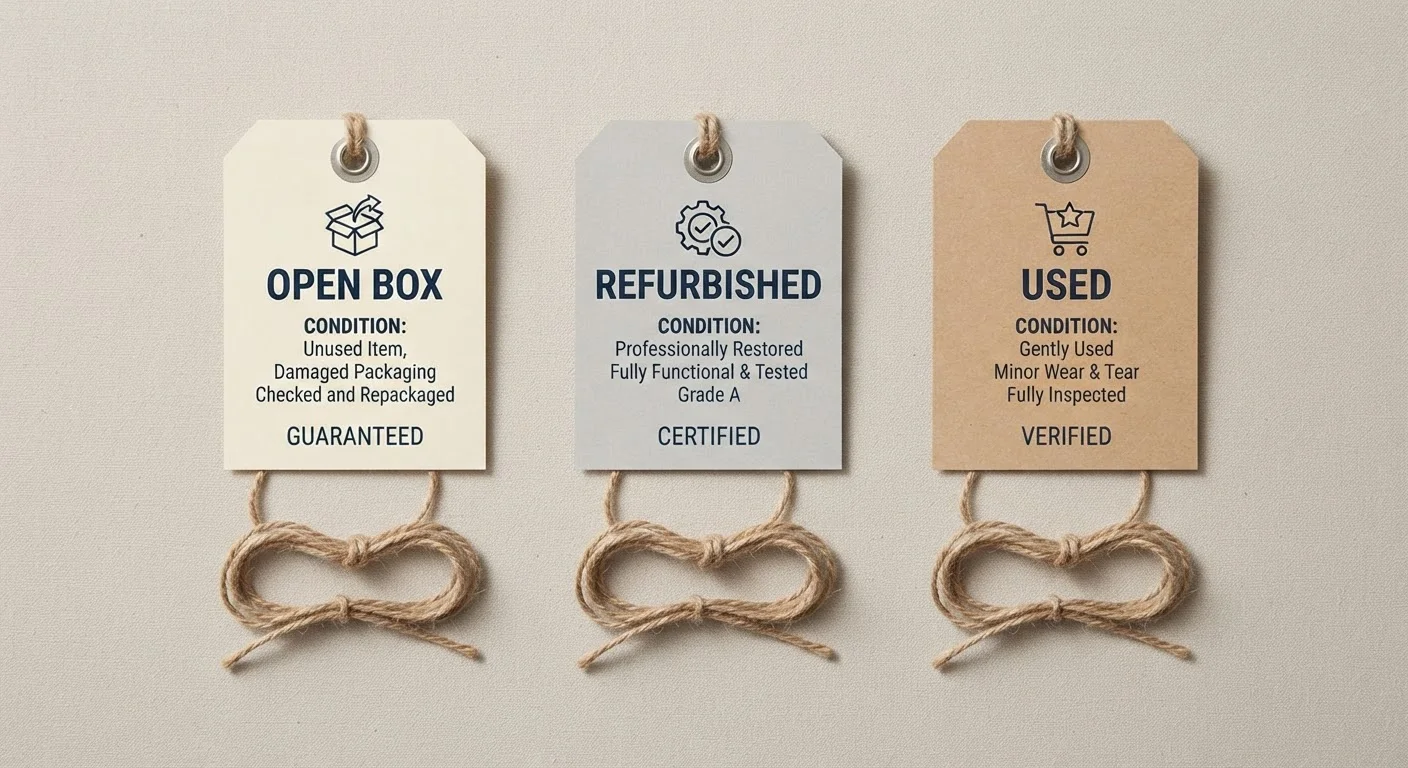
Our Verdict
Open box offers the lowest risk if you need something close to new at a modest discount. Manufacturer-refurbished products can be a smart middle ground - inspected, tested, and often backed by a real warranty. Used goods carry the most uncertainty but can still make sense when the price is right and you know what you're evaluating. In all three cases, the seller's reputation and warranty terms matter more than the label alone.
| Best for | Recommended |
|---|---|
| Shoppers who want near-new condition with minimal risk | Open Box |
| Those who want tested functionality with some warranty protection | Manufacturer-Refurbished |
| Budget-focused buyers comfortable evaluating condition themselves | Used |
| Those prioritizing peace of mind over maximum savings | Manufacturer-Refurbished |
Why These Labels Get Confused - and Why It Costs You
Walk through any major retailer's clearance section or browse a marketplace listing and you'll encounter all three terms: open box, refurbished, used. Retailers and sellers often use them loosely, which means two products priced similarly under different labels can represent dramatically different levels of risk. Treating them as interchangeable is one of the more common - and avoidable - mistakes shoppers make.
The core differences come down to three things: what condition the item is actually in, who prepared it for resale, and what protection you have if something goes wrong. None of those answers are the same across all three categories. Understanding how warranties and return policies work before you buy is especially important here, since non-new goods often come with terms that differ sharply from new-item purchases.
Open Box: Nearly New, But Read the Fine Print
Open box generally means a product was returned to the retailer - sometimes after minimal or no actual use. The original packaging may be torn, missing components, or resealed. In many cases, the item itself has never been powered on; a customer simply changed their mind and returned it.
The risk with open box isn't usually condition - it's warranty status. Some retailers restore the full manufacturer warranty, while others offer only a limited store warranty or none at all. Missing accessories (cables, manuals, mounting hardware) are common, and you're typically relying on the retailer's grading, which isn't standardized across the industry.
Open box is generally the lowest-risk non-new category, but only when you buy from a retailer with a clear return window and explicit warranty disclosure. Ask specifically: what warranty applies, what's included in the box, and has the item been inspected or just reshelved? Manufacturer warranties are often narrower than shoppers expect, so verify the terms before assuming coverage continues.
| Open Box | Refurbished | Used | |
|---|---|---|---|
| Typical Condition | Unused or minimally used | Inspected and repaired | Previously owned, variable |
| Standardized Grading | Retailer-defined | Varies by source | No standard - seller-defined |
| Warranty Likelihood | Sometimes; retailer-dependent | Often; varies by refurbisher | Rarely; sold as-is |
| Who Prepares It | Retailer | Manufacturer or third party | Previous owner or reseller |
| Return Window | Usually available | Often available | Uncommon |
| Risk Level | Low to moderate | Low to moderate | Moderate to high |
Refurbished: A Label That Spans a Wide Quality Range
Refurbished is where the label matters most and varies most. At its best, a manufacturer-refurbished product has been returned, disassembled, inspected, repaired to factory spec, and tested - then repackaged with a warranty. At its worst, "refurbished" is a third-party label applied to a cleaned-up return with minimal actual work done.
The single most important distinction: manufacturer-refurbished versus third-party refurbished. When a manufacturer sells a refurbished unit directly, they're applying the same standards as their repair centers. Third-party refurbishers vary enormously in competence and transparency. Some are excellent; others simply wipe a device and rebox it.
Look for explicit details: what was inspected, what was replaced, what warranty is offered, and by whom. A 90-day warranty from a refurbisher you've never heard of is a very different proposition than a one-year warranty from the original manufacturer. Third-party certifications can help signal quality standards - some refurbishers carry independent certification that adds meaningful accountability.
Used: Maximum Variability, Buyer Beware
Used means the item was owned and operated by someone else, and it's being resold with no standardized preparation. There's no inspection requirement, no repair baseline, and often no warranty. Condition descriptions like "good," "fair," or "like new" are seller-defined and not governed by any universal standard.
That doesn't make used goods a bad deal - it means the burden of evaluation falls squarely on the buyer. For simple, durable items (cookware, furniture, books), used carries relatively low risk. For electronics, appliances, or anything with hidden mechanical complexity, the stakes are higher. Seller feedback and verified reviews become especially important signals when buying used, since you're largely relying on the seller's honesty about condition.
Always clarify: Is there any return window? Has the item been tested recently? Are there visible signs of wear or damage not shown in photos? For high-value used purchases - vehicles in particular - the calculus gets more complex. The new versus used trade-off in autos involves depreciation, reliability history, and inspection costs that don't apply to a used blender.
The Question That Matters Most: Who Stands Behind It?
Across all three categories, seller accountability is the variable that most determines your actual risk. A major retailer selling open box with a 30-day return window gives you meaningful recourse. An anonymous marketplace seller listing a "refurbished" item with no returns leaves you exposed regardless of the label.
Before purchasing any non-new item, answer these questions: Who is the seller, and do they have a verifiable track record? What specific warranty or return protection applies to this item? Is the condition description detailed and consistent with photos? For refurbished goods, what exactly was done - and who did it?
Labels are starting points, not guarantees. The same word on two different listings can represent very different levels of quality and protection. Treating those questions as non-negotiable - not optional due diligence - is what separates a smart non-new purchase from an expensive lesson. The same logic applies to brand versus store labels: the name matters less than the substance behind it.
The content on this site is provided for informational purposes only and should not be considered a substitute for professional advice. While we strive to provide accurate and up-to-date information, we make no guarantees regarding its completeness or accuracy. Always consult a qualified professional for advice specific to your circumstances before making any decisions.