

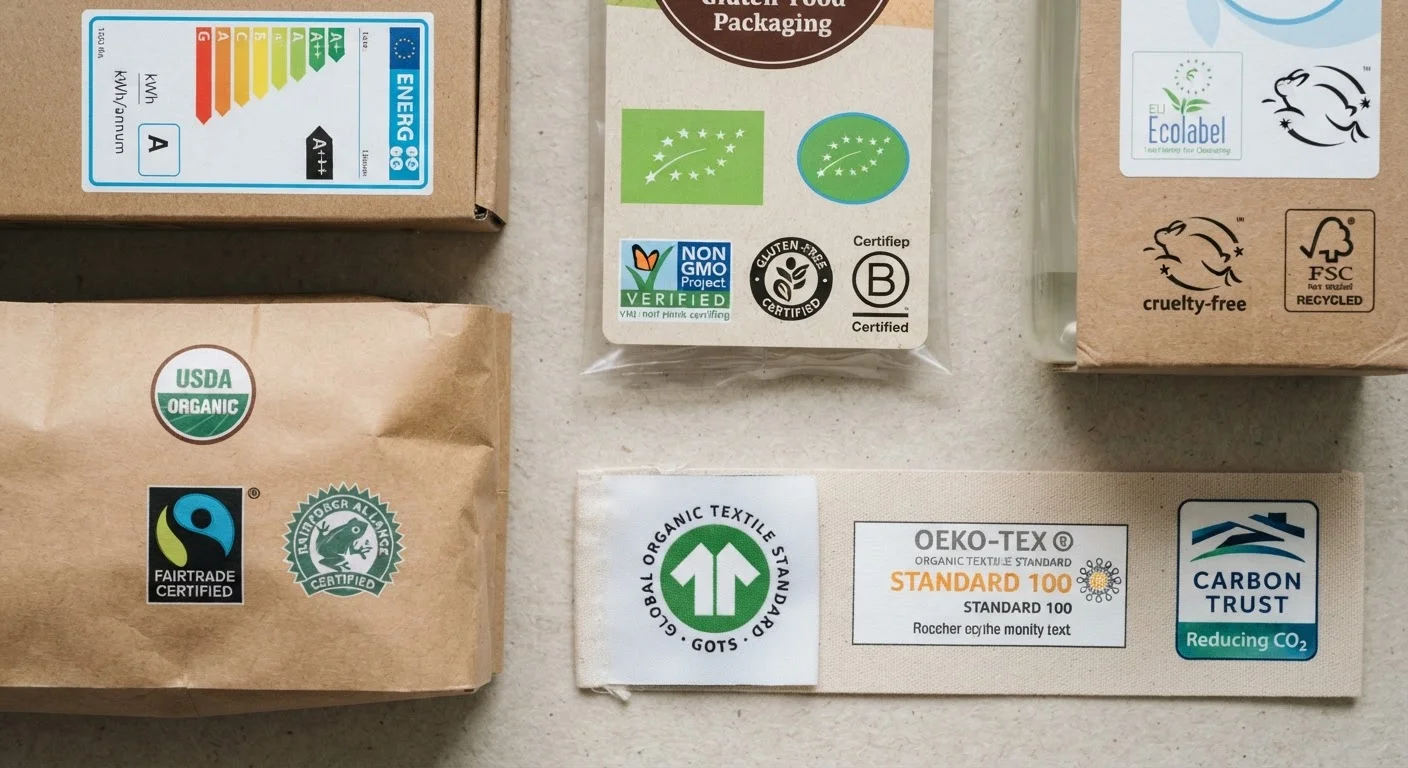
Why Certification Labels Exist - and What They Can't Do
Certification marks are designed to solve a trust problem. When you can't personally test whether an appliance is fire-safe or whether a food was grown without synthetic pesticides, a credible third party steps in, sets a standard, and verifies compliance. The mark on the package is shorthand for that entire process.
The catch: not every logo that looks official carries the same weight. Some marks are awarded by rigorous, independent bodies with laboratory testing requirements. Others are self-declared by manufacturers or maintained by industry trade groups with minimal outside oversight. Knowing the difference is the foundation of smarter shopping. For a broader look at navigating label language, see how to read product labels without getting lost in the fine print.
Third-Party Certification
Verification of a product's compliance with a standard by an organization independent of both the manufacturer and the buyer. Independence is what gives these marks credibility.
UL Listed
A designation from Underwriters Laboratories indicating a product has been tested against specific safety standards. Factory inspections are required to maintain the listing.
Energy Star
A U.S. EPA and DOE joint program that certifies products meeting category-specific energy-efficiency thresholds set above the federal minimum.
USDA Organic
A federal certification requiring that products meet USDA standards prohibiting most synthetic inputs and genetically engineered ingredients, verified by accredited third-party inspectors.
Self-Declared Claim
A label or mark applied by the manufacturer without independent verification. Terms like 'natural' or 'eco-friendly' typically fall into this category in the U.S.
Fair Trade Certified
A certification focused on labor and trade practices, requiring fair wages and safe working conditions for producers. It is administered by independent nonprofit organizations, not a government body.
Safety and Electrical: UL, ETL, and CSA
UL (Underwriters Laboratories) is one of the most recognized safety marks in the U.S. UL-listed products have been independently tested against established safety standards - covering things like electrical shock risk, fire hazard, and mechanical durability. UL publishes its standards publicly, and manufacturers must maintain factory inspections to keep the listing. A UL mark on a power strip or space heater means the specific product design was evaluated, not just the brand.
ETL and CSA (Canadian Standards Association) serve similar functions and are equally recognized by regulatory authorities. If a product carries any one of these marks, it has cleared a baseline of independent safety testing. That said, none of these marks certify long-term reliability or everyday performance - they confirm the product passed defined safety tests at the time of certification.
| UL Founded | 1894 (Underwriters Laboratories) |
| Energy Star Launch Year | 1992 (U.S. EPA) |
| USDA Organic Minimum Threshold | 95% organic ingredients to carry the 'Organic' label (USDA Agricultural Marketing Service) |
| Energy Star Efficiency Requirement (Refrigerators) | At least 15% more efficient than federal minimum standard (U.S. EPA Energy Star program criteria) |
| Certification Bodies Compared | UL, ETL, CSA recognized equally by U.S. regulatory authorities for electrical safety (OSHA Nationally Recognized Testing Laboratory program) |
Energy Efficiency: Energy Star
Energy Star is a voluntary program run jointly by the U.S. Environmental Protection Agency (EPA) and the U.S. Department of Energy. Products earn the label by meeting energy-efficiency thresholds set by the EPA - thresholds that are product-category specific. A certified refrigerator, for example, must use at least 15% less energy than the federal minimum standard.
Importantly, Energy Star requirements vary by product type, and the EPA periodically tightens them. A certified clothes washer and a certified light bulb have gone through entirely different criteria. The label reliably signals lower energy consumption compared to non-certified alternatives in the same category, but it says nothing about build quality, noise level, or feature set. For related label literacy, understanding nutrition labels follows similar principles of knowing what a mark does and doesn't cover.
Food and Agriculture: USDA Organic, Non-GMO Project, and Fair Trade
USDA Organic is one of the most regulated food labels in the country. The U.S. Department of Agriculture requires that certified organic products meet a detailed federal standard - prohibiting most synthetic pesticides, synthetic fertilizers, sewage sludge, irradiation, and genetically engineered ingredients. Third-party certifiers accredited by the USDA conduct annual on-site inspections. Products labeled "100% Organic" contain only organic ingredients; those labeled simply "Organic" must be at least 95% organic by weight.
What USDA Organic doesn't guarantee: superior nutrition, local sourcing, or humane animal treatment (separate welfare certifications exist for that). The label is about how the product was produced, not how nutritious or sustainable it is in every dimension.
Non-GMO Project Verified is administered by a nonprofit and signals that a product went through testing and supply-chain tracing to verify it avoids genetically modified organisms. It is not a government program, but it does involve independent verification. Fair Trade Certified (issued by Fair Trade USA and similar bodies) focuses on labor and trade practices - primarily fair wages and safe working conditions for producers in developing countries. Neither mark overlaps with USDA Organic; a product can carry one, both, or neither.
Labels That Require More Scrutiny
Some marks look credible but rest on weaker foundations. Terms like "natural," "eco-friendly," or "sustainably sourced" generally have no standardized regulatory definition in the U.S. and can be applied without independent verification. Similarly, some industry-created seals - such as those issued by a trade association whose members fund the certification - may reflect lower-bar standards than fully independent bodies.
A useful question to ask about any certification: Who sets the standard, who does the testing, and is there ongoing verification after initial approval? If the answer to all three points back to the manufacturer itself, treat the mark as a marketing claim rather than an independent guarantee. The same skepticism applies to credential-style badges in other contexts - not all certifications carry equal weight, whether on a product or a résumé. For physical goods that aren't brand new, understanding what refurbished and open-box labels mean follows the same principle of reading behind the label.
The content on this site is provided for informational purposes only and should not be considered a substitute for professional advice. While we strive to provide accurate and up-to-date information, we make no guarantees regarding its completeness or accuracy. Always consult a qualified professional for advice specific to your circumstances before making any decisions.