

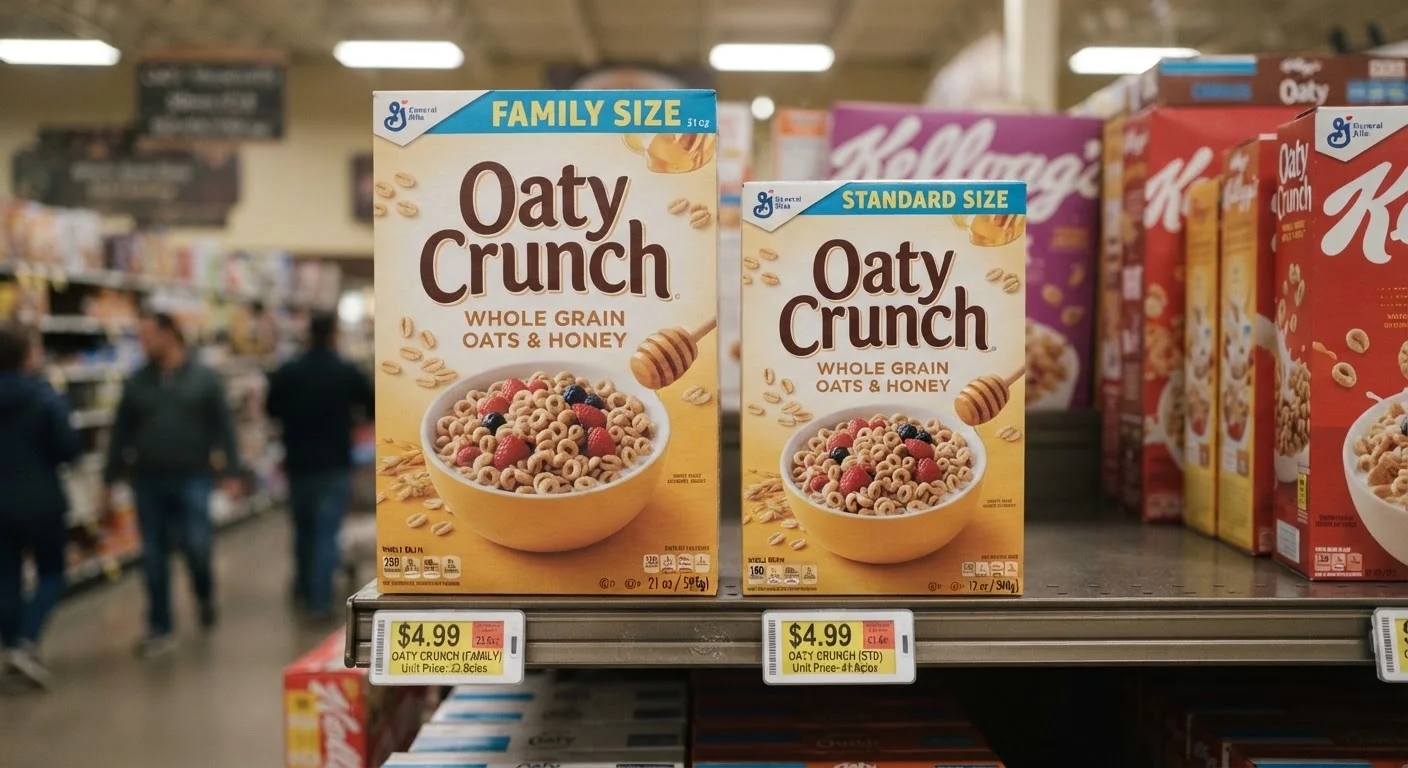
How Shrinkflation Works in Practice
The mechanics are straightforward: a manufacturer quietly reduces the contents of a package - say, from 16 ounces to 14 ounces - while the retail price stays at $3.99. The box, bottle, or bag looks nearly the same. Nothing on the label announces the change. The shopper at the checkout counter has no obvious signal that anything is different.
This is not a new phenomenon. Manufacturers have been adjusting package sizes for decades in response to fluctuating commodity prices, labor costs, and transportation expenses. What drew renewed public attention to the practice was the sharp rise in input costs beginning around 2021, when supply chain disruptions and inflation pressures pushed companies to find ways to protect profit margins.
The key economic mechanism is simple: a 12.5% reduction in product quantity is mathematically equivalent to a 14.3% price increase per unit - even though the price tag never moved. For households buying the same items week after week, those fractions add up over the course of a year.
~10%
Typical size reduction in affected products
Consumer advocacy groups have documented reductions commonly ranging from 5% to 15% across packaged goods categories during recent inflationary periods.
4,000+
Products tracked for size changes by one consumer database
The consumer research site Shrinkflation.com has catalogued thousands of documented package reductions across U.S. grocery categories as of recent years.
3-in-4
Shoppers who report noticing fewer product ounces
A 2023 survey by Consumer Reports found a large majority of American grocery shoppers believed they were getting less product for the same price compared to prior years.
Why Companies Choose Shrinkflation Over a Price Hike
Consumer psychology plays a central role. Decades of behavioral research suggest that shoppers anchor strongly to the price they expect to pay for a familiar product. A yogurt container that has always cost $1.29 still reads as $1.29 - even if it now holds six ounces instead of eight. An outright price increase to $1.59, by contrast, is immediately visible and can trigger a switch to a store brand or a competing product.
Retailers also bear some responsibility for the dynamic. Many supply contracts with manufacturers are built around maintaining consistent price points on shelf. Downsizing a product can be easier to negotiate through the supply chain than renegotiating a price point.
Shrinkflation is one of several related tactics companies use when costs rise - including skimpflation, where the recipe or material quality quietly declines rather than the quantity. Understanding both helps consumers see the full picture.
Spotting Shrinkflation Before It Hits Your Budget
The most practical defense is the unit price label - the small tag on most grocery shelves that expresses cost per ounce, per sheet, per count, or per fluid ounce. When the unit price climbs while the shelf price holds steady, a size reduction has almost certainly occurred. Unit pricing is a tool many shoppers overlook, but it's the most reliable way to make fair comparisons across sizes and brands.
Other signals worth watching:
- Redesigned packaging - a new look often coincides with a size change, since new tooling is already required.
- Package shape changes - a wider base or indented bottom can reduce volume without reducing height.
- "New look, same great taste" messaging - when the emphasis is on aesthetics, the net weight line on the back deserves a second glance.
It's also worth remembering that even when headline inflation eases, grocery prices tend to stay elevated - and shrinkflation can persist long after the cost pressures that caused it have subsided.
Make Unit Price Your Default Check
Before placing a familiar product in your cart, take five seconds to check the unit price label on the shelf edge - not just the package price. Most U.S. grocery retailers are required to display unit prices, and they update when package sizes change. If the unit price has crept up while the package price looks the same as always, you're likely looking at a shrunken product.
The Broader Consumer Picture
Shrinkflation sits alongside other pricing tactics that shape what consumers actually pay versus what they perceive they're paying. Sale prices carry their own set of optical illusions, and the combination of anchored price expectations, downsized packages, and promotional framing can make it genuinely difficult to track the real cost of a household's weekly shop.
Awareness is a practical starting point. Consumers who understand shrinkflation are better positioned to compare products on a per-unit basis, consider store-brand alternatives that may not have undergone the same adjustments, and push back - through purchasing choices - on the practice. It does not require an economics degree: checking the unit price label takes about five seconds and gives a clearer picture than the sticker price alone.
This article is for general informational purposes only and does not constitute financial or consumer legal advice. Readers should verify product information and pricing directly with retailers and manufacturers.
Frequently Asked Questions
No, shrinkflation is legal in the United States. Manufacturers are required to accurately label the net weight or quantity of a product, but they are not required to alert consumers when that amount decreases. Some other countries, such as France, have introduced rules requiring stores to label recently downsized products.
The most effective method is checking the unit price label on the shelf - typically shown as the cost per ounce, per count, or per liter. If the unit price has risen while the sticker price looks familiar, the package has likely shrunk. You can also compare current package weights against past purchases.
Research in consumer psychology suggests shoppers are more sensitive to price increases than to subtle size reductions. A price jump is immediately visible at the register, while a slightly lighter bag or shorter roll often goes unnoticed. Companies use shrinkflation to protect margins while minimizing customer backlash.
Partially. The U.S. Bureau of Labor Statistics attempts to account for package size changes when computing the Consumer Price Index, but tracking every product adjustment is difficult. Shrinkflation can therefore cause official inflation figures to understate the real-world cost increase consumers experience.
Packaged foods - snacks, cereals, ice cream, coffee, and beverages - are the most frequently cited categories. Household paper goods, personal care products, and cleaning supplies are also commonly affected. Essentially, any branded product sold by weight or volume is a candidate.
The content on this site is provided for informational purposes only and should not be considered a substitute for professional advice. While we strive to provide accurate and up-to-date information, we make no guarantees regarding its completeness or accuracy. Always consult a qualified professional for advice specific to your circumstances before making any decisions.