

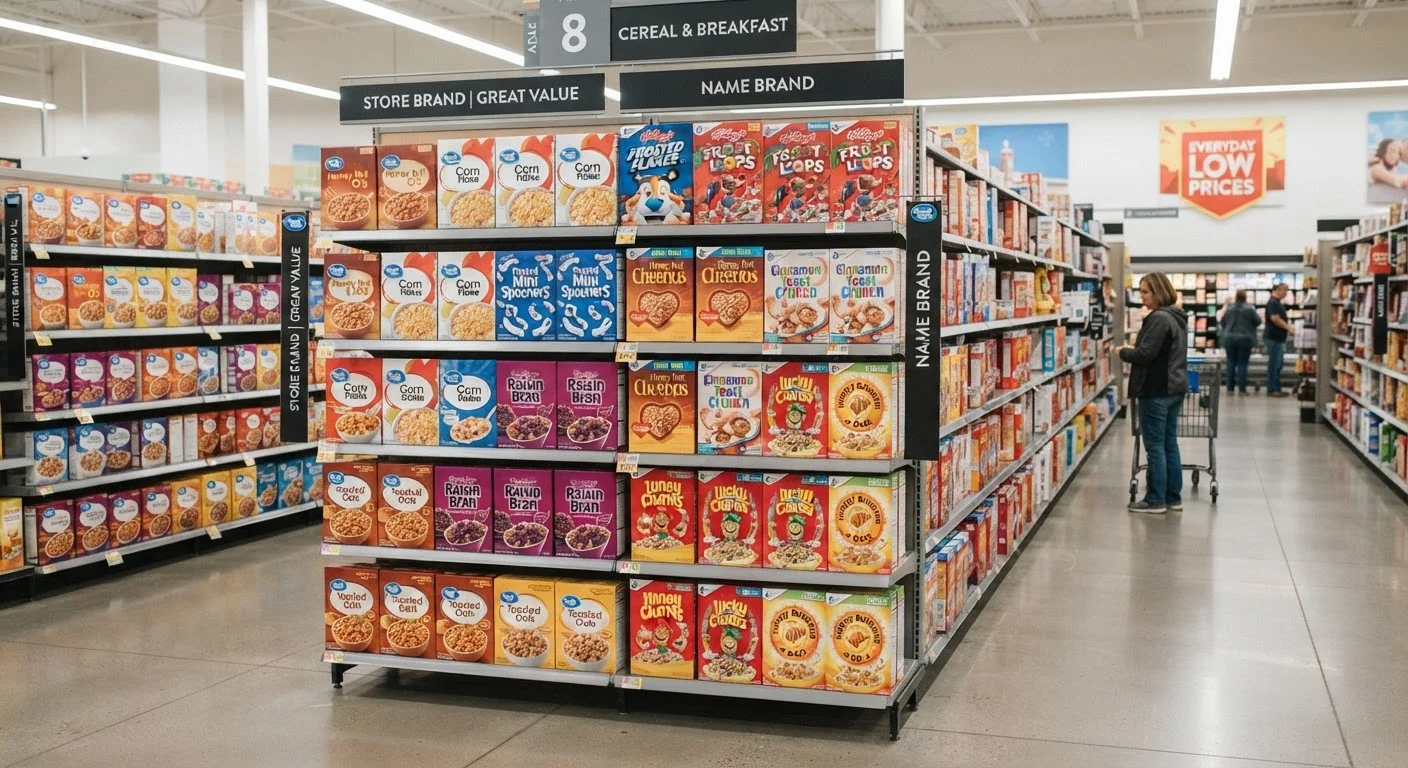
Option A
Private Label (Store Brands)
The retailer-owned, value-forward contender gaining serious market ground.
Best for: Shoppers seeking lower prices on everyday staples without sacrificing much in quality.
Option B
Name Brands (National Brands)
The established, heavily marketed products consumers have trusted for decades.
Best for: Consumers who prioritize brand recognition, specific formulations, or consistent taste experiences.
A Shifting Balance of Power in the Grocery Aisle
For most of the 20th century, store brands occupied the bottom shelf - literally and figuratively. They were the no-frills option: plain packaging, uncertain quality, purchased out of necessity rather than preference. That dynamic has changed substantially. Private label products now account for roughly one in four items sold in U.S. grocery stores by unit volume, according to industry research from the Private Label Manufacturers Association.
The shift reflects a convergence of forces: sustained inflation squeezing household budgets, improving retailer investment in product development, and a broader erosion of unconditional brand loyalty among American shoppers. As the decline of traditional brand loyalty accelerates, private label has moved from fallback option to deliberate choice for a growing segment of U.S. consumers.
Retailers have noticed. Chains from Costco (Kirkland Signature) to Trader Joe's to Kroger have built private label portfolios that span everyday staples, organic lines, and premium tiers - in some cases displacing national brands from prime shelf real estate entirely.
| Criterion | Private Label | Name Brands |
|---|---|---|
| Typical Price Point | 20-30% lower on average | Higher; includes marketing costs |
| Quality Consistency | Varies by retailer and category | Generally more standardized |
| Product Innovation | Growing, but lags national brands | Higher R&D investment |
| Shelf Visibility | Increasing as retailers prioritize | Established but under pressure |
| Premium Tiers Available | Yes, expanding rapidly | Yes, longstanding |
| Consumer Trust Trend | Rising steadily since mid-2010s | Softening among younger shoppers |
| Retailer Margin | Higher for retailer | Shared with manufacturer |
Where the Quality Gap Is Real - and Where It Isn't
The honest answer is that the private label vs. name brand debate has no universal winner. The quality gap is highly category-dependent, and understanding that distinction helps consumers make more informed decisions at the shelf.
In commodity-driven categories - think dried pasta, canned beans, frozen vegetables, and paper goods - private label products are often manufactured in the same facilities as name brand equivalents. The difference is largely packaging and margin structure. In these segments, switching to store brands represents a straightforward trade that many consumers have already made.
National brands hold more meaningful advantages in categories where proprietary formulas, R&D investment, or flavor development create genuine product differentiation. Certain condiments, specialty cheeses, beverages, and personal care products involve enough complexity that the name brand may offer a distinctly different experience - not just a perception difference.
For a more granular look at specific categories, see where brand name quality genuinely holds up.
~25%
U.S. grocery unit sales held by private label
According to the Private Label Manufacturers Association, store brands account for roughly one in four units sold in U.S. grocery retail.
20-30%
Typical price difference vs. national brands
Industry research consistently finds private label products priced noticeably below national brand equivalents across most grocery categories.
~40%
Share of grocery sales in some European markets
Private label penetration in countries like the U.K. and Germany suggests U.S. store brands still have significant room to grow by international comparison.
How Retailers Are Raising the Private Label Stakes
What distinguishes today's private label landscape from a decade ago is the deliberate investment retailers are making at the premium end. Rather than competing solely on price, major grocery chains are building tiered private label portfolios: a budget tier, a standard tier, and an elevated tier with premium sourcing claims, distinctive packaging, and positioning that directly challenges national brands on quality perception.
This strategy is reshaping how shelf space gets allocated. Retailers control their own shelves, and as private label margins are typically higher than national brand margins, the financial incentive to grow store brand penetration is significant. Some analysts have noted that this dynamic is pushing national brand manufacturers to negotiate harder on pricing and promotion just to maintain placement.
The broader retail context matters here too. As grocery retail evolves toward omnichannel models - detailed in our piece on the shift from in-store to omnichannel retail - private label brands gain new visibility through retailer apps, loyalty programs, and curated online shopping experiences that national brands don't automatically share.
Pricing strategies are also evolving. Retailers experimenting with dynamic pricing models have another lever to pull with private label products, since they control both the product and the price point simultaneously.
What This Means for Everyday Shoppers
The practical implication for consumers is that a blanket strategy - always buy name brands or always buy store brands - is increasingly outdated. A more useful approach is category-level awareness: identifying where private label delivers comparable value and where national brand formulations serve a specific need.
Terminology in this space is also evolving. Terms like "trading down" (switching to a cheaper alternative) are increasingly contested - many consumers describe their shift to store brands as a rational upgrade in value, not a compromise. For a useful glossary of consumer behavior terms shaping these conversations, see key consumer trend terms every shopper should know.
The broader consumer trends landscape suggests this isn't a temporary inflation response. Surveys consistently indicate that shoppers who switch to store brands during economic pressure often maintain those habits even when their budgets ease - a pattern that suggests private label growth has a durable behavioral foundation, not just a cyclical one.
This article is for informational purposes only. Market conditions, product availability, and retailer strategies vary and may change over time. Readers should verify current offerings and pricing directly with retailers.
The content on this site is provided for informational purposes only and should not be considered a substitute for professional advice. While we strive to provide accurate and up-to-date information, we make no guarantees regarding its completeness or accuracy. Always consult a qualified professional for advice specific to your circumstances before making any decisions.