

Why Retail's Channels Are Merging
For most of retail history, selling was straightforward: customers came to stores, picked products, and paid at a register. Online shopping introduced a parallel track. For a while, many retailers managed these as separate businesses with separate teams, websites, and inventory pools.
That separation is now widely seen as a liability. Shoppers today expect to move between channels without noticing the seam. They research products on social media, check availability on a retailer's app, visit a store to see the item in person, and may ultimately order it for home delivery. Retailers that can't support that journey risk losing the sale at any step.
This pressure has driven sustained investment in omnichannel infrastructure - the behind-the-scenes systems that connect inventory, customer accounts, fulfillment, and returns across every channel a retailer operates. Understanding why that integration matters helps explain a lot of what shoppers now encounter at checkout and beyond. For a broader look at shifting consumer habits, see the Consumer Trends hub.
What Omnichannel Looks Like in Practice
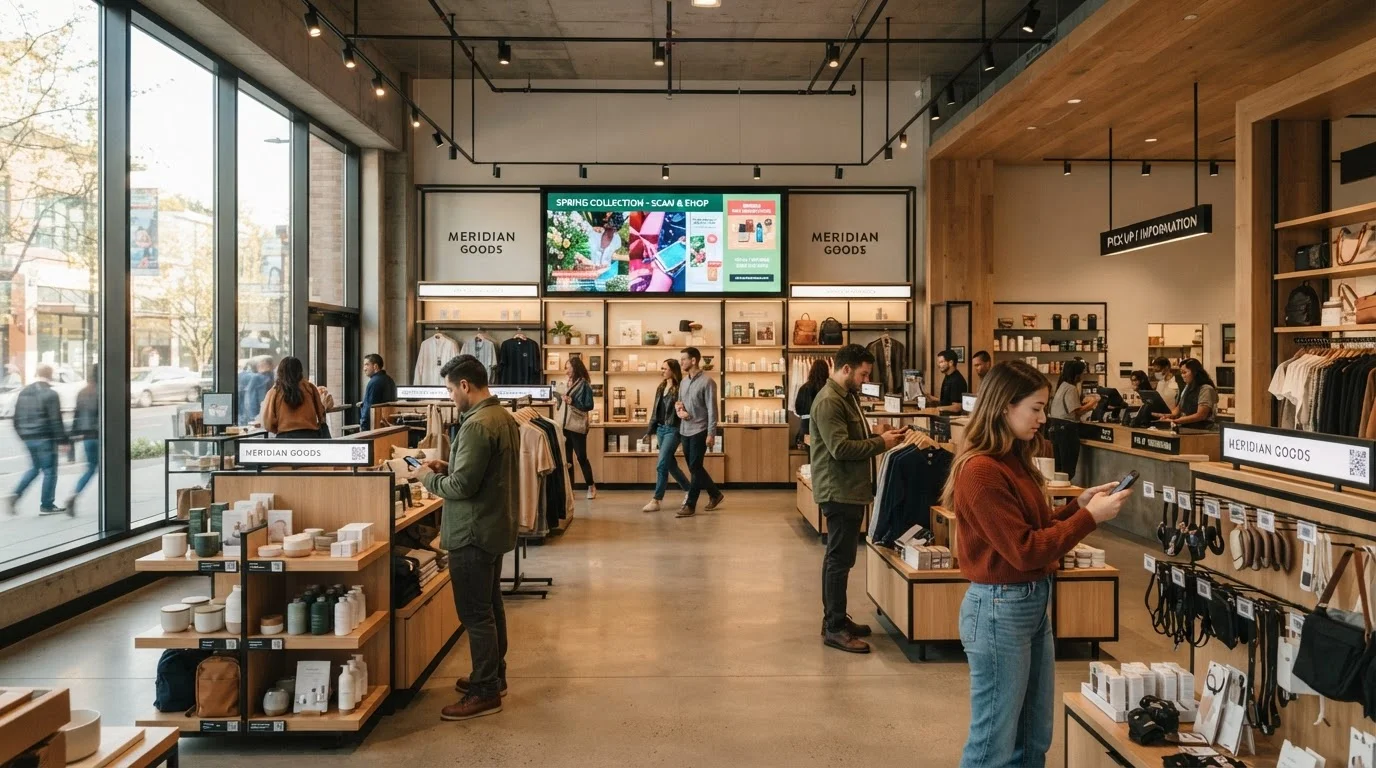
The most visible omnichannel feature for most shoppers is buy online, pick up in store (BOPIS). A customer purchases on the retailer's website and collects the order at a physical location - sometimes within hours. Closely related is curbside pickup, where the order is brought to the customer's vehicle. These services require real-time inventory visibility and coordinated fulfillment workflows that traditional store systems weren't designed for.
Returns are another major integration point. Many retailers now allow items purchased online to be returned in-store, which keeps customers engaged with the physical location and reduces the friction of shipping items back. Unified loyalty programs - where points earned online apply in-store and vice versa - are another sign of integrated systems at work.
Store layouts themselves are shifting. Some retailers have reduced floor space dedicated to product display and expanded back-of-house areas to handle order staging and fulfillment. Others have opened smaller format locations designed more as pickup hubs and showrooms than traditional stores.
~$94B
U.S. BOPIS market estimated value
Industry analysts have estimated the U.S. buy online, pick up in store market reached tens of billions of dollars annually, reflecting widespread consumer adoption of the format.
73%
Shoppers using multiple channels before buying
Research from Harvard Business Review found that a significant majority of retail customers use more than one channel during a single shopping journey.
10%+
Higher spending by omnichannel shoppers
Multiple retail studies have found that customers who engage across both digital and physical channels tend to spend more per transaction than single-channel shoppers.
The Consumer Expectations Driving the Change
Retail analysts broadly agree that consumer expectations - not just competitive pressure - are the engine behind omnichannel investment. Shoppers who experienced the convenience of fast, flexible online shopping during periods of restricted in-store access recalibrated what they consider acceptable from any retailer.
Flexibility is now a baseline expectation rather than a premium feature. A retailer that can't tell a customer whether an item is in stock at a nearby location, or that requires a mailed return for an online purchase, faces measurable disadvantage. This shift is especially pronounced among younger demographics, as detailed in our look at how Millennial and Gen Z shoppers differ.
It's also worth noting how the path to purchase has fragmented. Social platforms have become discovery engines - places where consumers encounter products before ever visiting a website or store. That dynamic, explored in our piece on discovery shopping and social media, adds yet another channel retailers must account for.
Trade-Offs and Tensions in the Transition
Building omnichannel capability is expensive and operationally complex. Retailers must invest in software that unifies inventory across warehouses and stores, train staff to handle fulfillment tasks alongside customer service, and redesign physical spaces. These costs are not evenly distributed - large chain retailers with existing technology infrastructure have adapted faster than smaller competitors.
For consumers, the transition brings its own trade-offs. Greater convenience - fast pickup, easy returns, flexible delivery - often comes with costs embedded elsewhere in pricing structures. Our piece on the convenience versus savings trade-off examines how those decisions play out at the individual level.
There are also workforce implications. Store employees increasingly perform roles that blend sales associate, warehouse picker, and customer service functions. That job redefinition has prompted ongoing conversations about training, compensation, and the nature of retail work itself.
Omnichannel Is Not the Same for Every Retailer
The term 'omnichannel' covers a wide spectrum. A grocery chain offering same-day delivery and a clothing brand allowing in-store app checkouts are both practicing omnichannel retail, but their implementations differ substantially. Shoppers may notice inconsistent experiences depending on which retailer they're dealing with and how far along that retailer is in its integration. Managing expectations accordingly can reduce friction.
Despite the complexity, the direction is clear: retail is not splitting into online and offline - it is consolidating into a single, channel-agnostic experience that meets shoppers wherever they are.
Frequently Asked Questions
It means you can start a shopping journey on your phone, continue it in a store, and finish it online without friction. Retailers aim to make transitions between channels smooth and consistent. In practice, this shows up as features like curbside pickup, in-store returns for online orders, and app-based loyalty programs.
Not exactly. Physical store traffic has shifted rather than simply dropped. Stores are playing a different role - acting as pickup points, return centers, and experience spaces alongside traditional browsing and buying. Many retailers report that customers who shop both in-store and online spend more overall than those who use only one channel.
Consumer behavior changed faster than most retailers anticipated, especially following the acceleration of e-commerce adoption in the early 2020s. Retailers that lack integrated channel experiences risk losing customers who expect flexibility. Competitive pressure from large e-commerce platforms has also pushed traditional retailers to upgrade their digital and logistics capabilities.
It can. When inventory and pricing systems are integrated, retailers can adjust prices more dynamically across channels. This connects to broader trends in <a href="/news-trends/industry-updates/the-shift-toward-dynamic-pricing-in-retail-and-what-it-means-for-shoppers">dynamic pricing</a>, where algorithms influence what you see online versus in-store.
Increasingly yes, though the complexity and cost depend on scale. Affordable point-of-sale platforms and third-party fulfillment services have lowered the barrier for small and mid-sized businesses to offer features like online ordering with local pickup. The gap between large chains and independent retailers, however, remains significant.
The content on this site is provided for informational purposes only and should not be considered a substitute for professional advice. While we strive to provide accurate and up-to-date information, we make no guarantees regarding its completeness or accuracy. Always consult a qualified professional for advice specific to your circumstances before making any decisions.