

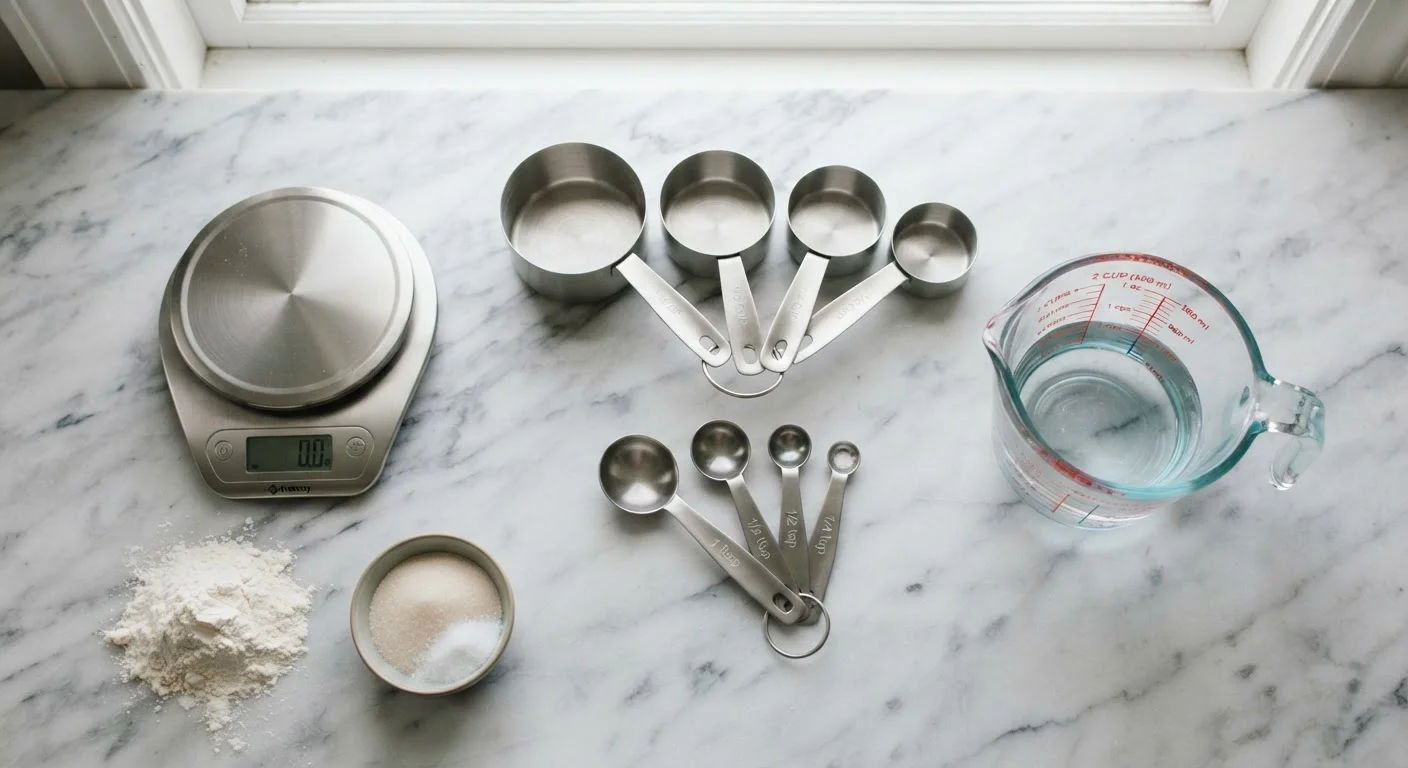
Volume vs. Weight: The Fundamental Difference
Every recipe measurement falls into one of two categories: volume (how much space an ingredient takes up) or weight (how heavy it actually is). In American home cooking, volume dominates-cups, tablespoons, and teaspoons are the default. Most other culinary traditions, and virtually all professional baking, rely on weight measured in grams or ounces.
Why does the distinction matter? Because the same volume of different ingredients can weigh vastly different amounts. One cup of all-purpose flour weighs roughly 120-130 grams when properly spooned and leveled, but if you scoop directly from the bag and pack it down, that same cup can approach 160 grams. A 25% error in flour alone is enough to turn a tender cake dense. Volume is convenient; weight is precise.
For everyday savory cooking-soups, stir-fries, pasta sauces-the difference rarely makes or breaks a dish. But for baking, where chemistry drives the outcome, weight measurements produce far more consistent results. As you build your skills, learning both systems gives you fluency with any recipe you encounter. See the full cooking fundamentals guide for how measurement fits into the broader picture of confident cooking.
Volume Measurements: Cups, Tablespoons, and Teaspoons
The U.S. volume system follows a logical hierarchy. Knowing these relationships lets you scale recipes up or down without a calculator:
- 1 cup = 8 fluid ounces = 16 tablespoons
- 1 tablespoon = 3 teaspoons
- ¼ cup = 4 tablespoons
- ½ cup = 8 tablespoons
Use dry measuring cups (the nested metal or plastic set) for flour, sugar, oats, and similar solids. Spoon the ingredient into the cup and level the top with a straight edge-never scoop directly, which compacts the ingredient. Use a liquid measuring cup (the clear pitcher-style cup with a spout) for water, milk, oil, and broth. Set it on a flat surface and read at eye level to avoid a parallax error.
Measuring spoons serve both liquids and solids. Fill them to the rim for solids; for sticky ingredients like honey or peanut butter, a light coat of cooking spray inside the spoon helps it slide out cleanly. A well-stocked kitchen toolkit should include a complete set of measuring spoons and both types of measuring cups.
Weight Measurements and When to Use Them
Weight measurement requires a kitchen scale-a modest investment that pays off quickly in baking accuracy. Digital scales that read in both grams and ounces are widely available and easy to use. The key technique is taring (zeroing out the scale after placing a bowl on it), so you measure only the ingredient, not the container.
Volume measurement
A way of measuring ingredients by how much space they occupy, using tools like cups, tablespoons, and teaspoons. Common in American home cooking for both liquids and solids.
Weight measurement
A way of measuring ingredients by their mass, typically in grams or ounces using a kitchen scale. More precise than volume, especially for baking.
Taring
The process of zeroing out a kitchen scale after placing a bowl or container on it, so only the ingredient's weight is recorded-not the container's.
Leveling
Sweeping excess ingredient off the top of a dry measuring cup with a straight edge so the measurement is accurate and not overflowing.
Fluid ounce
A unit of liquid volume equal to 2 tablespoons or one-eighth of a cup. Distinct from a weight ounce-the two are not interchangeable.
Mise en place
A French culinary term meaning 'everything in its place.' The practice of measuring and prepping all ingredients before cooking begins, reducing errors and improving flow.
Weight becomes especially important with these ingredient types:
- Flour and cocoa powder - highly compressible; volume measurements vary too much by technique.
- Cheese - shredded vs. finely grated yields very different volumes from the same weight.
- Meat and produce - recipes specifying "8 oz chicken breast" or "6 oz baby spinach" are clearer by weight than by cup.
- Chocolate - bar chocolate chopped at home has uneven volume; grams are unambiguous.
When a recipe gives both measurements (e.g., "1 cup / 120g all-purpose flour"), the gram figure is the more reliable target. If you're adapting an older American recipe that lists only cups, a reliable conversion chart or food reference database can help you find the standard weight equivalent.
Learning to read recipes accurately is equally important-understanding common cooking terminology goes hand-in-hand with using the right measurements.
Practical Tips for Consistent Measuring
A few habits separate cooks who get repeatable results from those who wonder why the same recipe turns out differently each time:
- Measure before you mix. Pre-measuring all ingredients-sometimes called mise en place-keeps you from losing count or over-pouring under pressure. Setting up your kitchen before you start cooking is a habit worth building early.
- Level dry ingredients. Use the back of a butter knife or a straight offset spatula to sweep excess off the top of a dry measuring cup.
- Don't eyeball small amounts. The difference between ¼ teaspoon and ½ teaspoon of baking soda or salt is significant. Use proper measuring spoons for anything under a tablespoon.
- Check your scale's accuracy. If you own a scale, periodically verify it reads zero with nothing on it. Most digital scales have an auto-calibration feature.
- Use the same technique every time. Consistency in method matters more than perfection-pick a technique and stick with it.
Pairing good measuring habits with solid knife skills puts you in a strong position to follow nearly any recipe with confidence.
The content on this site is provided for informational purposes only and should not be considered a substitute for professional advice. While we strive to provide accurate and up-to-date information, we make no guarantees regarding its completeness or accuracy. Always consult a qualified professional for advice specific to your circumstances before making any decisions.