

Start here
Why Knife Skills Come Before Everything Else
Next
How to Hold a Knife Correctly
Practice this
The Core Cuts Every Beginner Needs
Stay safe
Knife Safety Habits That Stick
Maintain your tools
Keeping Your Knife Sharp Enough to Be Safe
Why Knife Skills Come Before Everything Else
Nearly every recipe starts with prep: onions to dice, garlic to mince, carrots to chop. Before heat, seasoning, or timing comes into play, you're standing at a cutting board with a knife. That reality is why knife skills are the true foundation of home cooking - not a nice-to-have advanced technique, but a prerequisite for everything else.
Inconsistent cuts matter more than most beginners realize. When pieces are uneven, smaller bits overcook before larger ones are done. A dice that's all over the place produces a stew where some bites are mush and others are underdone. Uniform cuts mean uniform cooking - and uniform cooking means better-tasting food, consistently. See our cooking fundamentals overview for how knife work fits into the broader picture of confident everyday cooking.
How to Hold a Knife Correctly
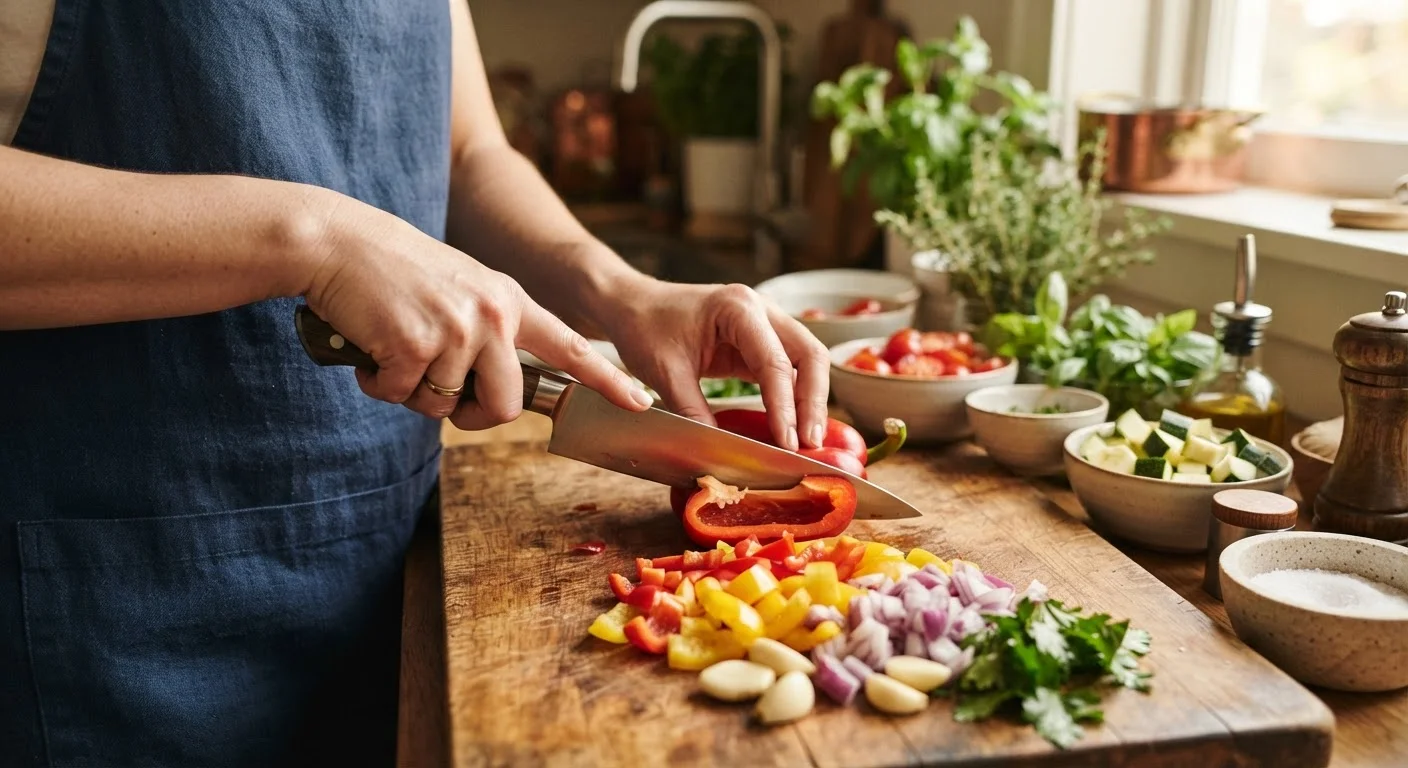
Most people grip a chef's knife like a hammer - wrapped around the handle. That grip actually gives you less control, not more. The correct technique is called the pinch grip: pinch the blade itself just above where it meets the handle, between your thumb and the bent side of your index finger, with your remaining three fingers wrapped around the handle.
It feels strange for about ten minutes. After that, it feels like the only sensible way to hold a knife. The pinch grip lowers the center of gravity, reduces wrist fatigue, and gives you direct feedback on where the blade is pointing.
Your non-knife hand is equally important. Use the claw position: curl your fingertips under so your knuckles face outward and act as a guide for the blade. The flat side of the knife blade rests lightly against your knuckles as you cut. Your fingertips are never exposed. Practice this deliberately on the first ten cuts of every cooking session until it becomes automatic.
Practice the Claw on Something Forgiving
Zucchini, cucumbers, and bananas are soft and low-risk - ideal for building the claw habit before moving to harder vegetables like carrots or beets. Spend five minutes with a zucchini before your first real recipe and the muscle memory will start to form. Consistency in that one hand position pays off quickly.
The Core Cuts Every Beginner Needs
You don't need a culinary school vocabulary. You need three cuts that together handle nearly everything a home recipe asks for.
Pinch grip
A knife-holding technique where you pinch the blade itself - just above the handle - between your thumb and index finger for maximum control.
Claw position
A hand position for the non-knife hand where fingertips are curled under and knuckles face forward, acting as a safe guide rail for the blade.
Dice
A knife cut that produces uniform cubes of food, typically described as small (¼ inch), medium (½ inch), or large (¾ inch).
Mince
A very fine knife cut, used most often for garlic, shallots, and fresh herbs, that releases maximum flavor quickly during cooking.
Honing
Using a honing steel to realign a knife's edge - this maintains sharpness between sharpenings but does not remove metal or restore a dull blade.
Julienne
An intermediate cut that produces thin, uniform matchstick strips of food, often used as a step toward producing a fine dice.
The Chop
A rough chop produces irregular pieces in the general size range specified - "roughly chopped" means size doesn't need to be precise. Use a rocking motion: keep the tip of the knife on the board and rock the heel down through the food. This is fast and appropriate for soups, stews, and anything pureed.
The Dice
A dice produces uniform cubes. Start by cutting planks (slices of even thickness), then cut those planks into sticks (julienne), then cut across the sticks to produce cubes. A small dice is about ¼ inch, a medium dice is about ½ inch, and a large dice is about ¾ inch. When a recipe says "diced onion," medium dice is typically assumed.
The Mince
Mincing means cutting as finely as possible. After rough-chopping garlic or herbs, keep one hand on the spine of the blade and rock the knife back and forth over the pile, gathering it back to center periodically with the blade. This produces the fine texture that releases maximum flavor in a short cook time.
For a fuller picture of how prep terms appear in recipes, see reading a recipe without getting tripped up by cooking terminology.
Knife Safety Habits That Stick
Safety in knife work isn't about being timid - it's about building a few reliable habits that become invisible with practice.
- Stabilize your cutting board. Place a damp towel or a non-slip mat underneath. A sliding board causes accidents immediately.
- Create flat surfaces first. Any round vegetable - an onion, a potato, a beet - should be halved first so it sits flat and stable.
- Never catch a falling knife. If a knife goes over the edge of a counter, step back and let it fall. Catching it reflexively is how serious cuts happen.
- Walk with a knife pointing down. Blade down, edge facing back toward you, close to your body.
- Don't leave knives in soapy water. Hidden under suds, a knife edge can catch a hand reaching in. Wash and dry knives immediately after use.
Once you have the basics down, building out a proper prep workflow pays dividends. The concept of having everything prepped before you start cooking is explored in setting up your kitchen before you cook.
Keeping Your Knife Sharp Enough to Be Safe
A dull knife is the most dangerous tool in the kitchen. It requires excess force to cut, which means any slip sends the blade somewhere unintended. A sharp knife moves through food with minimal pressure and stays where you direct it.
Two tools maintain a knife's edge: a honing steel and a sharpener. They are not the same thing. Honing realigns the microscopic edge of a blade that's already sharp but has been bent slightly through use - run the blade down the steel at a consistent 15-20 degree angle, alternating sides, a few strokes before each cooking session. Sharpening actually removes metal to create a new edge on a blade that has gone genuinely dull - this is needed only a few times a year for most home cooks.
Store knives on a magnetic strip or in a knife block, not loose in a drawer where edges bang against other utensils. A knife that's cared for consistently will perform reliably for years. For guidance on equipping your kitchen more broadly, see essential equipment for a functional home kitchen.
Frequently Asked Questions
The pinch grip means holding the blade itself - just above the bolster - between your thumb and the side of your index finger, with your remaining fingers wrapped around the handle. It gives you far more control and reduces hand fatigue compared to gripping only the handle. Most professional cooks use it automatically.
A chop produces rough, irregular pieces - size is approximate and doesn't matter much. A dice means cutting food into uniform cubes, typically small (¼ inch), medium (½ inch), or large (¾ inch). A mince means cutting as finely as possible, usually applied to garlic, shallots, or fresh herbs.
Yes. A dull knife requires more downward pressure to cut through food, which means it's more likely to slip off a surface and contact your hand. A sharp knife glides with minimal effort, giving you far better control over where the blade goes.
They do different things. Honing realigns the edge of a blade that's already sharp but has become slightly bent from use - it doesn't remove metal. Sharpening actually grinds a new edge onto a blade that has become dull. Hone frequently; sharpen a few times a year.
Wood and plastic boards are both fine for everyday use. Avoid glass, ceramic, or stone surfaces - they destroy an edge very quickly. Wood boards are gentler on blades and self-healing to a degree, but plastic boards are easier to sanitize thoroughly.
Slice a flat face onto any round vegetable first - cut it in half and set the flat side down. That single step eliminates the rolling problem and makes every subsequent cut far more stable and controlled.
The content on this site is provided for informational purposes only and should not be considered a substitute for professional advice. While we strive to provide accurate and up-to-date information, we make no guarantees regarding its completeness or accuracy. Always consult a qualified professional for advice specific to your circumstances before making any decisions.