

Summary
22 items · 20-40 minutes
Why Your Tool List Matters More Than Your Recipe List
Most home cooks accumulate tools gradually - an impulse buy here, a holiday gift there - and end up with cluttered drawers full of gadgets they rarely touch. The result is a kitchen that feels disorganized even before cooking starts. A more intentional approach is to define a functional baseline: the specific tools that cover the widest range of everyday recipes without redundancy.
This checklist is designed to help you audit what you have, identify genuine gaps, and make smarter decisions about what to add. Before going through it, it helps to understand how kitchen setup and workflow connect - see how mise en place transforms your cooking experience for a strong companion read.
Work through each category below and mark what you own, what you're missing, and what you can prioritize based on the recipes you cook most often.
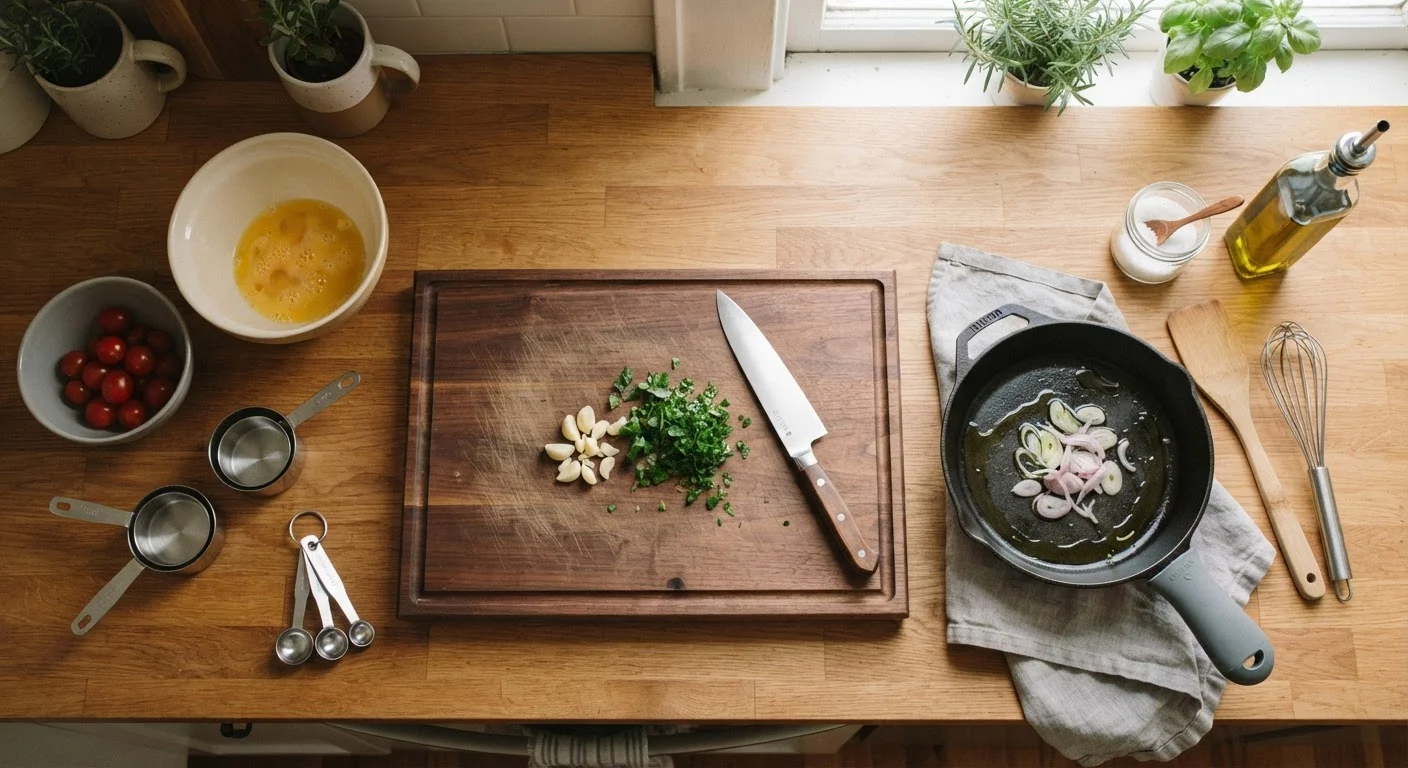
Chef's Knife (8-inch)
Handles the majority of chopping, slicing, and dicing tasks across nearly every recipe.
Large Cutting Board
Provides a stable, hygienic surface for all prep work and protects countertops.
12-inch Skillet
Used for searing, sautéing, and building pan sauces - the single most-used piece of cookware.
Measuring Cup & Spoon Set
Ensures accurate ingredient quantities for consistent, repeatable cooking results.
Rimmed Half-Sheet Pan
Handles roasting, baking, and sheet-pan meals - one of the most versatile oven tools available.
Digital Kitchen Scale
Provides weight-based measurements that are more accurate than volume for baking.
Instant-Read Thermometer
Confirms safe internal temperatures in meat, poultry, and fish without guessing.
Dutch Oven (5-7 quart)
Enables braising, soups, and slow-cooked dishes that develop deeper flavor over time.
The Essential Equipment Checklist
The items below are organized by function. Must items are foundational - missing them will make everyday cooking significantly harder. Should items handle common tasks that come up frequently. Nice-to-have items add convenience but have reasonable workarounds.
Cutting & Prep
Cookware
Measuring & Mixing
Baking & Oven Tools
Handheld Utensils & Gadgets
Once you've confirmed your knife kit is solid, sharpen your technique too - core knife skills every home cook needs will make your prep faster and safer from day one.
Don't Skip the Instant-Read Thermometer
Judging doneness by look or touch alone is unreliable and can result in undercooked meat or poultry. An instant-read thermometer is an inexpensive tool that removes all guesswork and is one of the most meaningful safety investments a home cook can make. The USDA publishes safe minimum internal temperature guidelines for different proteins - keep them accessible in your kitchen.
How to Use This List Without Overbuying
Resist the urge to purchase everything at once. Instead, cross-reference this checklist against the recipes you cook most in a typical week. If you rarely bake, a digital kitchen scale is a lower priority than if you make bread regularly. If you cook for one or two people, a 10-inch skillet is often more practical than a 12-inch.
Consistent cooking also depends on being precise. Measuring tools, in particular, matter more than most beginners expect - how to navigate volume and weight measurements explains when each system applies and why it changes your results. And if you want to understand how all these tools connect to broader technique, the cooking fundamentals that make recipes easier to follow ties it all together.
Finally, building out your kitchen doesn't have to strain your grocery or household budget. Smart spending strategies - like buying multipurpose pieces first - align well with practical ways households trim costs without sacrificing quality.
The content on this site is provided for informational purposes only and should not be considered a substitute for professional advice. While we strive to provide accurate and up-to-date information, we make no guarantees regarding its completeness or accuracy. Always consult a qualified professional for advice specific to your circumstances before making any decisions.