

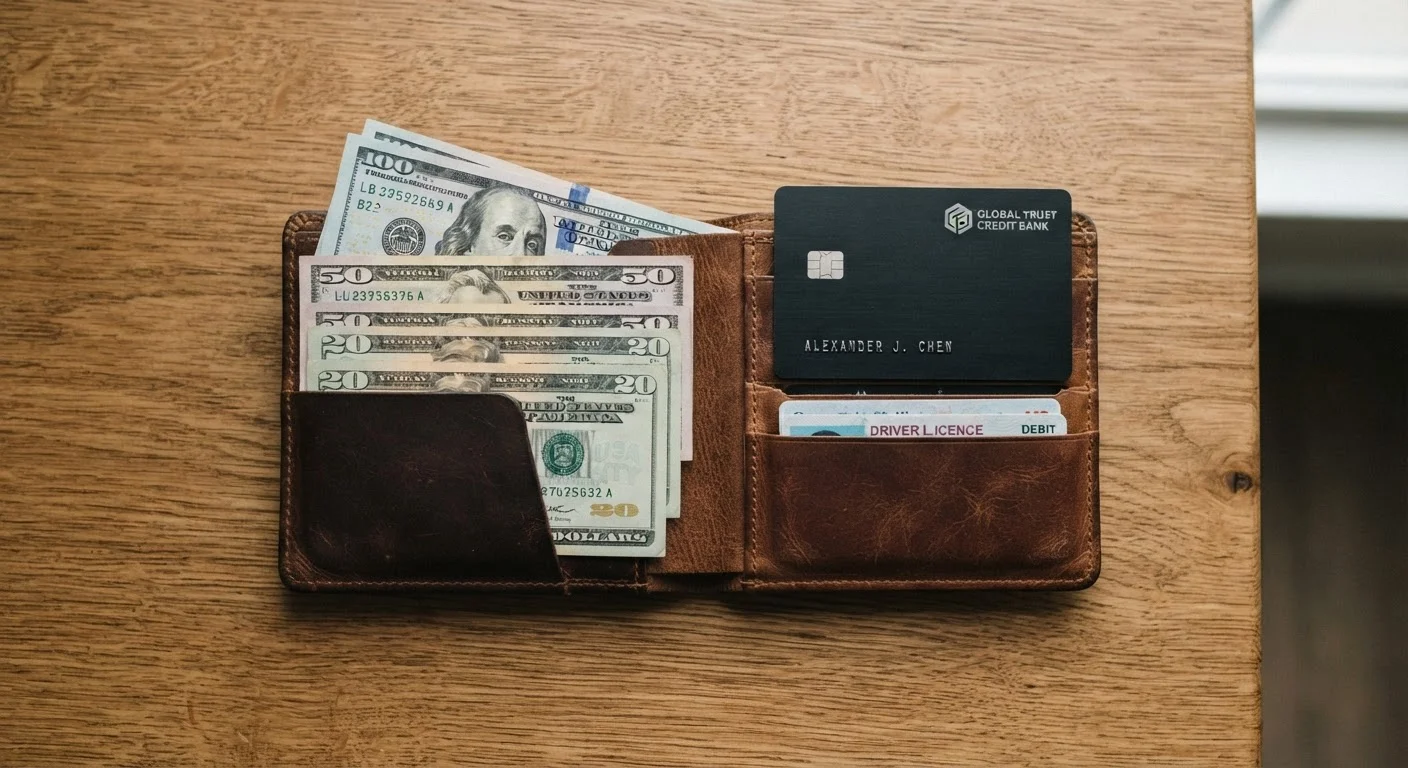
Option A
Paying Cash
The tangible, spend-what-you-have approach.
Best for: Shoppers who want hard spending limits and are open to negotiating cash discounts on larger purchases.
Option B
Using a Credit Card
The rewards-earning, protection-rich option for disciplined payers.
Best for: Consumers who pay their balance in full monthly and want to earn rewards or gain purchase protections.
The Case for Paying Cash
Cash carries a practical edge that gets overlooked in the age of tap-to-pay: some sellers will charge you less for using it. Businesses - particularly independent service providers, auto repair shops, and local retailers - often pay credit card processing fees ranging from roughly 1.5% to 3.5% of each transaction. When a business offers a cash discount, it's passing that savings directly to you.
Beyond price negotiation, behavioral research from consumer psychology studies suggests that spending physical money feels more psychologically "painful" than swiping a card, which tends to result in more deliberate purchasing decisions. This friction isn't a flaw - for shoppers who find it hard to stick to a budget, cash's built-in spending ceiling can be the most effective savings tool available.
Cash is also worth considering in specific contexts: farmers markets, local services, and small businesses where card minimums or surcharges apply. For a deeper look at how payment method affects your broader protections, see our payment protection comparison.
The Case for Using a Credit Card
For consumers who reliably pay their full statement balance each month, a credit card can function as a genuine savings tool. Cashback cards typically return 1-2% on general purchases, while category-specific cards may return more on groceries or gas. On $15,000 of annual spending, even a flat 1.5% cashback rate represents $225 returned - money that cash users simply forgo.
Beyond rewards, credit cards offer consumer protections that cash cannot match: federal chargeback rights under the Fair Credit Billing Act, zero fraud liability on most cards, and purchase protection or extended warranty features on select products. If a retailer fails to deliver or a fraudulent charge appears, card users have a clear dispute mechanism. Cash buyers generally do not.
| Criterion | Paying Cash | Using a Credit Card |
|---|---|---|
| Fraud protection | None - lost cash is gone | Zero liability on most cards |
| Rewards or cashback | None | Typically 1-5% depending on card |
| Risk of overspending | Low - hard spending ceiling | Higher - reduced spending friction |
| Cash discounts available | Yes, at select businesses | No - may incur surcharges |
| Interest cost risk | None | High if balance carried (20-25% APR) |
| Purchase dispute rights | None | Federal chargeback rights apply |
| Accepted everywhere | Nearly universal | Some small vendors decline cards |
The critical caveat: carrying a balance changes the math entirely. A card charging 20-25% APR will consume any rewards earned - and then some - within the first billing cycle you don't pay in full. Rewards only benefit those who treat the card like a debit card, spending only what they already have. For more on how debit and credit cards differ in practice, the real difference between a debit card and a credit card is worth reading.
Where Spending Psychology Changes the Equation
No payment comparison is complete without acknowledging how each method influences behavior. Multiple consumer studies - including work published by researchers at MIT and Carnegie Mellon - have found that card payments reduce the psychological "pain of paying," leading to higher spending totals than equivalent cash transactions. This effect doesn't disappear for experienced card users; awareness of the tendency helps, but doesn't fully neutralize it.
This matters practically: if using a credit card leads you to spend $50 more per grocery run, a 2% cashback reward of $1 doesn't offset that behavioral cost. The savings calculus has to account for what you actually spend, not just the reward rate on what you planned to spend. Shoppers interested in how invisible trade-offs shape their decisions may find our article on the convenience vs. savings trade-off useful context.
One honest middle-ground approach: use cash for discretionary, impulse-prone categories (dining out, entertainment) and a credit card for fixed, predictable expenses (subscriptions, utilities) where behavioral overspending isn't a variable. This hybrid method lets disciplined consumers capture some rewards without handing over behavioral control.
Which Method Actually Wins?
There is no single correct answer - which is itself the most important finding. The payment method that saves you more money is the one that aligns with your actual financial habits, not your idealized ones. A rewards card in the hands of a full-balance payer generates genuine value. The same card in the hands of someone carrying a balance becomes one of the most expensive payment tools available.
Cash, meanwhile, isn't just a fallback - it's a structurally sound strategy for anyone who benefits from hard spending limits or regularly makes purchases where cash discounts are available. It also sidesteps the risks explored in adjacent payment models; for perspective on how deferred payment plans compare, our coverage of what BNPL really costs American shoppers provides useful contrast.
Evaluate your own payment history honestly. If your card balance carries forward month to month, cash is almost certainly the financially safer choice. If your balance hits zero every statement period, the rewards and protections of a credit card represent real, quantifiable value you're otherwise leaving on the table.
This article is for general informational purposes only and does not constitute financial advice. Consult a qualified financial professional for guidance specific to your situation.
The content on this site is provided for informational purposes only and should not be considered a substitute for professional advice. While we strive to provide accurate and up-to-date information, we make no guarantees regarding its completeness or accuracy. Always consult a qualified professional for advice specific to your circumstances before making any decisions.