

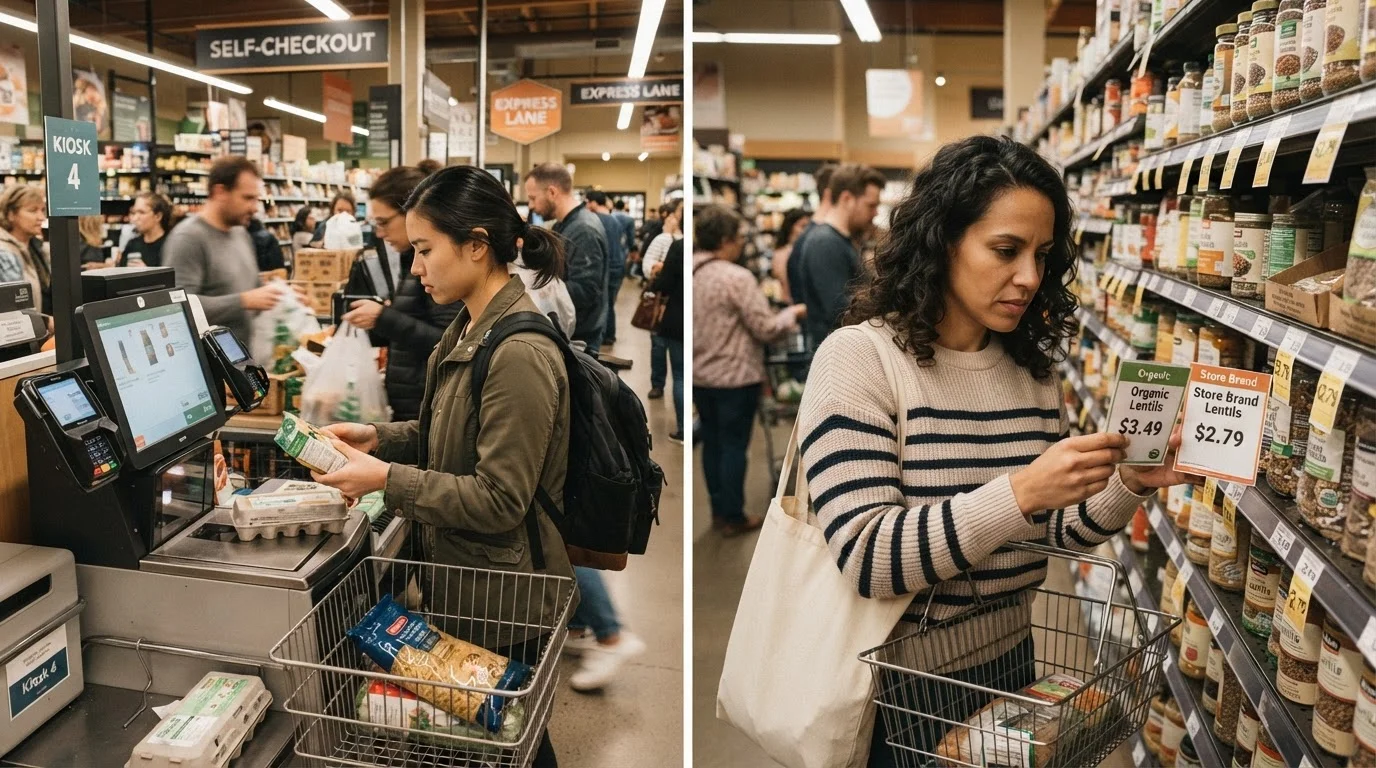
Option A
Convenience Shopping
The frictionless, time-saving default.
Best for: Shoppers who prioritize speed, ease, and reduced mental load over unit price.
Option B
Savings-Focused Shopping
The deliberate, cost-minimizing approach.
Best for: Shoppers willing to invest planning time and flexibility in exchange for meaningfully lower spending.
Convenience Is a Product, Not Just a Feature
Modern retail has become extraordinarily good at removing friction from the path to purchase. One-click ordering, same-day delivery, auto-replenishment subscriptions, app-based checkout - every layer of ease added to the shopping experience carries a cost that is rarely made explicit at the point of sale.
That cost takes several forms. Delivery fees and service charges are the most visible, but markups on convenience-oriented formats - corner stores, gas station mini-marts, pre-cut or pre-portioned grocery items - are structural and persistent. A bag of pre-washed salad greens can cost two to three times more per ounce than a whole head of lettuce. A single-serve yogurt cup typically runs higher per unit than a larger container of the same brand. These are not accidents; they reflect how retailers price the labor and packaging that make the product easier to use.
Understanding this framing matters. As retail pricing psychology research shows, shoppers tend to evaluate prices relative to immediate alternatives rather than in aggregate. A $4.99 delivery fee feels trivial on a single order but adds up to over $250 annually if triggered weekly.
How the Two Approaches Stack Up
Comparing convenience shopping to savings-focused shopping side by side reveals how differently each approach distributes cost - and effort.
| Criterion | Convenience Shopping | Savings-Focused Shopping |
|---|---|---|
| Unit price paid | Generally higher | Generally lower |
| Time required | Minimal | Moderate to significant |
| Planning needed | Little to none | Consistent effort required |
| Flexibility required | Low | High |
| Hidden fees | Common (delivery, service charges) | Rare |
| Access requirements | Internet or nearby store | Multiple store options, transport |
| Annual cost impact | Potentially hundreds more | Savings compound over time |
The table above captures the structural differences, but the real-world gap depends heavily on individual behavior. Savings-focused shopping is not uniformly accessible. It requires a degree of schedule flexibility, access to multiple store options, and the cognitive bandwidth to track prices, plan meals, and time purchases around seasonal discount cycles. For many households - particularly those with irregular work hours, caregiving responsibilities, or limited transportation - convenience is not a preference but a practical necessity.
The Invisible Accumulation Effect
Where convenience costs do the most damage is in their invisibility. Unlike a single large purchase that prompts deliberate consideration, convenience premiums are distributed across dozens of small transactions that rarely trigger scrutiny. A $3 markup here, a $1.50 surcharge there, a subscription service that auto-renews at a higher tier - these are the quiet habits that erode savings plans without announcing themselves.
Consumer behavior researchers describe this as the aggregation problem: people are far better at evaluating single transactions than at estimating what a pattern of small decisions costs in total. A shopper who feels financially careful may still be spending hundreds of dollars a year in convenience premiums simply because no individual charge felt large enough to reconsider.
~$1,000+
Estimated annual convenience premium per U.S. household
Consumer financial analysis from multiple household budget studies suggests convenience-related markups and fees can collectively exceed $1,000 per year for average American households.
2-3×
Price premium for pre-prepared grocery items vs. whole equivalents
Grocery industry pricing data consistently shows pre-cut, pre-portioned, or ready-to-eat items cost significantly more per unit than their unprocessed counterparts.
~35%
U.S. shoppers who regularly use grocery or retail delivery services
Survey data from U.S. commerce and retail research firms indicates roughly a third of American consumers use delivery or same-day fulfillment services at least monthly.
This mirrors a broader pattern documented in spending data across American households: fewer purchases, higher price tags, and a persistent sense that money disappears faster than expected.
Finding a Sustainable Balance
The goal is not to eliminate convenience - that framing is unrealistic and unhelpful. A more durable approach is intentional selection: identifying which convenience premiums are genuinely worth the time they save, and which are habitual rather than considered.
Some practical entry points: auditing subscription services annually, comparing unit prices rather than total prices when grocery shopping, and reserving delivery services for situations where time constraints are real rather than perceived. The practical grocery tactics used by cost-conscious households often involve modest planning steps - not dramatic deprivation.
It also helps to recognize that the convenience-versus-savings trade-off is not static. Life circumstances change. A period of tighter finances might warrant a more deliberate approach; a particularly demanding stretch of work might justify leaning into convenience temporarily. The shoppers who navigate this trade-off well tend to revisit their defaults periodically rather than locking into one mode indefinitely.
What becomes clear through this lens is that neither approach is a moral stance. Convenience shopping is not laziness, and savings-focused shopping is not virtue. Both are rational responses to real constraints - the question is whether those constraints are being examined honestly or assumed automatically.
This article is for informational purposes only. Individual financial circumstances vary; consider consulting a financial professional for personalized guidance.
The content on this site is provided for informational purposes only and should not be considered a substitute for professional advice. While we strive to provide accurate and up-to-date information, we make no guarantees regarding its completeness or accuracy. Always consult a qualified professional for advice specific to your circumstances before making any decisions.