

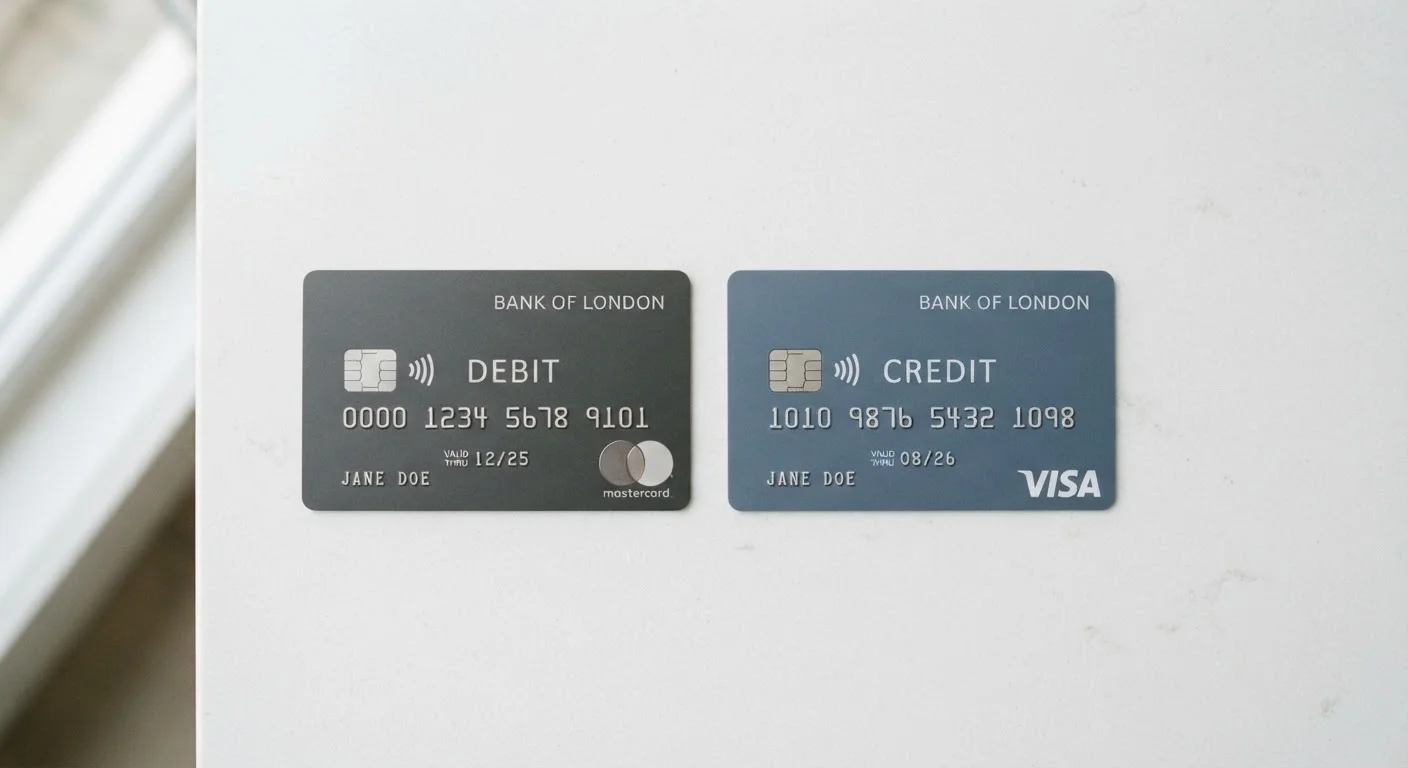
Option A
Debit Card
The direct-access card tied to your own money.
Best for: Everyday purchases when you want to spend only what you already have in your checking account.
Option B
Credit Card
The borrowed-funds card that comes with stronger consumer protections.
Best for: Larger purchases, travel bookings, and situations where fraud protection and dispute rights matter most.
How Each Card Actually Works
Despite looking nearly identical in your wallet, a debit card and a credit card operate through entirely different financial mechanisms.
When you swipe a debit card, the transaction pulls funds directly from your linked checking account - usually within seconds. If your balance is insufficient, the transaction is declined (or, if you've opted into overdraft coverage, you may incur a fee). There is no bill at the end of the month because the money is already gone.
A credit card works differently. You are borrowing money from a card issuer up to a pre-approved credit limit. You receive a monthly statement and have the option to pay the full balance, the minimum due, or something in between. Paying less than the full amount means interest charges - often at rates well above 20% annually - begin accumulating on the remaining balance.
Understanding this distinction is the foundation. Everything else - fraud protection, credit building, spending psychology - flows from it. For a broader look at how these two compare against cash, see which payment method offers the most protection.
| Criterion | Debit Card | Credit Card |
|---|---|---|
| Funding source | Your checking account balance | Issuer's line of credit |
| Fraud liability law | EFTA - time-sensitive caps | FCBA - max $50, often $0 |
| Risk of debt | None (spend what you have) | Yes, if balance isn't paid in full |
| Builds credit history | No | Yes, with responsible use |
| Monthly bill | No bill | Statement due each month |
| Best for | Daily spending, budget control | Travel, large purchases, credit building |
Fraud Protection: Where the Gap Is Real
One of the most consequential differences between debit and credit cards is how U.S. law treats unauthorized transactions - and how quickly you must act.
Under the Fair Credit Billing Act (FCBA), credit card holders are generally liable for no more than $50 of unauthorized charges, and most major issuers offer zero-liability policies voluntarily. Disputes can be initiated after the fact because the money hasn't left your account yet - you're disputing a charge on a statement.
Debit cards fall under the Electronic Fund Transfer Act (EFTA), which ties your liability directly to how quickly you report the fraud. Report within two business days, and your liability is capped at $50. Wait between two and 60 days, and that cap rises to $500. Beyond 60 days, you could be responsible for the full amount. Crucially, debit fraud means real money has already left your account - your rent or grocery funds could be frozen while the bank investigates, which may take days.
This doesn't mean debit cards are unsafe. It means timing and vigilance matter significantly more when a debit card is compromised.
Credit Building, Budgeting, and the Psychology of Spending
One area where credit cards hold a clear functional advantage is credit history. Your credit score - used by landlords, lenders, and sometimes employers - is built primarily from how you manage borrowed money. Debit card activity is not reported to credit bureaus and has no effect on your score, positive or negative.
Paying a credit card balance in full each month is one of the most straightforward ways to demonstrate responsible borrowing. Doing so avoids interest entirely and, over time, can meaningfully strengthen your credit profile.
That said, credit cards introduce a genuine behavioral risk. Research in consumer psychology consistently suggests people tend to spend more when using credit rather than cash or debit - the psychological pain of payment is reduced when money doesn't leave your account immediately. For people managing tight budgets or building new financial habits, this is worth taking seriously.
Debit cards enforce a hard ceiling: you cannot spend what you don't have (absent overdraft). That constraint is a feature for many users, not a limitation. For a closer look at how cash fits into this picture, paying cash versus using a credit card breaks down the spending psychology in more detail.
If you're making travel purchases specifically, the protection differences between payment types can be especially meaningful - similar to how travel insurance and trip cancellation coverage each protect you in distinct ways depending on timing and circumstances.
The content on this site is provided for informational purposes only and should not be considered a substitute for professional advice. While we strive to provide accurate and up-to-date information, we make no guarantees regarding its completeness or accuracy. Always consult a qualified professional for advice specific to your circumstances before making any decisions.