

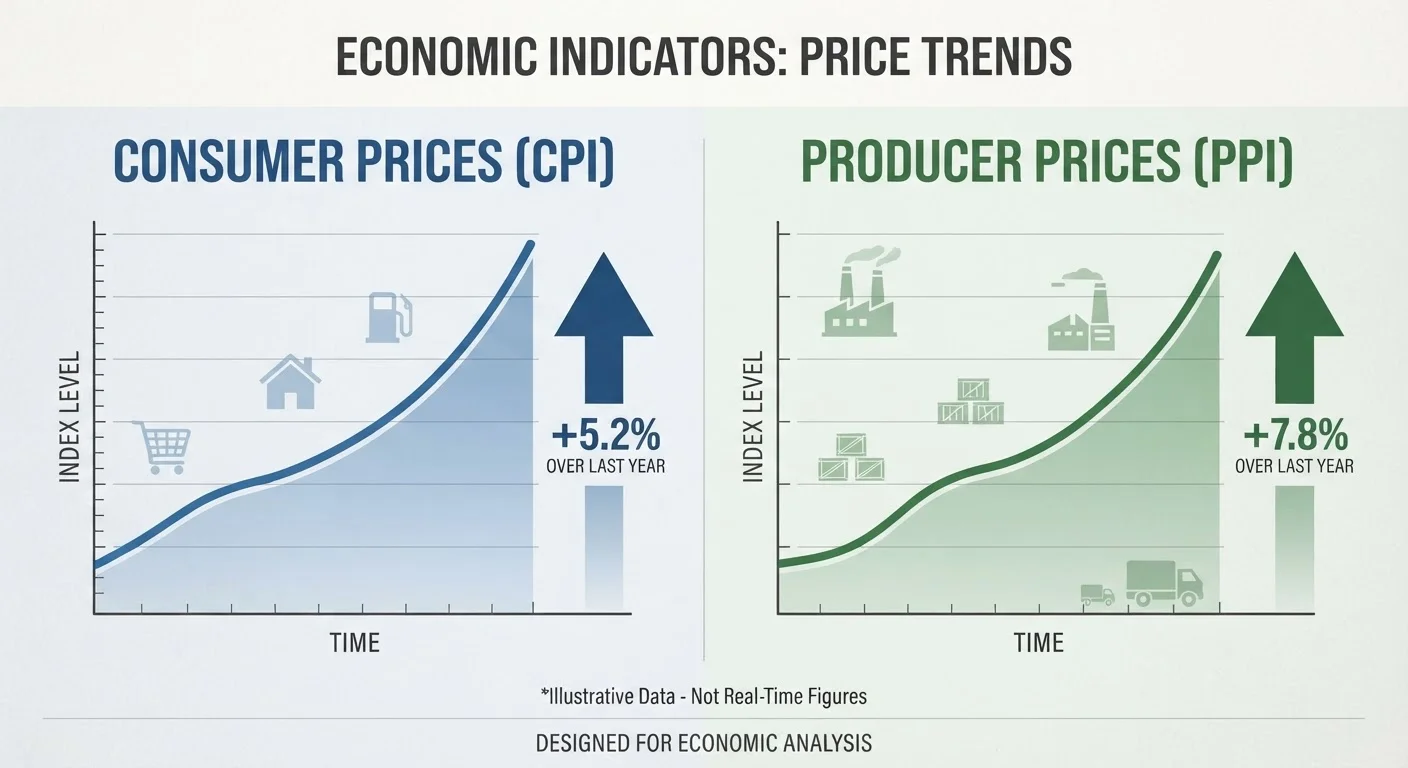
Option A
Consumer Price Index (CPI)
The household-level inflation gauge.
Best for: Understanding how much more everyday Americans are paying for goods and services at the retail level.
Option B
Producer Price Index (PPI)
The upstream, business-facing price signal.
Best for: Tracking price pressures entering the supply chain before they reach store shelves.
What Each Index Actually Measures
Both the Consumer Price Index and the Producer Price Index are published monthly by the U.S. Bureau of Labor Statistics (BLS), and both track price changes over time. But they observe prices at entirely different points in the economic chain.
The CPI measures the average change in prices that urban consumers pay for a representative basket of goods and services - things like groceries, gasoline, rent, medical care, and clothing. The BLS surveys thousands of retail outlets and service providers to compile this data. It's the number most often cited when news reports talk about inflation affecting everyday Americans.
The PPI, by contrast, measures the average change in selling prices received by domestic producers for their output. This includes raw materials, intermediate goods (components used to make finished products), and finished goods before they reach retail. Think lumber prices at the mill, wheat prices at the farm gate, or steel prices at the foundry.
In plain terms: CPI tells you what the checkout line costs you today. PPI tells you what inputs cost businesses further up the supply chain - often before those costs work their way to consumers. For a broader guide to parsing these numbers in context, see how to read an inflation report without an economics degree.
How the Two Indexes Relate - and Why the Gap Matters
Economists and analysts frequently read CPI and PPI side by side because of the pipeline relationship between them. When producer prices rise sharply, businesses eventually pass those higher costs to consumers - meaning a PPI spike can foreshadow a CPI increase weeks or months later.
This lag isn't guaranteed or perfectly predictable. Businesses may absorb some cost increases by accepting lower margins, adjust their product mix, or negotiate differently with suppliers. But sustained divergences between the two indexes are worth paying attention to.
| Criterion | CPI | PPI |
|---|---|---|
| What it measures | Retail prices paid by consumers | Prices received by domestic producers |
| Stage of supply chain | End of chain (retail) | Earlier stages (raw, intermediate, finished) |
| Who it most affects | Households and budget planners | Businesses, investors, policymakers |
| Published by | U.S. Bureau of Labor Statistics | U.S. Bureau of Labor Statistics |
| Frequency | Monthly | Monthly |
| Forward-looking signal | Reflects current consumer costs | Often predicts future consumer prices |
| Housing treatment | Owners' equivalent rent (survey-based) | Not directly included |
A case where PPI rises faster than CPI over several months often suggests that either businesses are absorbing costs or that competitive pressure is keeping retail prices in check - at least temporarily. When the gap reverses and CPI catches up, consumers may feel a delayed but concentrated price increase.
Conversely, when CPI rises but PPI is flat, the price pressure may be coming from retail-level factors - like labor costs at service businesses - rather than from raw material costs upstream. That distinction matters for understanding common myths about rising prices that mislead everyday shoppers.
What the Indexes Don't Capture
Neither index is a complete picture of economic reality, and each has documented limitations worth understanding.
The CPI has been criticized for how it handles housing costs. It uses a measure called owners' equivalent rent - a survey-based estimate of what homeowners would pay if they rented their own homes - rather than actual home prices or mortgage payments. This can cause CPI to understate or overstate housing inflation depending on market conditions. For a deeper look at this, housing costs vs. general inflation explains why those two figures so often diverge.
The PPI, meanwhile, focuses on domestic producer prices and may not fully capture import price changes or global commodity swings until they ripple through domestic supply chains. It also doesn't directly measure what consumers experience at the retail counter.
A Note on Federal Reserve Policy
The Federal Reserve monitors both CPI and PPI when making interest rate decisions, but its primary inflation target is tied to a separate measure called the Personal Consumption Expenditures (PCE) price index. Understanding how rate decisions connect to price indexes - and why the relationship isn't always intuitive - is explored further in interest rates and consumer prices. Readers should be aware that no single index drives Fed decisions in isolation.
Both indexes also reflect national averages. Local price conditions - whether you live in a high-cost urban area or a rural market - can differ significantly from the headline figures. Shoppers who want to apply inflation data to their own budgets should treat these indexes as directional signals, not precise personal cost calculators. Tools like unit pricing at the grocery store offer a more immediate way to assess whether prices in your cart are shifting.
The content on this site is provided for informational purposes only and should not be considered a substitute for professional advice. While we strive to provide accurate and up-to-date information, we make no guarantees regarding its completeness or accuracy. Always consult a qualified professional for advice specific to your circumstances before making any decisions.