

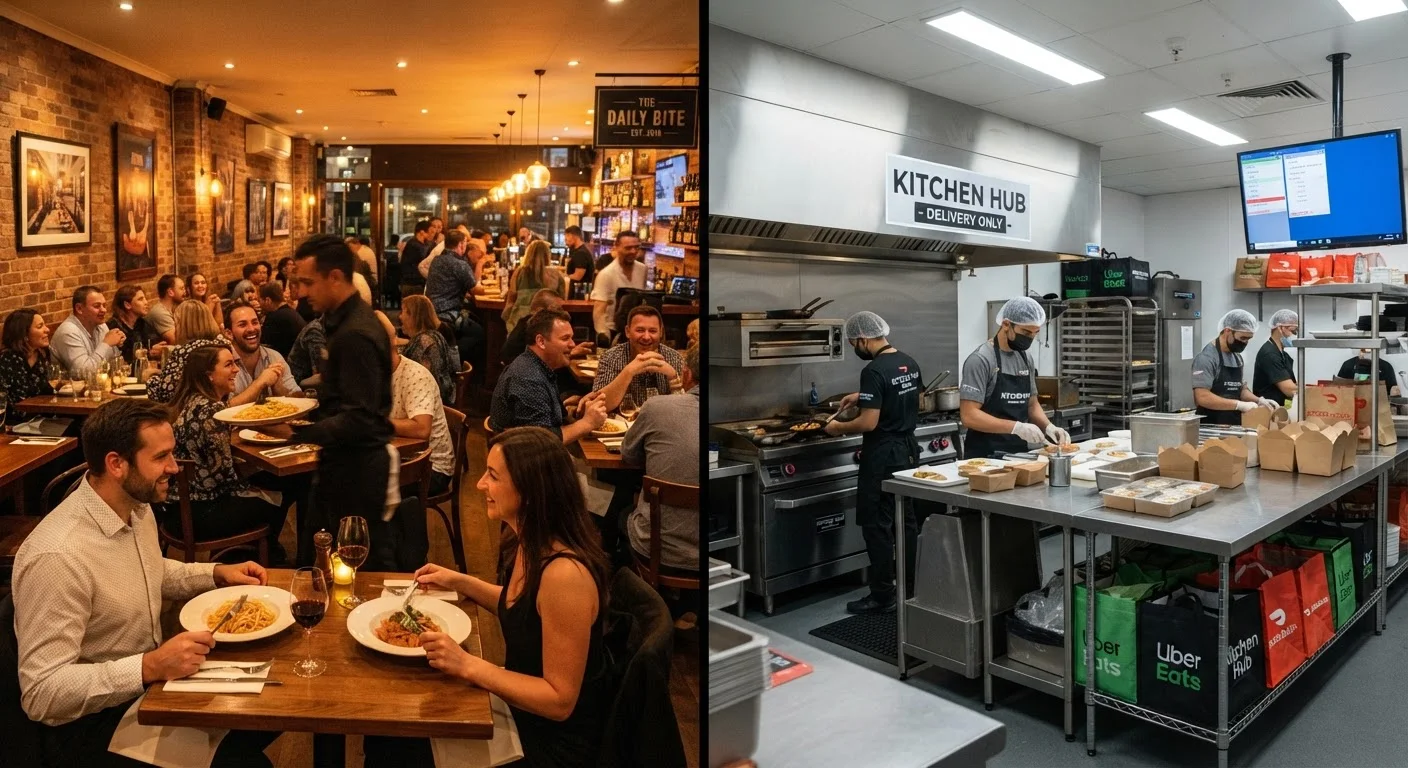
Option A
Ghost Kitchens
The delivery-only, storefront-free food operation.
Best for: Diners who prioritize convenience, variety, and ordering from home over ambiance or in-person service.
Option B
Traditional Restaurants
The full-service, brick-and-mortar dining experience.
Best for: Diners who value atmosphere, direct service, and a social or occasion-based meal experience.
What Is a Ghost Kitchen, Exactly?
A ghost kitchen - also called a virtual kitchen or dark kitchen - is a food preparation facility with no public dining area. Cooks produce meals exclusively for delivery, routed through third-party platforms like DoorDash, Uber Eats, or Grubhub. Customers may never know the physical location of the kitchen, and in some cases, multiple distinct menu brands operate out of the same building - or even the same set of burners.
The model gained momentum in the late 2010s and expanded sharply during the pandemic, when indoor dining restrictions made delivery-only operations suddenly practical at scale. To understand how delivery platforms reshaped the economics behind these models, see how food delivery platforms changed restaurant economics.
Traditional restaurants, by contrast, occupy a defined physical space where food is prepared and consumed on-site, with staffed front-of-house operations, visible branding, and a direct relationship between the kitchen and the diner sitting at a table.
How Each Model Affects Food Quality
Food quality is where the two models diverge most practically. In a traditional restaurant, dishes travel from the kitchen to a table in minutes - often seconds. Temperature, texture, and presentation can be controlled until the moment a plate is set down.
Ghost kitchen food, however, must survive packaging, a courier's bag, and variable transit times. Items that are crispy at the source - fried chicken, fries, thin-crust pizza - can arrive softened. Sauces may separate. Portions are sized for containers rather than presentation. This is not a flaw in execution so much as an inherent constraint of the delivery format. Why reheated or packaged food often disappoints is a well-documented phenomenon with real food science behind it.
Some ghost kitchens design menus specifically to hold up during transit - soups, tacos, grain bowls - which partially mitigates quality loss. Traditional restaurants can also offer takeout with the same limitations, but it is generally not their primary operational focus.
| Criterion | Ghost Kitchens | Traditional Restaurants |
|---|---|---|
| Dining experience | None - delivery only | Full in-person service |
| Food transit quality | Variable; packaging-dependent | Served immediately at table |
| Overhead costs | Lower (no dining room) | Higher (rent, staff, decor) |
| Menu transparency | Multiple brands, one kitchen possible | Single brand, visible kitchen |
| Health inspection visibility | Less publicly accessible | Often posted publicly |
| Concept variety | High - low barrier to test | Lower - higher investment risk |
| Delivery platform fees | Built into business model | Optional add-on channel |
Transparency, Accountability, and What Diners Can Verify
Traditional restaurants are subject to local health department inspections, and in most U.S. jurisdictions, their scores are publicly posted - sometimes literally on the front door. Diners can look up a restaurant's inspection history, visit the space, observe cleanliness, and develop an ongoing relationship with a place they trust.
Ghost kitchens operate in commercial or industrial zones that the public rarely visits. While they are subject to health codes, their inspection records may be harder to locate and their branding on delivery apps often gives no indication of the physical facility being used. A single address might run ten different "restaurants" with ten different names, each targeting a different cuisine category. This is legal and increasingly common, but it means diners have less inherent context about who is cooking their food and under what conditions.
For diners who care deeply about sourcing and kitchen culture - themes explored in the debate over what 'authentic' food actually means - the opacity of ghost kitchens can feel like a meaningful gap.
Cost, Variety, and What Diners Actually Pay
Ghost kitchens have lower overhead than traditional restaurants - no dining room build-out, no waitstaff, no prime retail lease. In theory, that cost saving could flow to consumers. In practice, delivery platform commissions (often ranging from 15% to 30% per order, according to publicly reported industry figures) frequently offset those savings, meaning menu prices on apps may not be significantly lower than comparable restaurant items.
Traditional restaurants carry higher fixed costs, but diners pay for those costs in a bundled experience: the room, the service, the occasion. When price comparisons are made purely on food cost, neither model reliably wins. The value calculation depends on what the diner includes in their definition of "value."
Variety is a genuine advantage of the ghost kitchen model. Because startup costs are lower, operators can test concepts that a full restaurant investment would make too risky. That experimentation occasionally produces menus and flavors that would not otherwise exist in a given market - a dynamic connected to how food trends spread through American culture.
15-30%
Typical delivery platform commission per order
Industry analysts and restaurant trade groups have widely reported that major delivery apps charge operators commissions in this range, affecting menu pricing.
$1 trillion+
Projected global ghost kitchen market size by 2030
Research firms including Euromonitor and others have estimated the ghost kitchen sector could reach or exceed this figure, reflecting rapid global expansion.
~40%
U.S. restaurants that added delivery during pandemic years
National Restaurant Association surveys found a substantial share of operators adopted or expanded delivery during 2020-2021, blurring lines between models.
The content on this site is provided for informational purposes only and should not be considered a substitute for professional advice. While we strive to provide accurate and up-to-date information, we make no guarantees regarding its completeness or accuracy. Always consult a qualified professional for advice specific to your circumstances before making any decisions.