

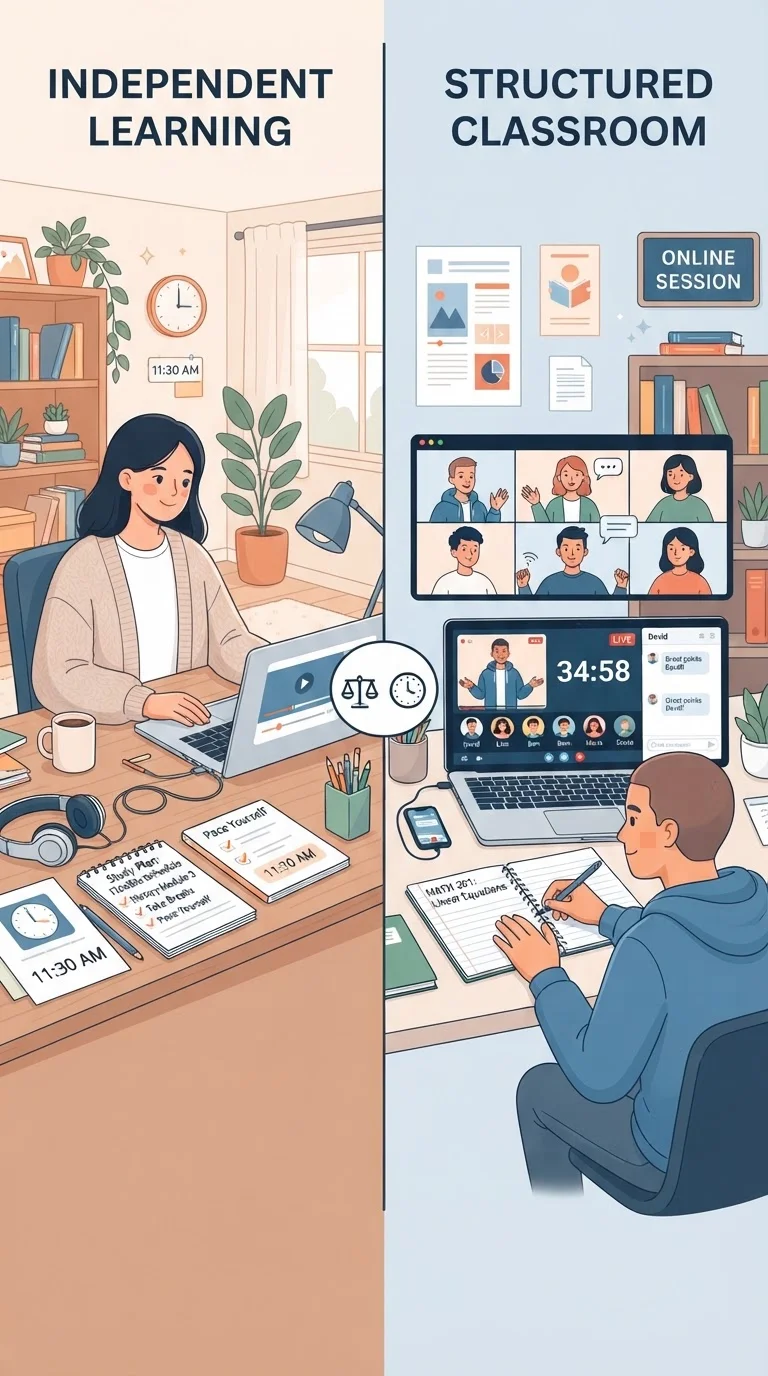
Option A
Self-Paced Online Courses
The flexible, autonomous learning model.
Best for: Learners who need to fit study around unpredictable schedules and prefer working through material at their own speed.
Option B
Instructor-Led Online Courses
The structured, community-driven learning model.
Best for: Learners who benefit from deadlines, direct feedback, and interaction with instructors and peers.
How Each Format Actually Works
The difference between self-paced and instructor-led online courses isn't just about scheduling - it's about the entire structure of accountability, interaction, and feedback. Understanding how each model is built helps you predict how well it will fit your life before you enroll.
Self-paced courses make all content available from day one. Video lessons, readings, quizzes, and assignments are pre-recorded or pre-built, and you work through them whenever you choose. There are no live sessions to attend and no classmates waiting on you. Some platforms allow indefinite access; others set a course expiration window - typically 30 to 180 days - to encourage progress.
Instructor-led courses run on a fixed calendar. Content is released in weekly modules, assignments carry due dates, and learners often participate in live or asynchronous discussions alongside a cohort - a group of students progressing through the course together. Instructors are actively present: grading work, answering questions, and sometimes hosting live office hours or Q&A sessions.
For a broader look at how delivery formats like video lectures and discussion boards fit into these two models, see how online learning formats actually differ.
| Criterion | Self-Paced | Instructor-Led |
|---|---|---|
| Schedule flexibility | Study anytime, no live sessions | Fixed calendar, weekly deadlines |
| Instructor interaction | Minimal to none | Active - grading, Q&A, feedback |
| Peer community | Rare or absent | Cohort discussions, shared progress |
| Accountability structure | Self-imposed only | Built-in via deadlines and cohort |
| Typical completion rates | Generally lower | Generally higher |
| Personalized feedback | Automated quizzes only | Direct instructor feedback |
| Ideal learner | Self-motivated, experienced learners | Those needing structure and guidance |
| Content access | All available from day one | Released in weekly modules |
The Completion Gap: Why Format Affects Whether You Finish
One of the most significant and well-documented differences between these formats is how often learners actually finish. Research on massive open online courses (MOOCs) - which are typically self-paced - consistently shows completion rates in the single digits for free or low-commitment offerings. Instructor-led formats, particularly those with fees and cohort accountability, tend to produce meaningfully higher completion rates, though they vary widely by course and platform.
The mechanism isn't mysterious. When there are no external deadlines, it's easy to deprioritize study when life gets busy. A module you plan to complete "this weekend" can quietly become a module you never touch again. Instructor-led courses introduce friction that works in your favor: a due date on Thursday means you're more likely to open the material on Wednesday.
Why finishing an online course is harder than starting one explores the psychology behind dropout patterns and what research suggests about reversing them - worth reading regardless of which format you choose.
If you're drawn to self-paced study but worry about motivation, building a personal schedule with clear weekly targets can partially replicate the structure of an instructor-led course. Building a personal learning plan for self-directed online study walks through how to do this practically.
Matching Format to Your Learning Situation
Neither format is universally superior. The right choice depends on four honest questions:
- How predictable is your schedule? If your hours vary significantly - shift work, caregiving, freelance projects - self-paced courses reduce the risk of missing live sessions. If you can reliably protect a block of time each week, instructor-led courses are feasible.
- How experienced are you at self-directed study? Learners returning to education after a long break often underestimate how much structure they need. Online learning for adult learners returning to education addresses this honestly and helps set realistic expectations.
- What do you need from the course outcome? If your goal is job-relevant skill-building or a credential that signals rigor to employers, instructor-led formats - especially those with graded assessments and instructor feedback - may carry more weight. For casual knowledge-building, self-paced access is often sufficient.
- Do you want peer interaction? If working alongside others, sharing ideas, and building a professional network matter to you, instructor-led cohort courses offer those opportunities in ways self-paced modules rarely can.
For help connecting your format choice to broader career goals, upskilling vs. reskilling offers useful framing on which learning investments align with which career objectives.
Making a Confident Choice
Once you understand how each model functions, the decision becomes less about which format is objectively better and more about which one fits your habits, goals, and constraints right now. Those factors can shift - a learner who thrives in a self-paced environment today may benefit from an instructor-led course when pursuing a more demanding credential later.
When evaluating a specific course, look past the format label. Check whether the instructor actively participates in self-described "instructor-led" courses, or whether it's essentially pre-recorded content with a cohort shell. Conversely, some self-paced courses include community forums, peer review, and optional mentor check-ins that partially bridge the accountability gap.
Picking an online course when every platform claims to be the best offers a practical framework for assessing course quality beyond marketing descriptions. And if you're still getting oriented to the broader online learning landscape - understanding credentials, platforms, and course types - the landscape of online learning is a useful starting point before committing to any format.
The content on this site is provided for informational purposes only and should not be considered a substitute for professional advice. While we strive to provide accurate and up-to-date information, we make no guarantees regarding its completeness or accuracy. Always consult a qualified professional for advice specific to your circumstances before making any decisions.