

Our Verdict
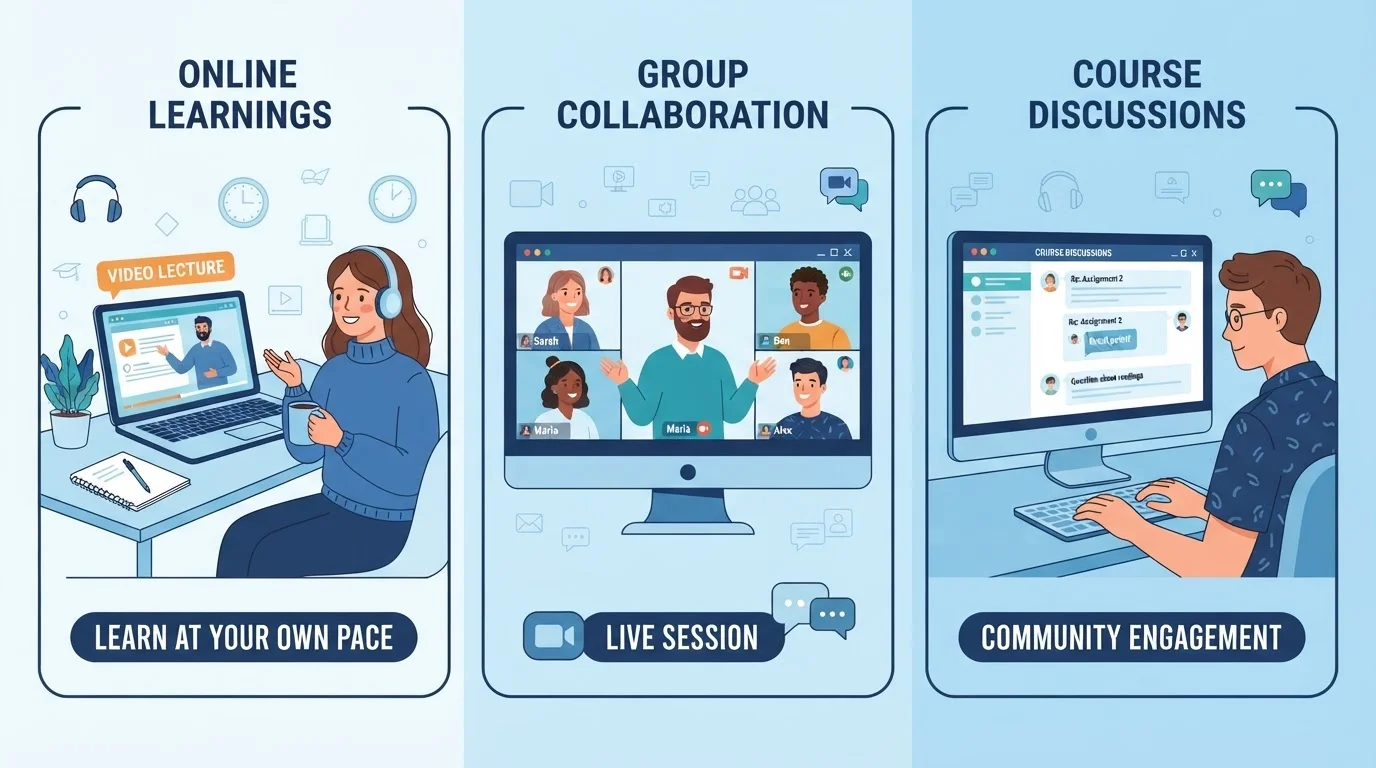
No single delivery format is objectively superior - each serves different learners and goals. Video lectures reward independent, flexible learners; live sessions suit those who thrive on real-time interaction and structure; discussion boards work best as a complement that deepens understanding through peer exchange. Most substantive online courses combine all three to varying degrees, so developing literacy in each format helps you assess a course before you enroll.
| Best for | Recommended |
|---|---|
| Learners with unpredictable schedules or multiple commitments | Video Lectures (asynchronous) |
| Those who need accountability and direct instructor access | Live Sessions (synchronous) |
| Learners who process ideas by writing and reading peer perspectives | Discussion Boards |
| Most adult learners seeking depth and flexibility together | Blended format (video + live + discussion) |
Why Format Matters More Than You Might Expect
When people compare online courses, they often focus on topic, price, or credential. The delivery format - how content actually reaches you - tends to get less attention. That's a mistake. Format shapes when you learn, how much you interact with others, and how accountable you stay over time.
Understanding the three most common formats - pre-recorded video lectures, live sessions, and discussion boards - gives you a clearer lens for evaluating any course you're considering. If you're new to the terminology, the Online Learning Glossary defines foundational terms like asynchronous, synchronous, and LMS that come up constantly in this space.
Pre-Recorded Video Lectures: Flexibility With Trade-offs
Pre-recorded video lectures - sometimes called asynchronous content - let you watch at any time that suits your schedule. A 20-minute lecture recorded by an instructor is available whether you log in at 6 a.m. or midnight. This makes video-heavy courses popular with working adults managing jobs, families, or irregular hours.
The trade-off is that flexibility can become a liability. Without a fixed schedule, it's easy to defer watching. Research on online learning consistently finds that courses relying primarily on passive video consumption tend to have lower completion rates than those with structured interaction. If you've ever wondered why finishing an online course is so difficult, the reasons are well-documented and format is a significant factor.
Video lectures work best for learners who are genuinely self-directed, can build consistent viewing habits, and treat the material actively - pausing to take notes, rewinding complex segments, or working through practice problems alongside the content.
Live Sessions: Structure and Real-Time Access
Live sessions - also called synchronous learning - happen in real time, typically via video conferencing. Instructors can answer questions on the spot, gauge confusion, and adjust their explanations. Learners benefit from the social pressure of showing up and the energy of a shared learning moment.
The obvious limitation is scheduling. A live session at 7 p.m. Eastern on Tuesdays works for some learners and is simply impossible for others. Time zone differences compound this for anyone taking courses from institutions outside their region.
Live formats tend to suit learners who find that accountability to a scheduled commitment keeps them consistent, who have questions that benefit from immediate back-and-forth, or who simply feel more engaged when other people are present. They're also common in cohort-based programs, where a defined group moves through the curriculum together. For a deeper look at how this compares to fully self-directed study, see the comparison of self-paced vs. instructor-led formats.
| Video Lectures | Live Sessions | Discussion Boards | |
|---|---|---|---|
| Scheduling flexibility | High - watch anytime | Low - fixed time required | High - post on your schedule |
| Real-time interaction | None | Yes, with instructor and peers | No - responses arrive over hours or days |
| Accountability built in | Low - self-managed | High - attendance expected | Moderate - often graded |
| Best for learning style | Independent, self-directed learners | Those who need structure and feedback | Reflective writers and peer learners |
| Typical completion challenge | Easy to fall behind without structure | Scheduling conflicts or time zones | Low peer engagement hurts quality |
| Technical demands | Stable internet for streaming | Reliable video/audio connection | Basic platform login and typing |
Discussion Boards: Depth Through Peer Exchange
Discussion boards are the most misunderstood of the three formats. At their best, they require learners to articulate their thinking in writing, respond to peers' interpretations, and refine their understanding through dialogue over days rather than moments. This kind of asynchronous exchange can produce genuine critical thinking that passive video viewing rarely does.
At their worst, discussion boards devolve into perfunctory posts - two-sentence responses written to satisfy a participation requirement, read by no one. Quality depends heavily on how the instructor designs prompts, whether they participate themselves, and whether the student community is engaged.
Discussion boards are particularly valuable for adult learners who bring real-world experience to a topic, since those perspectives enrich the conversation for everyone. Adults returning to education after time away often find peer discussion boards one of the more rewarding surprises of online study - a point explored further in the guide to online learning for adult learners.
Evaluate Discussion Board Culture Before Enrolling
Many platforms allow prospective students to preview course forums or read sample discussions. If you can access them, look for evidence of instructor participation, substantive peer responses, and prompts that go beyond simple recall questions. A well-designed discussion board can be one of the most valuable parts of an online course - but only if it's actively maintained. When in doubt, ask directly whether the instructor monitors and contributes to discussions.
How to Use This When Evaluating a Course
Most substantive online courses blend all three formats in some combination - video for core content delivery, live sessions for Q&A or office hours, and discussion boards for peer engagement. Understanding each element helps you assess what you're actually signing up for before you commit time or money.
Before enrolling, try to answer: What percentage of the course is pre-recorded vs. live? Are discussion boards graded or optional? How active is the instructor in responding? These details often appear in course syllabi or promotional descriptions, and they significantly affect whether the experience will fit your life and learning style.
For broader guidance on evaluating course quality and platform credibility, the article on picking an online course covers what to look for beyond the format. And if you're still mapping out the credential landscape - certificates, degrees, and everything in between - this overview is a useful starting point.
The content on this site is provided for informational purposes only and should not be considered a substitute for professional advice. While we strive to provide accurate and up-to-date information, we make no guarantees regarding its completeness or accuracy. Always consult a qualified professional for advice specific to your circumstances before making any decisions.