

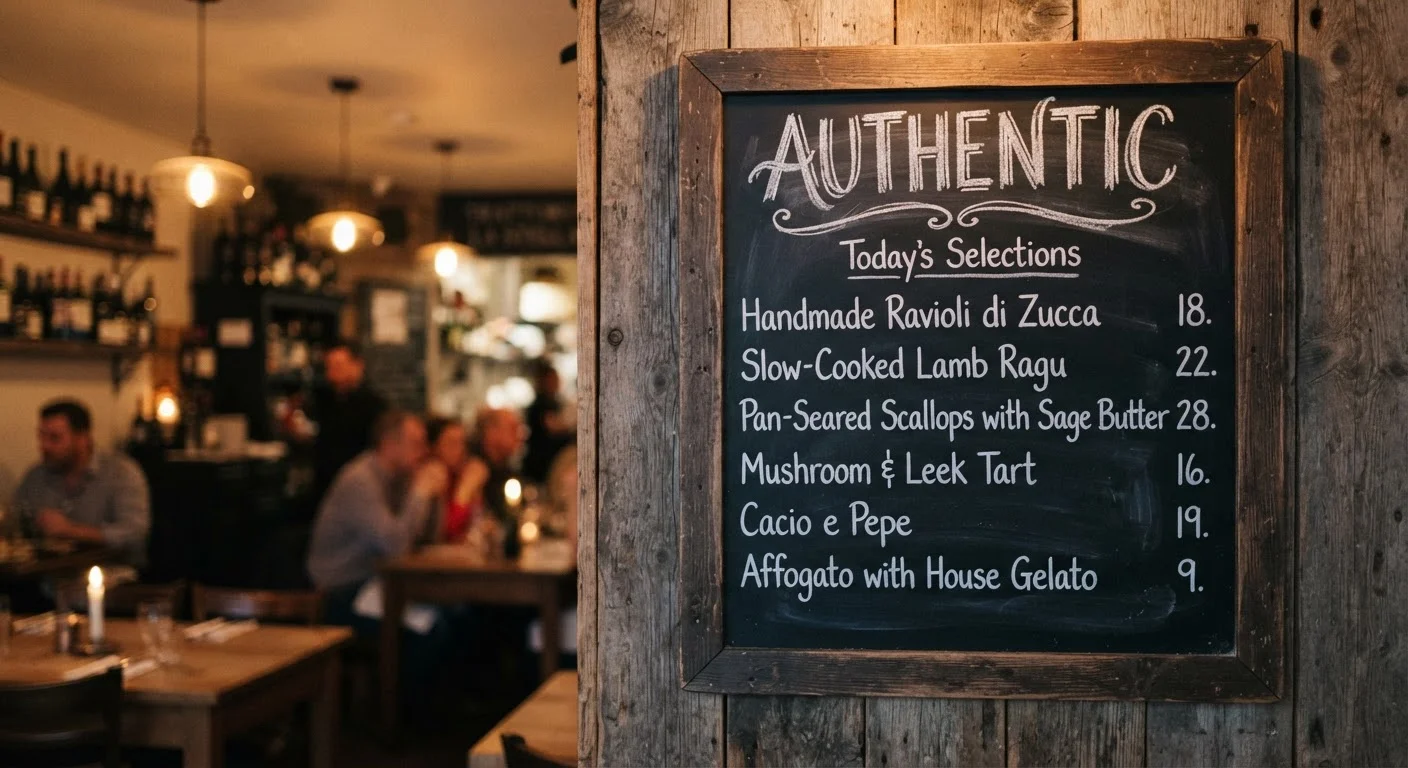
What "Authentic" Actually Promises - and What It Doesn't
Walk into almost any independent restaurant in America and you'll spot it: the word authentic somewhere on the menu, the signage, or the website. It's one of the most common claims in food marketing, yet it's entirely unregulated. No culinary authority, food-safety body, or government agency defines or certifies authenticity for restaurants. A dish can be labeled authentic whether it uses traditional techniques passed down through generations or whether it's a loosely inspired adaptation built around local ingredient availability and diner preferences.
That gap - between what the word implies and what it delivers - is worth understanding before you order. If you want a fuller picture of how restaurants use language to shape your expectations, our guide on reading a restaurant menu like a pro breaks down the broader patterns worth knowing.
Myth
If a restaurant calls its food authentic, it means the dishes match what people actually eat in that country.
Fact
The word is unregulated and self-applied - it reflects a restaurant's marketing choice, not a verified standard of accuracy.
No culinary or government authority certifies restaurant authenticity. Chefs apply the label themselves, sometimes to signal genuine expertise and sometimes simply because it appeals to diners. What counts as a traditional dish can also vary significantly by region, family, or generation within the same country of origin.
Myth
Authentic dishes never change - they're made the same way they've always been made.
Fact
Food traditions evolve continuously in response to ingredient availability, migration, technology, and cultural exchange.
Treating any cuisine as static misunderstands how food cultures actually work. Recipes shift when cooks move, when trade routes open, and when communities adapt to new environments. A dish made with local American ingredients by a skilled chef from that culinary tradition may be closer in spirit to its origins than a rigidly preserved version using hard-to-source imports.
Myth
A restaurant run by someone from that culture is automatically more authentic than one run by an outsider.
Fact
Background can signal credibility, but it doesn't guarantee quality or accuracy, and outsiders can develop deep culinary expertise over time.
Heritage is a meaningful - but not definitive - indicator. A chef raised in a culinary tradition brings lived knowledge that's hard to replicate. However, culinary traditions have always been learned, borrowed, and transmitted across cultures. The more useful question is whether the food reflects genuine knowledge and care, regardless of the cook's background.
Myth
Dishes adapted to suit American palates are lesser versions of the "real" thing.
Fact
Adaptation is a normal part of culinary history, and modified dishes can be excellent on their own terms.
Framing adaptation as dilution assumes a fixed original worth protecting. In practice, many beloved dishes - including staples of American-Chinese, Americanized Italian, and Tex-Mex cooking - developed through deliberate creative evolution. What matters more than purity is whether the restaurant is honest about what it's serving and whether the food is skillfully prepared.
Myth
"Authentic" is a reliable sign of quality.
Fact
Authenticity and quality are separate qualities - a dish can be both traditional and poorly executed, or inventive and brilliantly made.
Menu labels describe a restaurant's positioning, not its execution. A dish prepared with traditional techniques can still be underseasoned, poorly sourced, or carelessly cooked. Conversely, a creative interpretation of a classic can be outstanding. Quality comes from skill, fresh ingredients, and attention to detail - none of which authenticity claims can guarantee.
Why Food Traditions Resist Simple Labels
Cuisines are living systems. They absorb new ingredients, respond to migration, adapt to climate, and shift across generations. The tomato, now central to Italian cooking, didn't arrive in Europe until the 16th century. Chili peppers, foundational to many Thai dishes, came from the Americas. Declaring a single version of any cuisine "authentic" freezes a tradition at an arbitrary moment in time and ignores the ongoing negotiation that defines how people actually cook and eat.
This is especially relevant in American dining, where immigrant communities have long adjusted recipes to match what's available locally - different flour types, substitute vegetables, different cuts of meat. Those adaptations aren't failures of authenticity; they're evidence of culinary resilience. For a deeper look at how two closely related traditions differ in meaningful ways, see our piece on Tex-Mex vs. interior Mexican cuisine.
500+
Years tomatoes have been used in Italian cooking
Despite being associated with Italian cuisine globally, tomatoes didn't reach Europe from the Americas until the late 1500s - a reminder of how recently "traditional" ingredients were introduced.
~20%
Of U.S. restaurants identify as ethnic or international
According to the National Restaurant Association's industry research, multicultural cuisine represents a significant and growing share of American dining, making menu literacy around these terms increasingly relevant.
Better Questions to Ask Instead
Rather than taking an "authentic" label at face value, a few targeted questions will tell you much more about what's actually on your plate. Ask your server where the chef trained or what region of a country inspires the menu. Ask whether key ingredients are imported or sourced domestically. Ask if the dish follows a traditional preparation or has been modified for local tastes - and whether the restaurant is transparent about that distinction.
Restaurants that handle these questions confidently and specifically tend to take their culinary identity seriously. Those that offer vague or evasive answers may be leaning on the label more than the cooking. The same critical thinking that helps you evaluate online reviews applies here - our article on trusting online reviews outlines the patterns that separate reliable signals from noise.
It's also worth noting that community reception matters. A restaurant that's been embraced by the diaspora community whose cuisine it represents carries a different kind of credibility than one that hasn't - though this isn't a perfect test either, since communities themselves disagree about what counts as authentic.
Authenticity Claims Are Not Consumer Guarantees
When you see "authentic" on a menu, you're reading a marketing claim - not a verified fact. No regulatory body audits or certifies restaurant authenticity in the United States. Use the term as an invitation to ask better questions, not as a reason to stop asking them.
How to Eat Smarter Without Getting Caught Up in the Label
The goal of dining out isn't to score points on authenticity - it's to eat well, learn something new, and spend your money wisely. When you encounter the word authentic on a menu, treat it as a starting point for curiosity, not a guarantee of quality. Look for transparency about sourcing and technique, read the dish descriptions carefully for specificity, and notice whether the menu reflects a genuine point of view or a generic assortment of "ethnic" dishes assembled without clear intention.
Understanding how menus are priced and structured also helps. Some dishes labeled as authentic are straightforward value options; others carry a premium that may or may not reflect real ingredient costs or labor. Our guide on dishes that look like a deal but aren't can help you think through where the value actually sits. And if you're curious about the broader cultural debate around this word, the truth behind authentic food explores the food-critic and academic arguments in more depth.
The content on this site is provided for informational purposes only and should not be considered a substitute for professional advice. While we strive to provide accurate and up-to-date information, we make no guarantees regarding its completeness or accuracy. Always consult a qualified professional for advice specific to your circumstances before making any decisions.