

A Brief, Greasy History
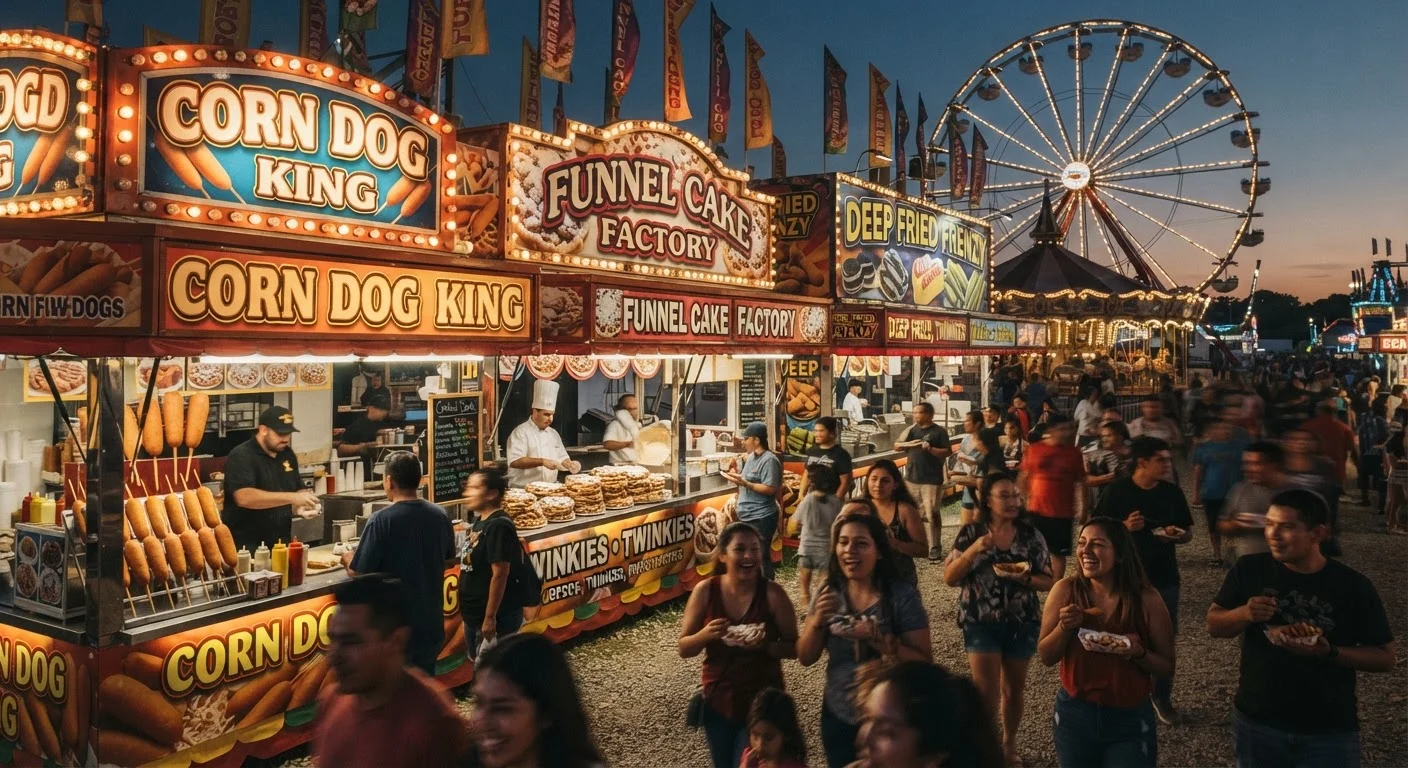
State fairs in America began as agricultural showcases in the early 1800s - the point was to display prize livestock, new farming equipment, and regional produce. Feeding the crowds was a logistical challenge, and portable, inexpensive food served from temporary stalls became the practical solution. Vendors needed items that could be prepared quickly, held without a plate, and eaten on the move.
Deep-frying answered all of those requirements. It was fast, forgiving, and produced food with a shelf life measured in minutes rather than seconds - exactly right for a midway full of distracted fairgoers. The foods that stuck around - corn dogs, funnel cakes, caramel apples - survived not because of culinary sophistication but because they worked reliably at scale in a chaotic outdoor environment.
This practical foundation is easy to forget when staring at a skewer of deep-fried cheesecake, but the logic is continuous. State fair food has always been shaped by what's cookable fast and consumable while walking.
The Novelty Competition Industrial Complex
Somewhere in the late 20th century, fair food crossed a threshold. It stopped being purely about feeding people and started being about spectacle. Major fairs - particularly in Texas and Minnesota - formalized this shift by introducing annual competitions for the most creative new food item.
These contests changed the economics of fair vending. A winning novelty item generates media coverage worth far more than a vendor's booth revenue, and that coverage drives fair attendance broadly. Deep-fried butter, introduced at the Texas State Fair, became international news. So did deep-fried Coca-Cola, deep-fried bubblegum, and - perhaps the most discussed - deep-fried bacon-wrapped cereal on a stick.
1.8M+
Annual attendees at the Minnesota State Fair
The Minnesota State Fair consistently draws over 1.8 million visitors in a roughly 12-day run, making it one of the largest state fairs in the United States by attendance.
~$14
Average spend on food per fair visit
Industry surveys of fairgoers suggest the average visitor spends roughly $12-$16 on food and beverages during a single day at a major state fair.
60+
New food items debuted at Texas State Fair annually
The State Fair of Texas typically sees more than 60 new vendor food submissions each year, with finalists chosen through a formal judging process.
The absurdism is intentional. Vendors are competing not just for sales but for virality, and the judging criteria explicitly reward creativity. This has created a feedback loop where each year's entries must out-weird the last. As a result, state fair food now occupies a strange dual role: comfort tradition and deliberate provocation at the same time. That tension is part of what keeps people engaged - and keeps journalists writing about it every August and September.
Understanding how these novelty items occasionally escape the fairground and influence mainstream menus connects to a larger pattern explored in how food trends actually get set.
Regional Identity on a Stick
For all its shared deep-fryer DNA, state fair food is genuinely regional. The Minnesota State Fair is famous for its milk consumption statistics and cheese curds. Iowa fairs lean into pork - specifically, the pork chop on a stick has become something of a state symbol. Texas fairs reflect the state's barbecue and Tex-Mex cultures alongside the novelty spectacle. Southern fairs frequently feature boiled peanuts, peach cobblers, and locally sourced produce prepared in festive ways.
This regional specificity matters because state fairs function as community identity rituals, not just entertainment events. Attending the fair is an annual act of belonging for many American families, tied to memory, season, and place in a way that few other food experiences replicate. The food is the vehicle for that ritual - even when the vehicle is a deep-fried stick of butter.
That community dimension connects state fair food to a broader tradition of Americans using shared eating as social glue, something explored at length in what the potluck tradition reveals about American community. Both events - the potluck and the fair - use food to mark belonging.
Why We Keep Showing Up
State fair food is not nutritionally defensible, and nobody pretends otherwise. That's part of its cultural function. It occupies a deliberately bracketed space - a once-a-year permission slip for excess that is understood by everyone involved to be exceptional, not routine. Anthropologists who study food rituals note that cultures frequently use feasting and abundance as a way to mark celebration and transition. The state fair, arriving at summer's end, fits that pattern neatly.
There's also the role of nostalgia. For adults who attended fairs as children, the food carries emotional freight that has nothing to do with taste. The smell of funnel cake or the sight of a candy apple can activate decades-old memory in a way that a restaurant meal rarely does. Vendors understand this and deliberately maintain consistency - the funnel cake at your state fair probably tastes exactly like the one you ate there as a child because that continuity is the product.
This is sharply different from the convenience-and-speed logic that defines drive-through fast food culture. State fair food is slow, intentional, and consumed in a specific place. You don't grab it on your way somewhere else - the fair is the destination.
Frequently Asked Questions
The corn dog's exact origin is debated, but several vendors at the 1942 Texas State Fair and the 1946 Minnesota State Fair have strong historical claims. The combination of a hot dog dipped in cornmeal batter and deep-fried proved immediately popular with fairgoers. It has since become one of the most recognized American fair foods.
Deep-frying is efficient for high-volume outdoor cooking - it's fast, requires minimal equipment, and produces food that stays hot and handheld. Frying also adds a universally appealing texture contrast and flavor richness. For vendors managing massive crowds, it's a practical and proven method.
Yes, many large fairs - including those in Texas, Minnesota, and Iowa - hold formal competitions where vendors submit new food creations to be judged on taste, creativity, and presentation. Winners receive significant publicity, which can make a novelty item a breakout attraction.
Significantly. Texas fairs feature kolaches and jalapeño-forward items; Midwestern fairs lean on pork chops on a stick and dairy-rich treats; Southern fairs often include boiled peanuts and peach-themed sweets. Regional identity is a strong driver of what shows up on any given fairground.
Several have. Funnel cakes, fried Oreos, and loaded baked potatoes all trace popularity boosts to fair exposure. As discussed in <a href="/food-eating/dining-out/how-american-dining-trends-actually-spread">how American dining trends spread</a>, fair foods often seed broader consumer appetite for indulgent novelty items.
Yes - deep-fried butter became famous after winning the Big Tex Choice Award at the Texas State Fair. A frozen pat of butter is coated in dough and flash-fried so the outside crisps while the inside melts. It's a deliberate provocation as much as it is a food item.
The content on this site is provided for informational purposes only and should not be considered a substitute for professional advice. While we strive to provide accurate and up-to-date information, we make no guarantees regarding its completeness or accuracy. Always consult a qualified professional for advice specific to your circumstances before making any decisions.