

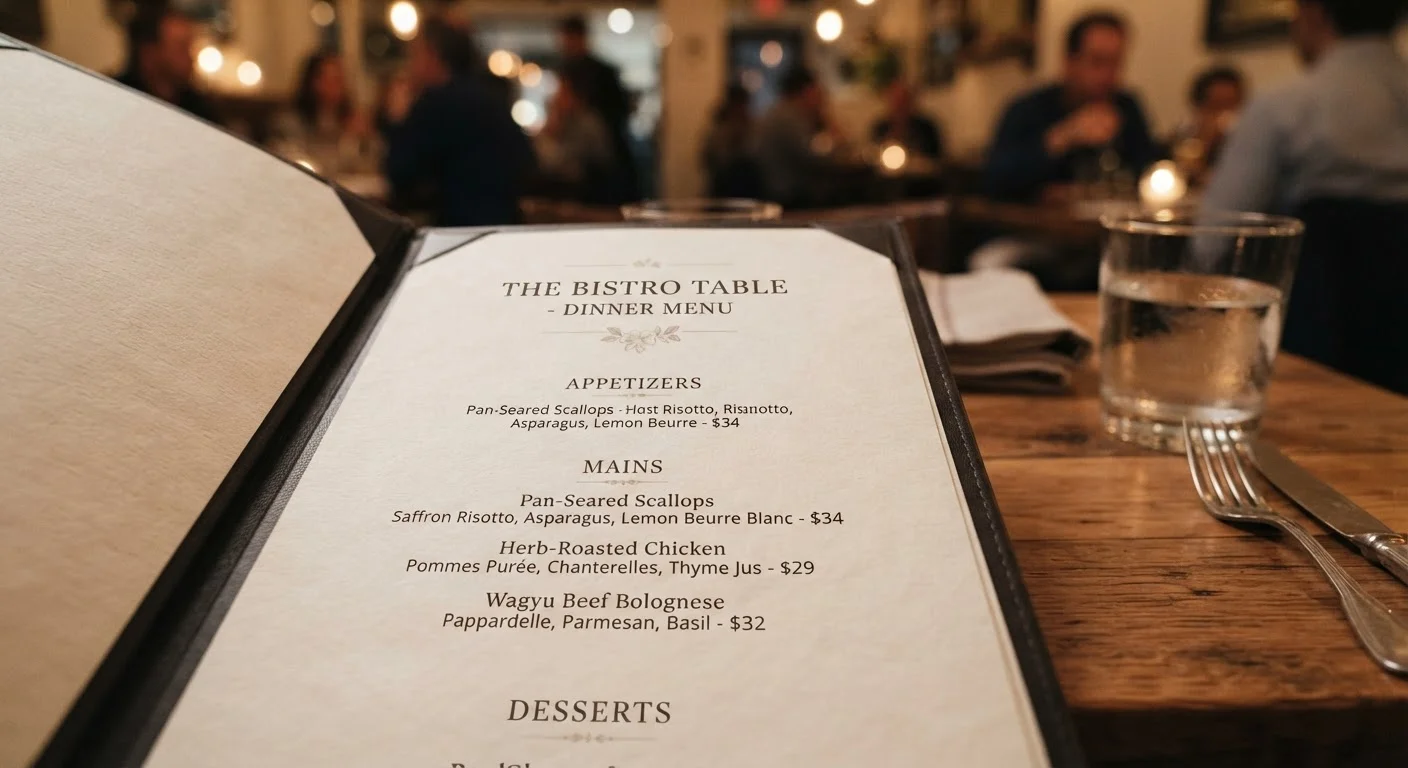
Why Menus Are Built to Influence You
A restaurant menu is never neutral. Operators and designers work together to shape where your eye travels, what feels appealing, and which items get ordered most. Understanding this structure is the first step toward making choices that reflect what you actually want - not what the layout nudges you toward.
Research in menu engineering - a field that restaurants use to optimize profitability - suggests that diners tend to look at the top-right area of a two-page spread first, then drift toward the upper-left. Items placed in those zones are often the ones a restaurant most wants to sell. Borders, boxes, photographs, and bold typefaces serve a similar purpose: they draw the eye to specific dishes.
Menus also tend to omit currency symbols (writing "14" instead of "$14") because the dollar sign is a psychological cue that triggers cost awareness. Prices in lower contrast or smaller type have a similar effect. None of this is manipulative in a harmful sense - it's retail psychology applied to dining - but knowing it helps you scan with intention rather than impulse.
For a deeper look at how pricing works across a full meal structure, see The Anatomy of a Multi-Course Meal.
Scan the Full Menu First
Before your eyes settle on any single dish, take a slow pass through every section. Menus are designed to capture attention early - giving yourself a full overview helps you make a deliberate choice rather than a reactive one. Even 60 seconds of unhurried reading makes a measurable difference in satisfaction.
Decoding Menu Language and Terminology
Menus borrow from culinary French, regional American dialects, and marketing copy - sometimes all at once. A few terms worth knowing:
- Provenance descriptors ("local," "farm-raised," "wild-caught") signal sourcing priorities but are not always third-party verified. Ask your server for specifics if it matters to you.
- Preparation methods - braised, seared, en papillote, charred - tell you how a dish is cooked and, by extension, its texture and richness. If you're unfamiliar with a term, your server expects the question.
- Accompaniments and garnishes are often listed at the end of a description and are easy to overlook. They can meaningfully affect whether a dish fits a dietary need.
- "Market price" means the cost fluctuates with supply and is not printed. Always ask before ordering; the price can be notably higher than surrounding items.
If you have dietary restrictions, communicating them clearly to your server matters as much as reading the menu itself - dish descriptions rarely capture every ingredient.
Finding the Value on Any Menu
Value on a menu is rarely where you'd expect it. Here's where to look:
Middle sections and mid-range prices. Menu engineering places high-margin "star" dishes where you look first and last. Items in the middle of a section or mid-range in price are sometimes the most honestly priced relative to their ingredient cost and preparation complexity.
Daily specials. Specials exist partly to move perishable inventory, but in kitchens that pride themselves on sourcing, they also represent what's freshest that day. They're worth asking about even if they're not on the printed menu.
Appetizers as a meal. Ordering two appetizers instead of an entrée is a widely used strategy at higher-end restaurants where appetizer portions are generous. It broadens your tasting range and can reduce total spend.
Prix-fixe and set menus. When a restaurant offers a fixed-price multi-course option, it's often priced below what those courses would cost individually. Eating out on a budget without sacrificing the experience covers this strategy in more detail.
To understand which specific dish categories tend to carry the highest markups, Dishes That Look Like a Deal But Aren't (And Vice Versa) is worth reading alongside this guide.
How to Use Your Server as a Resource
A well-trained server is one of the most underused tools at your table. The menu is a static document; your server knows what's been popular that evening, which dish the kitchen is executing particularly well, and what's actually in a preparation that isn't fully described.
Effective questions to ask:
- "What's the kitchen proud of tonight?" - invites an honest recommendation rather than an upsell.
- "How large is the ?" - portion sizes vary dramatically and are almost never described.
- "Is the made in-house or sourced?" - relevant for pastas, bread, desserts, and charcuterie.
- "What would you pair with this?" - useful for wine, cocktails, or side dishes, and reveals the server's knowledge level.
Treat the menu as a starting framework and the conversation with your server as the way to fill it in. Most restaurants welcome engaged diners - it tends to result in a better experience on both sides of the table.
The content on this site is provided for informational purposes only and should not be considered a substitute for professional advice. While we strive to provide accurate and up-to-date information, we make no guarantees regarding its completeness or accuracy. Always consult a qualified professional for advice specific to your circumstances before making any decisions.