

Why Timers Are Only a Starting Point
A recipe's stated cooking time is an estimate built around average conditions - a typical oven, a standard pan, food at roughly room temperature. The moment any of those variables shifts, the timer becomes less reliable. Your oven may run 25 degrees hot. Your chicken breast may be thicker than the one the recipe writer used. The pan may have been only half preheated.
This is why experienced cooks treat time as a prompt to check, not a verdict that food is done. Learning to read doneness through your senses is the most transferable skill in the kitchen - it applies across every recipe, every appliance, and every ingredient. It also makes you a more confident cook, because you stop depending on a number and start trusting what you observe.
As part of the cooking fundamentals that make every recipe easier to follow, doneness judgment is a habit worth building early. Here's how to do it across the most common foods you'll cook.
Start Checking Early, Not Late
Begin checking for doneness a few minutes before the recipe's minimum time, especially with a new oven or pan. It's easy to give food a little more time - you can't undo overcooking. Building in an early check also helps you learn how your specific equipment behaves.
The Four Senses That Signal Doneness
You don't need specialized equipment for most doneness checks. Four sensory cues - sight, touch, sound, and smell - cover the majority of everyday cooking situations.
Sight: Color and Surface Changes
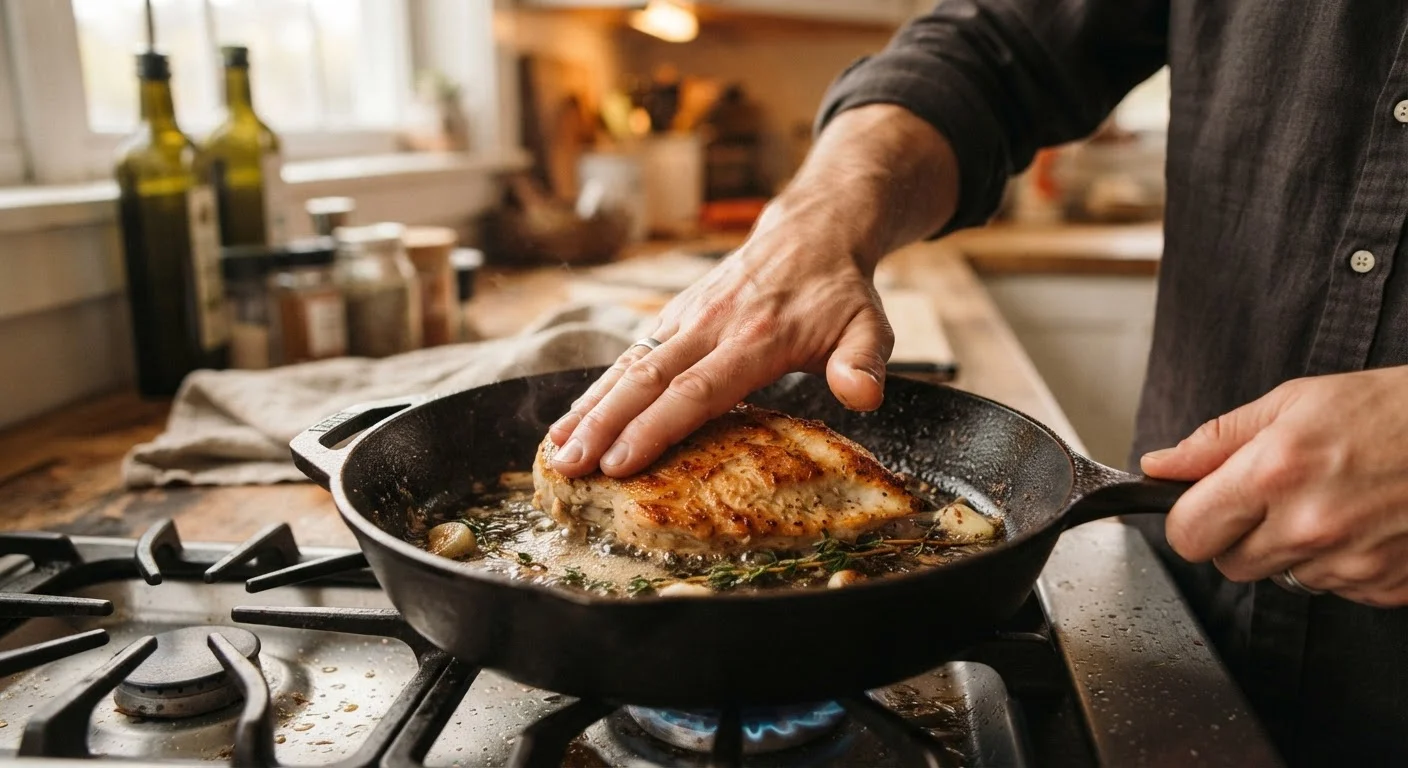
Color is often the first signal. Raw chicken is pale pink; properly cooked chicken is opaque white throughout with no translucent center. Sautéed onions turn from sharp white to soft gold to deep amber as their sugars caramelize. Baked goods shift from pale and matte to golden and set. The browning process (called the Maillard reaction) signals that surface moisture has evaporated and flavor compounds are developing - a reliable visual cue that heat has done its work.
Touch: Firmness and Resistance
Proteins firm up as they cook. A raw fish fillet yields completely when pressed; a properly cooked fillet resists your finger and flakes at the surface. The same principle applies to meat: well-done steak feels firm throughout, while medium-rare has noticeable spring. For baked goods, pressing the center of a cake lightly - if it springs back, it's done; if it leaves an indent, it needs more time.
Sound: What You Hear in the Pan
A confident sizzle means the pan is hot and moisture is evaporating properly. If you hear silence when food hits the pan, it's not hot enough. If sizzling becomes frantic popping and spitting, the heat may be too high. As food nears doneness, the sizzle often softens because surface moisture has largely cooked off.
Smell: Aroma Development
Raw flour smells starchy; baked bread smells nutty and yeasty. Garlic turns from sharp to sweet as it cooks. Burning sugar or meat has a distinct acrid quality that tells you to act immediately. Your nose can catch browning sooner than your eyes sometimes can, especially in an oven where you can't easily watch the surface.
When to Use a Thermometer - and How
For poultry, ground meat, pork, and stuffed dishes, relying on visual cues alone carries food-safety risk. An instant-read thermometer removes the guesswork entirely and is one of the most practical tools you can keep in a kitchen drawer. It doesn't replace your senses - it works alongside them.
Insert the thermometer into the thickest part of the food
Push the probe into the center of the thickest section, avoiding bones (which conduct heat differently and give a false reading). For a whole chicken, aim for the thigh where it meets the breast without touching the bone.
Wait for the reading to stabilize
Most instant-read thermometers display a stable number within 2-5 seconds. Hold the probe steady until the number stops climbing before reading it.
Compare against USDA safe minimum internal temperatures
The USDA publishes safe minimum internal temperatures for common proteins. Key benchmarks: poultry (whole and ground) at 165°F, ground beef and pork at 160°F, whole-muscle beef and pork at 145°F with a 3-minute rest, and fish at 145°F.
Account for carryover cooking before pulling food from heat
Proteins continue cooking after leaving the heat source. For most cuts, removing food 5-10°F below your target temperature and resting it tented loosely with foil allows carryover heat to finish the job without overshooting.
Once you're comfortable checking temperatures, pair that habit with understanding why meat needs to rest before cutting. Residual heat continues cooking proteins even off the flame, so pulling food 5-10 degrees below your target and letting it rest accounts for that carryover - and keeps the juices where they belong.
Applying Doneness Checks Across Common Foods
Different foods demand different combinations of cues. Here's a quick reference for the foods most home cooks encounter regularly.
- Pasta: Bite a strand - it should be tender but still offer slight resistance at the very center (called al dente, meaning "to the tooth"). No timer beats tasting.
- Vegetables: A fork or knife should slide in with little resistance for roasted or steamed vegetables. For sautéed greens, color deepens and volume shrinks significantly when done.
- Fish: Flesh transitions from translucent to opaque and separates into flakes when pressed gently with a fork. For food safety with thicker cuts, an internal temperature of 145°F is the guideline from the USDA.
- Eggs: Scrambled eggs are done just before they look fully set - they'll finish cooking in the residual heat of the pan. Fried eggs are done when the white is fully opaque and no longer jigles.
- Cakes and muffins: A toothpick or skewer inserted in the center should come out clean or with a few moist crumbs - not wet batter.
Pairing these checks with smart preparation habits makes everything easier. See how setting up your kitchen before cooking changes the whole experience for the prep habits that keep you attentive throughout the cooking process rather than reactive at the end.
The content on this site is provided for informational purposes only and should not be considered a substitute for professional advice. While we strive to provide accurate and up-to-date information, we make no guarantees regarding its completeness or accuracy. Always consult a qualified professional for advice specific to your circumstances before making any decisions.