

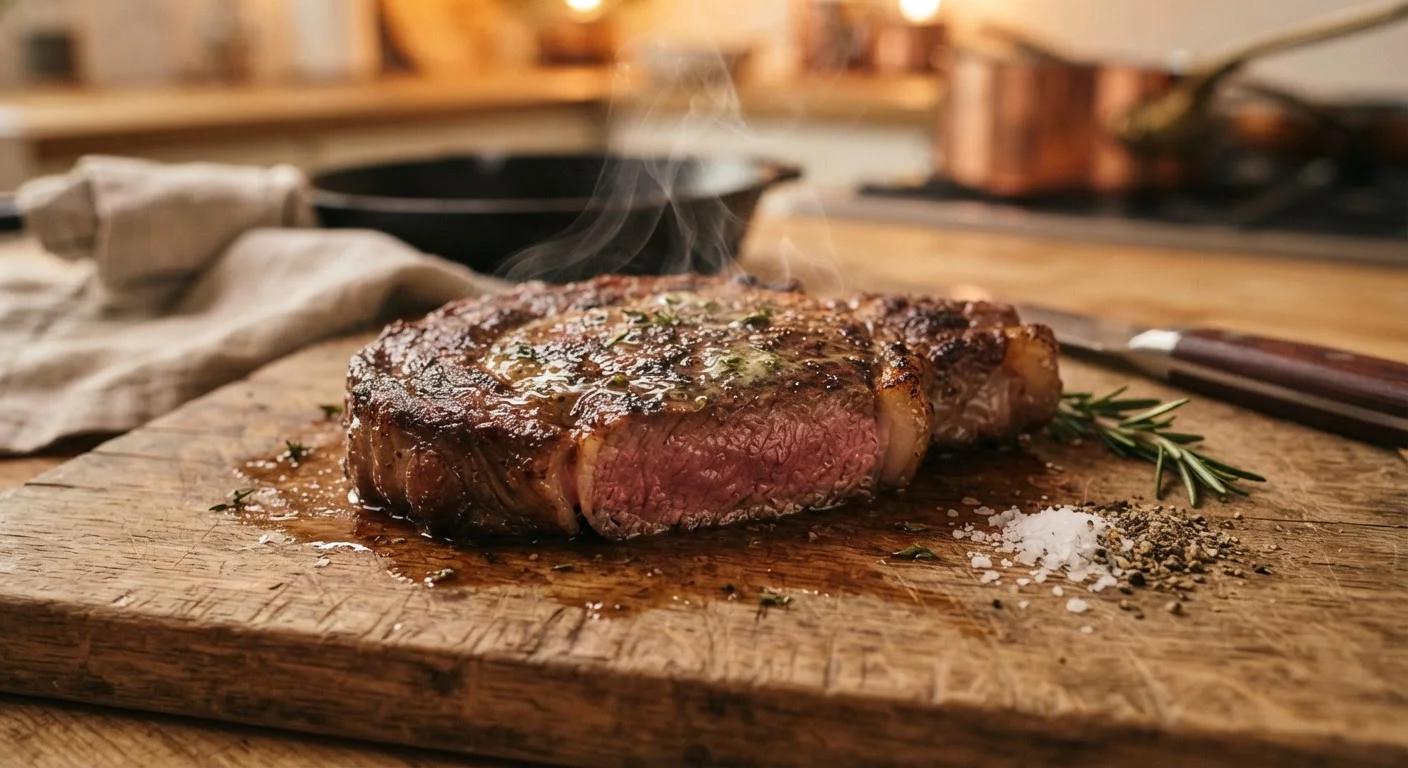
What Actually Happens Inside Meat When It Cooks
Meat is mostly muscle, and muscle is mostly water. When heat is applied, the proteins in those muscle fibers begin to contract - think of it like wringing out a sponge. That squeezing action forces moisture away from the outer layers and toward the cooler center of the cut.
By the time a steak reaches a target internal temperature, its center is packed with displaced liquid while the outer layers are comparatively dry. If you slice into it immediately, all that pressure has nowhere to go except straight onto your cutting board. What looks like a pool of "blood" is actually myoglobin - a protein that carries oxygen in muscle tissue - mixed with water-based juices. You've just lost the most flavorful part of your cook.
Understanding this process is the foundation of resting. It's not a kitchen superstition - it's straightforward biology. If you want to read more about decoding the language recipes use to explain steps like this, see our plain-language guide to cooking terminology.
Why Resting Reverses the Damage
When you pull meat off the heat and set it aside, the cooking process doesn't stop instantly - but it does slow dramatically. The residual heat continues to move from the hotter outer layers toward the cooler center, a process sometimes called carryover cooking. As that temperature difference evens out, the squeezed muscle fibers begin to relax.
As the fibers relax, they're able to reabsorb some of the liquid that was pushed inward. The juice redistributes more evenly throughout the cut rather than pooling under pressure at the center. When you finally slice the meat, the fibers hold their moisture rather than releasing it all at once.
Use Resting Time Productively
The few minutes your meat rests are ideal for finishing the rest of the meal. Build a pan sauce from the fond left in the skillet, plate your vegetables, or pour drinks. Resting rarely means standing idle - it just means sequencing your meal smartly.
The practical takeaway: resting doesn't just make meat juicier - it also means the juices stay in each bite rather than running out onto the plate. You worked to cook that meat well. Resting protects that work.
How Long to Actually Wait - By Cut
Resting times aren't one-size-fits-all. They scale with the thickness and mass of the cut. Here's a practical breakdown:
- Thin steaks and chops (under 1 inch): 5 minutes on a warm plate is usually sufficient.
- Thicker steaks (1-2 inches): 8 to 10 minutes. A loose foil tent helps maintain temperature without steaming the crust.
- Pork tenderloin or bone-in chops: 5 to 10 minutes depending on thickness.
- Whole chicken or large bone-in chicken pieces: 15 to 20 minutes. Bones retain heat and slow the cooling process.
- Large beef roasts and whole turkeys: 20 to 30 minutes. These cuts carry enough residual heat that they'll still be impressively warm after a full rest.
A useful general rule: rest meat for roughly half the time it spent cooking, up to a maximum of about 30 minutes. You don't need a timer specifically for resting - use the time to finish a sauce, plate the sides, or set the table.
Common Mistakes That Undercut the Rest
Even knowing the principle, a few habits can work against you. Wrapping meat tightly in foil traps steam, which softens any crust or sear you've built - instead, tent foil loosely so air can still circulate. Placing hot meat on a cold plate pulls heat out quickly; resting on a warm cutting board or a plate warmed briefly in a low oven makes a real difference.
Slicing immediately to "check" the doneness defeats the purpose entirely. If you're uncertain about doneness before pulling the meat off heat, an instant-read thermometer is a far more reliable tool than visual inspection after the fact. The meat's internal temperature is the right metric - not the color of the juices.
One more thing: resting applies equally to reheated meat. If you're warming leftover protein, giving it a brief rest after heating helps prevent moisture loss from slicing while still under pressure - the same principle that governs why leftovers often disappoint when handled carelessly.
Frequently Asked Questions
Yes, and it's one of the most significant improvements a beginner cook can make. A steak cut immediately off the heat can lose a large portion of its moisture onto the cutting board. A rested steak retains most of that moisture inside, producing a juicier bite.
Meat loses temperature slowly, especially thicker cuts. Loosely tenting it with aluminum foil helps retain warmth without trapping steam, which would soften any crust you've built. For most cuts, a proper rest still results in a perfectly warm plate.
A thin steak - under an inch thick - generally needs about 5 minutes. A thicker ribeye or strip steak benefits from 8 to 10 minutes. The goal is to let the internal temperature stabilize and the fibers relax before slicing.
Absolutely. The same physics apply to all muscle-based proteins. A whole roast chicken benefits from 15 to 20 minutes of rest, while pork chops or tenderloin generally need 5 to 10 minutes depending on thickness.
A loose foil tent is helpful for larger roasts and whole birds, where heat loss is more of a concern. For smaller cuts like steaks and chops, simply moving them to a warm plate is often enough - tight wrapping can steam and soften a seared crust.
The content on this site is provided for informational purposes only and should not be considered a substitute for professional advice. While we strive to provide accurate and up-to-date information, we make no guarantees regarding its completeness or accuracy. Always consult a qualified professional for advice specific to your circumstances before making any decisions.