

Why Tire Care Pays Off More Than Most Drivers Realize
Tires are the only part of your vehicle that actually touches the road - four contact patches, each roughly the size of a hand, are responsible for acceleration, braking, and steering. Despite that outsized role, tire maintenance is one of the most routinely skipped tasks in everyday car ownership.
The consequences aren't abstract. Underinflated tires increase fuel consumption, accelerate tread wear, and degrade handling - particularly in emergency maneuvers. Worn tires dramatically extend wet-weather stopping distances. And a preventable blowout on the highway carries real safety risk.
The good news: most tire care requires no tools beyond a $10 gauge and five minutes of attention. It's also closely tied to broader ownership habits - if you want to understand what else tends to get quietly neglected, our overview of routine maintenance schedules most drivers skip is worth a read. Tire pressure, tread depth, and rotation are the three fundamentals every driver should have locked in.
Tire Pressure: The Right Numbers and How to Check Them
Tire pressure is measured in PSI (pounds per square inch). The correct PSI for your vehicle is printed on a sticker inside the driver's door jamb - not on the tire sidewall. The sidewall number is the tire's maximum pressure, not its optimal operating pressure. These are not the same figure, and inflating to the sidewall number can make tires dangerously stiff.
Most passenger vehicles call for somewhere between 30 and 35 PSI, though trucks, SUVs, and performance vehicles often differ. Check your owner's manual if the door jamb sticker is missing or hard to read.
How to Check Pressure Correctly
- Check tires when they are cold - meaning the vehicle has been parked for at least three hours, or driven fewer than a mile. Driving heats the air inside tires, temporarily raising pressure readings by several PSI.
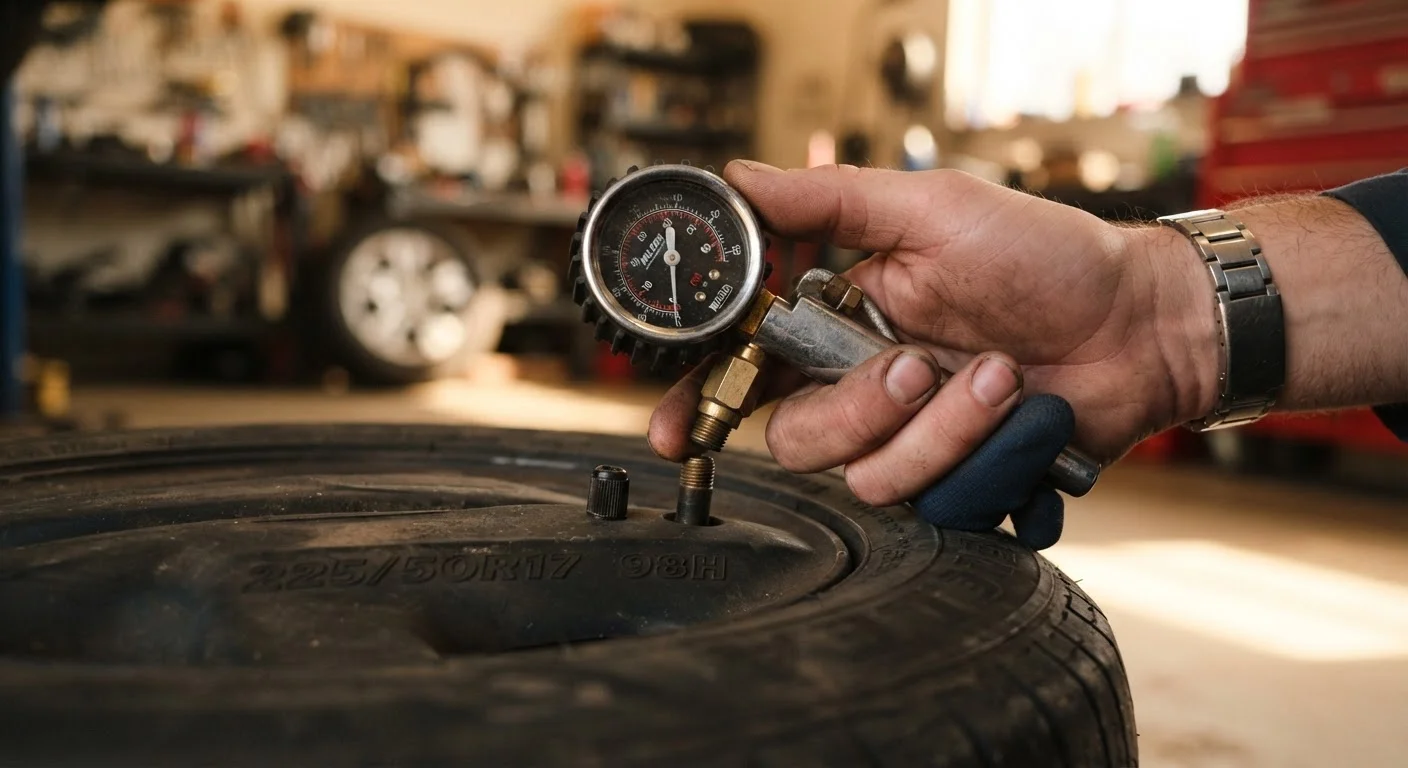
- Remove the valve cap, press the gauge firmly onto the valve stem, and read the result. A digital gauge is easier to read but a quality dial gauge works equally well.
- Add or release air as needed, then recheck.
Always check tire pressure before a long road trip, not after you've already driven an hour. Once the tires are warm, your reading will be elevated and you'll get a false sense of security.
Cold-tire readings are the accurate baseline - driving warms air inside the tire and temporarily raises pressure, which can mask underinflation that matters most at highway speeds.
If one tire keeps losing pressure faster than the others, don't just keep topping it off - have it inspected for a slow leak or valve stem issue before it becomes a roadside emergency.
Recurring pressure loss almost always has an underlying cause. Repeated refilling without diagnosis is a common pattern that ends with an inconvenient or dangerous blowout.
Pressure drops roughly 1 PSI for every 10°F drop in ambient temperature, which is why tires that were fine in October may read low in January. Check monthly as a habit, and always before a long trip. Don't forget the spare - a flat spare at the side of the road offers no help at all.
Tread Depth: Knowing When Your Tires Are Done
Tread channels water away from the contact patch so the rubber can grip the road. As tread wears down, that drainage capacity shrinks - and wet-weather performance degrades noticeably before a tire technically reaches its legal minimum.
The legal minimum tread depth in most U.S. states is 2/32 of an inch. Many safety organizations recommend replacing tires at 4/32 inch, particularly in regions with regular rain or snow, because stopping distances increase measurably between 4/32 and 2/32.
The Penny and Quarter Tests
You don't need a specialized gauge, though one costs only a few dollars and gives a precise reading. Two coins work well as quick checks:
- Quarter test: Insert a quarter into a tread groove with Washington's head pointing down. If you can see the top of his head, tread is at or below 4/32 inch - consider shopping for replacements.
- Penny test: Insert a penny with Lincoln's head pointing down. If you can see the top of Lincoln's head, tread is at or below 2/32 inch - the tire should be replaced promptly.
Check multiple grooves across the tire's width, not just one spot. Uneven wear - more on one edge than the other - can signal alignment or inflation problems that need attention beyond just the tire itself. For a broader look at how tire care fits into vehicle longevity, see our guide on keeping a vehicle for the long haul.
Tire Rotation: Why It Matters and How Often to Do It
Tires wear unevenly by design. Front tires on a front-wheel-drive vehicle handle steering, acceleration, and a larger share of braking - so they wear faster than the rears. Even on rear-wheel-drive and all-wheel-drive vehicles, weight distribution and drive forces create measurable wear differences between axles and sides.
Rotation moves each tire to a different position on the vehicle so wear distributes more evenly across all four. Done consistently, it can add thousands of miles to a set of tires - extending the interval before you need to pay for replacements.
Rotation Intervals and Patterns
A common guideline is to rotate tires every 5,000 to 8,000 miles, though your owner's manual may specify differently. Many drivers align rotations with oil changes to make scheduling easier. Common rotation patterns include:
- Forward cross: Rear tires move straight to the front; front tires cross to the opposite rear positions. Common for front-wheel-drive vehicles.
- X-pattern: All tires cross to the opposite axle and opposite side. Used in some front-wheel-drive applications.
- Rearward cross: Often recommended for rear-wheel-drive and four-wheel-drive vehicles.
Staggered tires (different sizes front and rear, found on some performance vehicles) typically cannot be rotated side-to-side and may have limited or no rotation options - consult your owner's manual or a qualified tire technician. If you're weighing whether to handle rotation yourself or hand it off, our breakdown of DIY car maintenance vs. taking it to a mechanic covers what factors make the call easier.
Putting It All Together: A Simple Tire Care Routine
None of these tasks requires mechanical expertise. The challenge is consistency, not complexity. A workable routine looks something like this:
- Monthly: Check all four tire pressures (and the spare) with a gauge. Takes two to three minutes.
- Every fill-up: Do a quick visual scan - look for obvious bulges, embedded objects, or tires that appear lower than the others.
- Every oil change or 5,000-8,000 miles: Rotate tires. Run the penny or quarter test on each tire at the same time.
- Seasonally: Recheck pressure when temperatures shift significantly, since cold weather reduces PSI. The seasonal car maintenance rhythm article offers a useful framework for timing these checks across the year.
Don't Ignore Uneven or Rapid Wear
Uneven tread wear - heavy on one edge, cupping, or feathering - is usually a symptom of misalignment, improper inflation, or a suspension issue, not just normal use. Replacing worn tires without correcting the underlying problem means the new set will wear just as fast. If you notice unusual wear patterns, have the alignment and suspension checked by a qualified technician before or when you replace the tires.
This routine also catches problems early - a nail in the tread, a slow leak, or the beginning of uneven wear - before they escalate. Tires that are well-maintained tend to last longer, perform more predictably, and give you clear warning signs before they fail. That's about as straightforward a return on five minutes a month as vehicle ownership offers. For a fuller picture of what else tends to get overlooked, the 15 most overlooked items on a standard maintenance schedule is a practical companion read.
This article is for informational purposes only. Always consult your vehicle's owner's manual and, for safety-critical tasks, a qualified tire or automotive technician.
The content on this site is provided for informational purposes only and should not be considered a substitute for professional advice. While we strive to provide accurate and up-to-date information, we make no guarantees regarding its completeness or accuracy. Always consult a qualified professional for advice specific to your circumstances before making any decisions.