

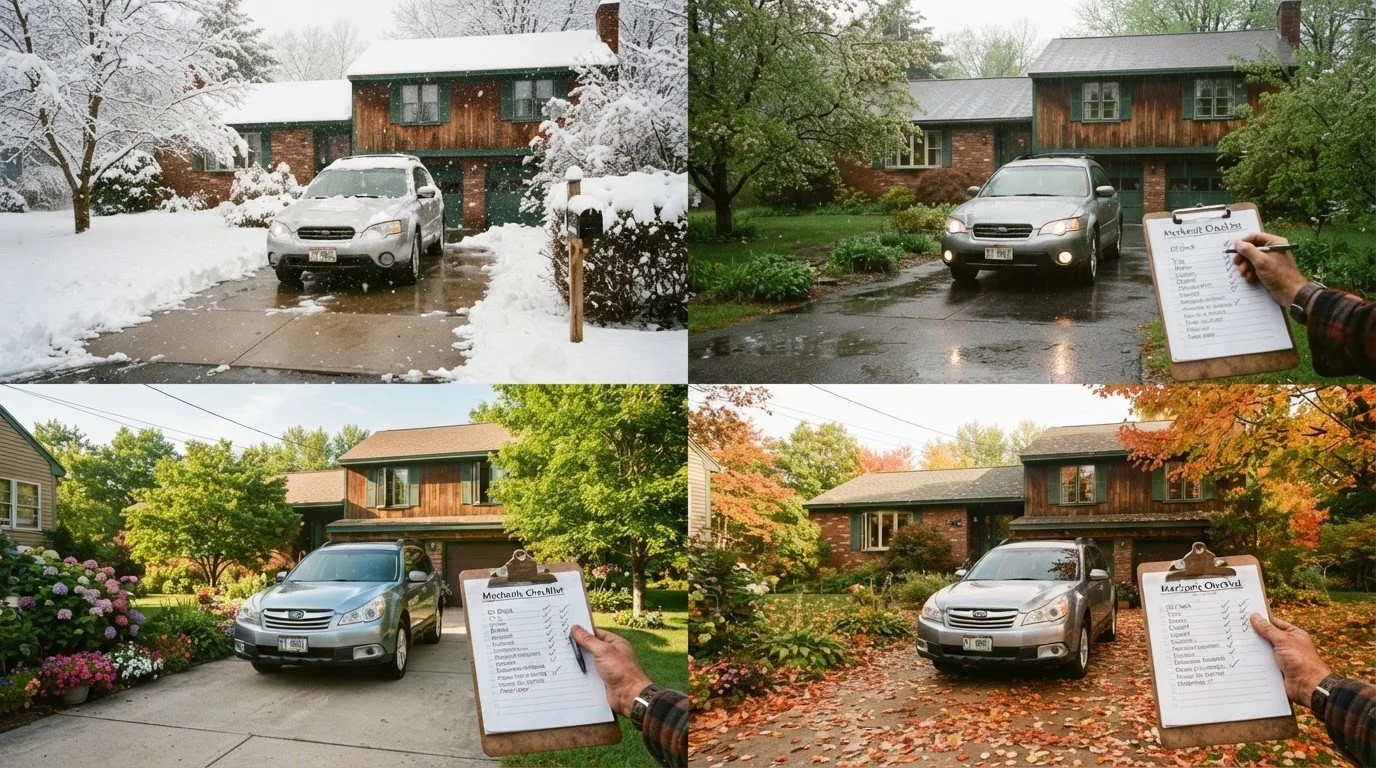
Why Seasonal Maintenance Is Different From Scheduled Maintenance
Most drivers are at least vaguely aware of mileage-based services - oil changes every 5,000 to 7,500 miles, tire rotations, and the occasional filter swap. What gets overlooked is that your vehicle's environment changes dramatically across seasons, and those changes create specific stresses that mileage intervals simply aren't designed to catch.
Extreme heat degrades rubber hoses and overworks your cooling system. Deep cold saps battery voltage and thickens fluids. Road salt corrodes metal components. Transition periods - fall and spring - are actually the most valuable windows for inspection because they let you assess damage from the season just passed and prepare for what's coming.
Think of seasonal checks as a complement to your regular service schedule, not a replacement. The goal is to reduce surprises. As detailed in our piece on how deferred maintenance compounds, skipping small checks doesn't keep the car in neutral - it tends to create downstream problems.
Your Climate Changes the Calculus
Drivers in the Sun Belt face different seasonal stresses than those in the Rust Belt or the Pacific Northwest. A driver in Phoenix worries about coolant and UV-damaged rubber far more urgently than one in Seattle worries about road salt. Adjust the priorities below based on your actual regional conditions - the seasonal rhythm is a framework, not a one-size-fits-all prescription.
The Core Seasonal Practices Every Driver Should Follow
The practices below are organized around the transitions and stresses that each season introduces. They don't require mechanical expertise to understand - but some tasks, particularly brake inspection and cooling system service, should be performed or at minimum confirmed by a qualified mechanic if you're not confident doing them yourself.
Test your battery before cold weather arrives, not after the first no-start morning.
Battery capacity drops significantly in low temperatures - a battery that's already marginal in October can fail completely by December. Catching a weak battery in fall costs a fraction of an emergency roadside call in a snowstorm.
Check tire pressure at every seasonal transition, not just when the low-pressure warning light appears.
Tire pressure drops roughly 1 PSI for every 10°F decrease in ambient temperature. Underinflated tires wear unevenly, handle poorly, and reduce fuel efficiency - and by the time the dashboard light activates, the pressure is already meaningfully low.
Flush and replace coolant (antifreeze) on your manufacturer's recommended schedule, not just when it looks dirty.
Coolant degrades chemically over time, losing its ability to protect against both freezing and corrosion of your cooling system components. A coolant flush is far cheaper than a cracked engine block or a failed water pump.
Inspect wiper blades at the start of fall and spring - replace them before they fail during a downpour.
Rubber wiper blades degrade from UV exposure and heat in summer and can crack or streak from freezing temperatures in winter. A wiper that smears instead of clears is a genuine visibility hazard.
Have your brakes inspected each spring, particularly after a winter involving road salt exposure.
Salt accelerates corrosion on brake rotors and calipers. Brake pad wear also tends to be higher in winter due to wet and icy conditions requiring harder stops. Waiting until you hear grinding means the damage - and the repair bill - is already larger than it needed to be.
Log every seasonal service you perform or have performed, noting mileage and date.
A written or digital service record removes the guesswork from "when did I last do that?" It also demonstrates responsible ownership if you sell the vehicle and helps a mechanic diagnose intermittent problems faster.
For a broader look at what else tends to fall off most drivers' radar, routine maintenance schedules most drivers quietly skip covers the patterns worth understanding.
Start With Quick Wins You Can Do Today
Seasonal maintenance sounds like a project, but the most impactful checks take less than 15 minutes and cost nothing beyond a basic gauge or a glance under the hood. These starting points build the habit without demanding a full afternoon.
Proper tire care in particular is one of the highest-leverage habits available to everyday drivers - for a deeper dive, see our tire care fundamentals guide. And if you want a reliable framework for tracking everything you do across seasons, practices that help cars last outlines the habits shared by drivers who keep their vehicles well past 150,000 miles.
The content on this site is provided for informational purposes only and should not be considered a substitute for professional advice. While we strive to provide accurate and up-to-date information, we make no guarantees regarding its completeness or accuracy. Always consult a qualified professional for advice specific to your circumstances before making any decisions.