

Start here
Why the Maintenance Schedule Section Exists
Next
How to Find and Navigate the Schedule
Then
Decoding Mileage vs. Time Intervals
Important nuance
Normal vs. Severe Driving Conditions
Apply it
Putting the Schedule Into Practice
Why the Maintenance Schedule Section Exists
Every vehicle's owner's manual includes a maintenance schedule because engineers know exactly how long the components they designed will last under predictable stress. This isn't generic advice - it's a service roadmap calibrated to your specific engine, transmission fluid chemistry, belt materials, and filter capacity.
Generic maintenance advice you find elsewhere is averaged across many vehicles. The schedule in your manual is not. Following it is one of the most direct ways to protect the vehicle you actually own. As explored in our guide on keeping a vehicle for the long haul, drivers who stick closest to manufacturer schedules tend to see fewer major failures over time.
How to Find and Navigate the Schedule
Open your manual's table of contents and look for chapter headings that include words like Maintenance, Service Intervals, or Scheduled Maintenance Requirements. Some manufacturers place it in a standalone supplement booklet included with the manual packet.
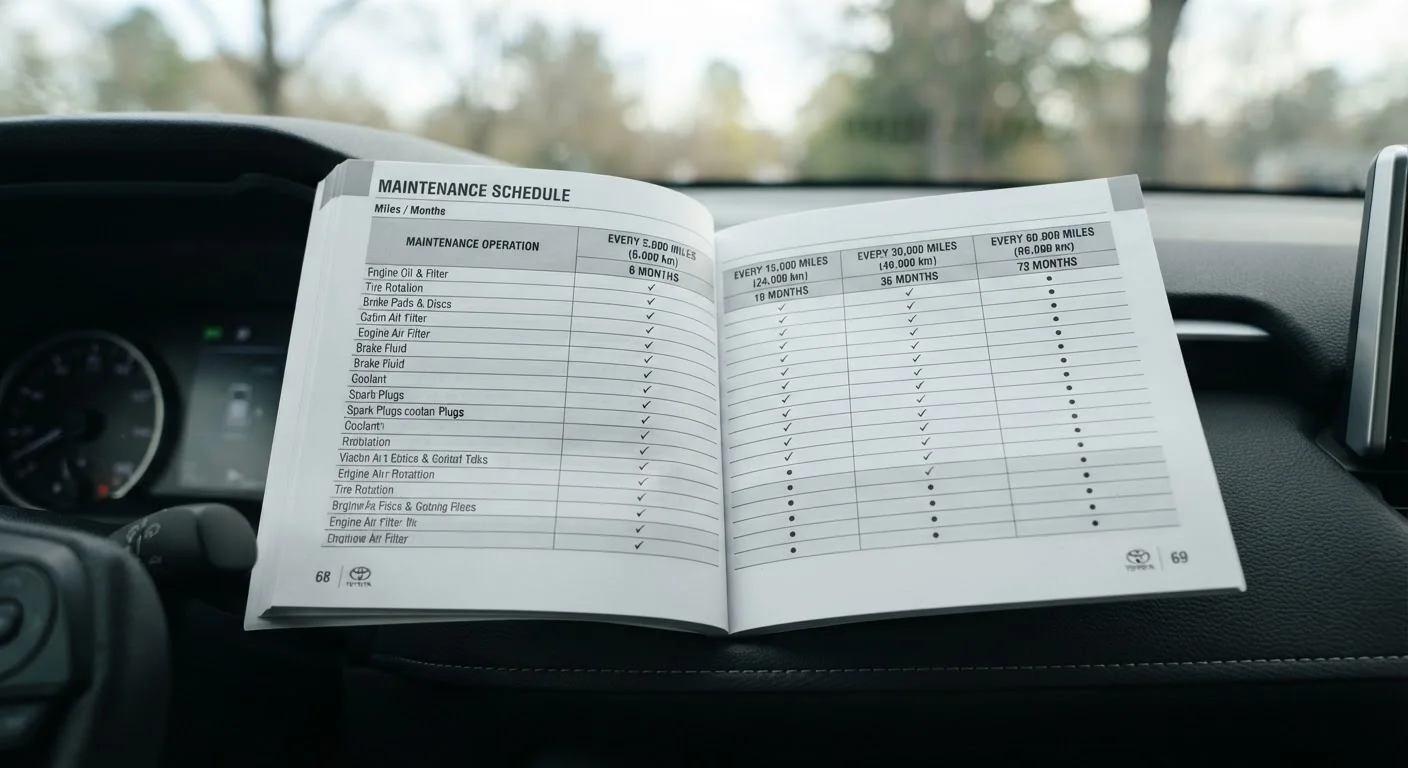
The schedule itself is typically a table. Rows represent service tasks - oil change, tire rotation, spark plug replacement, brake fluid inspection, and so on. Columns represent mileage milestones: commonly 5,000, 10,000, 15,000, and continuing in intervals up to 100,000 miles or beyond. A checkmark or dot at the intersection of a task and a mileage column tells you when that service is due.
Maintenance interval
The mileage or time period after which a specific service task should be performed, as specified by the vehicle manufacturer.
Dual-trigger interval
A service schedule rule where service is due when either a mileage threshold or a time period (whichever comes first) is reached.
Severe driving conditions
Operating patterns - such as frequent short trips, stop-and-go traffic, or towing - that put greater stress on vehicle components and require more frequent service than standard schedules.
Inspect vs. replace
'Inspect' means a technician evaluates the component and services it only if needed. 'Replace' means the part should be changed out at that interval regardless of how it looks.
Service milestone
A specific mileage or time point on the maintenance schedule where one or more service tasks are due - for example, 30,000 miles or 24 months.
Some tasks appear at every interval. Others appear only every 30,000 or 60,000 miles. Don't assume a task that wasn't listed at 15,000 miles isn't coming - scan the full table, not just the nearest column.
Decoding Mileage vs. Time Intervals
Most schedules list two triggers for each service: mileage and elapsed time (often expressed in months). The rule is straightforward - whichever comes first applies. A driver who puts only 5,000 miles per year on their vehicle still needs to follow the 12-month oil change interval if that's what the manual specifies, because oil degrades through oxidation even when the car sits.
This dual-trigger structure trips up low-mileage drivers most often. If you drive infrequently, you may assume your vehicle needs less maintenance. In practice, time-based intervals ensure that fluids and seals that degrade with age - not just use - are addressed on schedule. See our overview of seasonal car maintenance for context on how calendar timing fits into the broader picture.
Normal vs. Severe Driving Conditions
Most maintenance schedules include two tracks: normal and severe (sometimes called special operating conditions). Severe doesn't mean track racing. According to typical manufacturer definitions, it includes:
- Frequent short trips under 5 miles, especially in cold weather
- Stop-and-go urban driving for most of your mileage
- Towing or hauling heavy loads regularly
- Driving in dusty, sandy, or salted road environments
- Extreme temperature climates
Many everyday urban and suburban drivers actually qualify as severe-condition drivers without knowing it. If that describes your typical driving, the severe-condition column applies to you - and it usually calls for shorter intervals between services.
Check Both Tracks Before Your Next Service
Before booking an appointment, look at both the normal and severe columns in your schedule and honestly assess which applies to your driving. If you spend most of your miles in city traffic or regularly make short cold-weather trips, the severe-condition track likely applies. Using the wrong track - even unintentionally - can mean under-maintaining components that need more frequent attention.
Check commonly overlooked maintenance items to see which tasks tend to fall through the cracks regardless of driving classification.
Putting the Schedule Into Practice
Reading the schedule is only half the job. Acting on it consistently is what delivers value. A practical approach:
- Note your current mileage. Find where you fall on the schedule table today and identify the next upcoming service milestone.
- Set a reminder. Use your phone, a calendar, or a mileage-tracker app to flag the next service date or mileage - whichever comes first.
- Document every service. Keep dated receipts with mileage noted. This creates the service history that protects warranty claims and communicates a vehicle's care to future buyers. Our article on keeping a vehicle maintenance log covers exactly how to do this efficiently.
- Don't rely solely on dashboard reminders. Oil life monitors and service lights are helpful prompts, but they don't track every item in the schedule - timing belt replacements and coolant flushes, for example, typically don't trigger dashboard warnings.
Also worth reviewing: maintenance tasks drivers quietly skip, which covers the services that most commonly fall off the radar even among attentive owners.
Your manual's maintenance schedule isn't fine print - it's the most vehicle-specific advice you'll ever receive. Treating it as a working document rather than a booklet in the glovebox makes a meaningful difference over a vehicle's life.
Frequently Asked Questions
Look in the table of contents under headings like 'Maintenance,' 'Service Schedule,' or 'Scheduled Maintenance.' It typically appears in the middle-to-back section of the manual. Many manuals also include a separate booklet specifically for maintenance intervals.
Occasional minor overages are unlikely to cause immediate damage, but habitual delays accumulate wear. Oil that is long overdue loses its ability to lubricate effectively, and skipped inspections can allow developing problems to worsen. Stay as close to the recommended interval as practical.
No. Independent repair shops and qualified mechanics can perform schedule-based services. The key is documenting the work with dated receipts and mileage records, which preserves your ability to demonstrate proper upkeep for warranty or resale purposes.
An 'inspect' entry means a technician checks the component's condition and replaces it only if needed. A 'replace' entry means the item should be swapped out regardless of apparent condition, usually because the material degrades invisibly with use - brake fluid and timing belts are common examples.
Yes. Most manufacturers offer digital versions of owner's manuals on their official websites, searchable by model year and VIN. Several third-party databases also aggregate this information, though the manufacturer's site is the authoritative source.
Not always. Different engines, drivetrains, or transmissions within the same model line can have different service intervals. Always cross-reference the schedule with your specific engine size and configuration, which are listed on the vehicle's emissions label under the hood.
The content on this site is provided for informational purposes only and should not be considered a substitute for professional advice. While we strive to provide accurate and up-to-date information, we make no guarantees regarding its completeness or accuracy. Always consult a qualified professional for advice specific to your circumstances before making any decisions.