

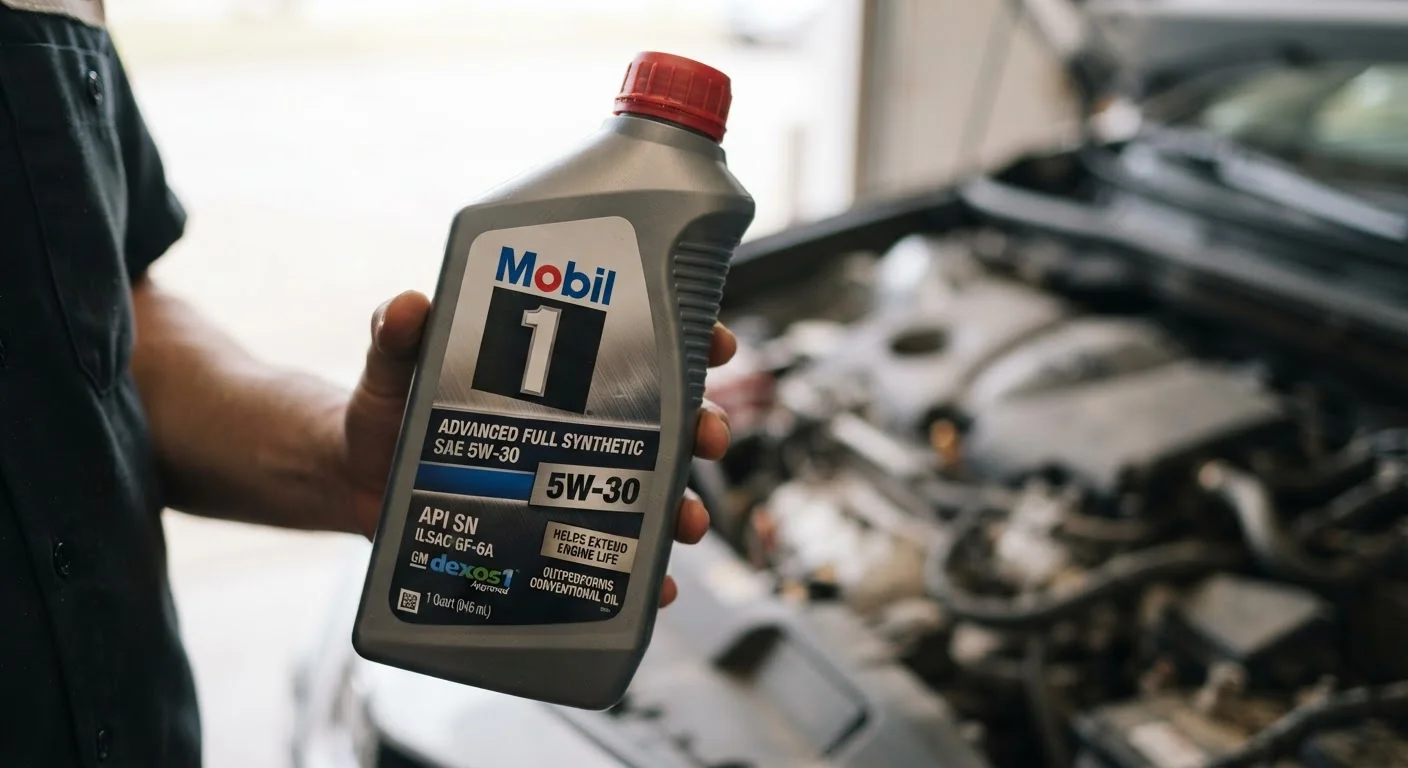
Breaking Down the Label: What 5W-30 Actually Means
Pick up any oil bottle and you'll see a code stamped on the label - 5W-30, 10W-40, 0W-20. It looks technical, but the logic is straightforward once you understand the structure.
The label contains two numbers separated by a 'W'. The W stands for Winter - not weight, as many drivers assume. The number before the W describes the oil's viscosity (resistance to flow) in cold conditions. A lower number means the oil stays thinner and flows more freely when temperatures drop. This matters enormously at startup, when the engine has no warm oil circulating yet and metal parts are briefly running against each other with minimal lubrication.
The number after the W describes the oil's viscosity at normal operating temperature - roughly 212°F (100°C). A higher number here means the oil maintains more thickness under heat. Think of it as the oil's staying power when your engine is working hard on a summer highway.
So a 5W-30 oil flows like a thin '5-weight' oil in the cold and behaves like a thicker '30-weight' oil once the engine warms up. That dual performance is made possible by polymer additives that help the oil resist thinning as temperature rises.
Single-Grade vs. Multi-Grade Oils
Older vehicles sometimes specified single-grade oils like SAE 30 or SAE 40, which were formulated for a narrow temperature range. Modern vehicles almost universally use multi-grade oils (the two-number format), which perform reliably across a much broader range of conditions. If you drive a classic or vintage vehicle, check with a qualified mechanic about whether single-grade oil is still appropriate for your engine.
Why the Right Grade Matters - and What Goes Wrong With the Wrong One
Engine oil's job is to create a thin film between moving metal components, preventing direct contact that would cause rapid wear. Viscosity is central to how well it does that job.
If the oil is too thin for your engine's design, it may not hold that protective film under high loads or heat. If it's too thick, it won't flow fast enough during a cold start - and the few seconds between ignition and full oil circulation are when a disproportionate share of engine wear actually occurs.
Using the wrong grade can also affect fuel economy. Manufacturers have increasingly specified lighter oils like 0W-20 in modern engines precisely because lower internal friction translates to measurable efficiency gains. Swapping to a heavier grade without cause can partially offset those gains.
Oil change interval myths are another area where outdated advice can lead drivers astray - and viscosity choices interact with how long oil actually lasts in service.
How to Find the Grade Your Engine Actually Needs
There's no guesswork required here. Every vehicle manufacturer specifies the correct oil viscosity grade, and that information is available in multiple places:
- Owner's manual - the most authoritative source. The maintenance schedule section will list the recommended SAE grade, and sometimes alternative grades for extreme climates. See how to read the maintenance schedule section if you've never worked through that part of the manual.
- Oil filler cap - many manufacturers print the recommended grade directly on the cap under the hood.
- Driver's door jamb sticker - sometimes includes fluid specifications alongside tire pressure data.
Viscosity grade is separate from the question of whether to use synthetic or conventional oil - those are two distinct choices. If you're unsure how they interact, understanding the difference between synthetic and conventional oil is a useful next step.
You can also check your oil level and condition at home as part of routine fluid monitoring. The guide to checking car fluids at home walks through the process for oil and other essential fluids.
~25%
Engine wear that occurs at cold startup
Industry engineering literature commonly estimates that a significant portion of engine wear happens in the first moments after a cold start, before oil fully circulates - underscoring why cold-flow viscosity ratings matter.
0W-20
Grade specified by many modern fuel-efficient vehicles
Many automakers have shifted to lighter oil specifications in recent years to meet fuel economy standards, reflecting how viscosity grade choices are increasingly tied to vehicle efficiency design.
Frequently Asked Questions
The 'W' stands for Winter, not Weight. It refers to how the oil flows in cold temperatures. A lower number before the W means the oil flows more easily when your engine is cold, which is critical for protecting engine parts during startup.
No. Thicker oil doesn't automatically mean better protection. Using a grade that's too thick for your engine can restrict oil flow during cold starts, leaving metal surfaces temporarily unlubricated. Always use the viscosity your manufacturer specifies.
Mixing grades isn't recommended as a routine practice, but it won't immediately damage your engine in an emergency. The resulting blend will have an unpredictable viscosity, and you should change to the correct single grade at your next oil change.
Check the oil cap under your hood, the sticker inside the driver's door jamb, or - most reliably - your owner's manual. The manual specifies the exact SAE grade your engine was engineered to use.
Yes, in some cases. Drivers in very cold climates may benefit from a lower first number (e.g., 0W instead of 5W) for better cold-start protection. However, many modern multi-grade oils handle broad temperature ranges well, and your owner's manual often accounts for typical climate variation.
It can. Thinner oils (lower viscosity) generally create less internal friction, which can modestly improve fuel efficiency. That's one reason many newer vehicles specify lighter grades like 0W-20. Deviating from the recommended grade - in either direction - can affect both efficiency and protection.
The content on this site is provided for informational purposes only and should not be considered a substitute for professional advice. While we strive to provide accurate and up-to-date information, we make no guarantees regarding its completeness or accuracy. Always consult a qualified professional for advice specific to your circumstances before making any decisions.