

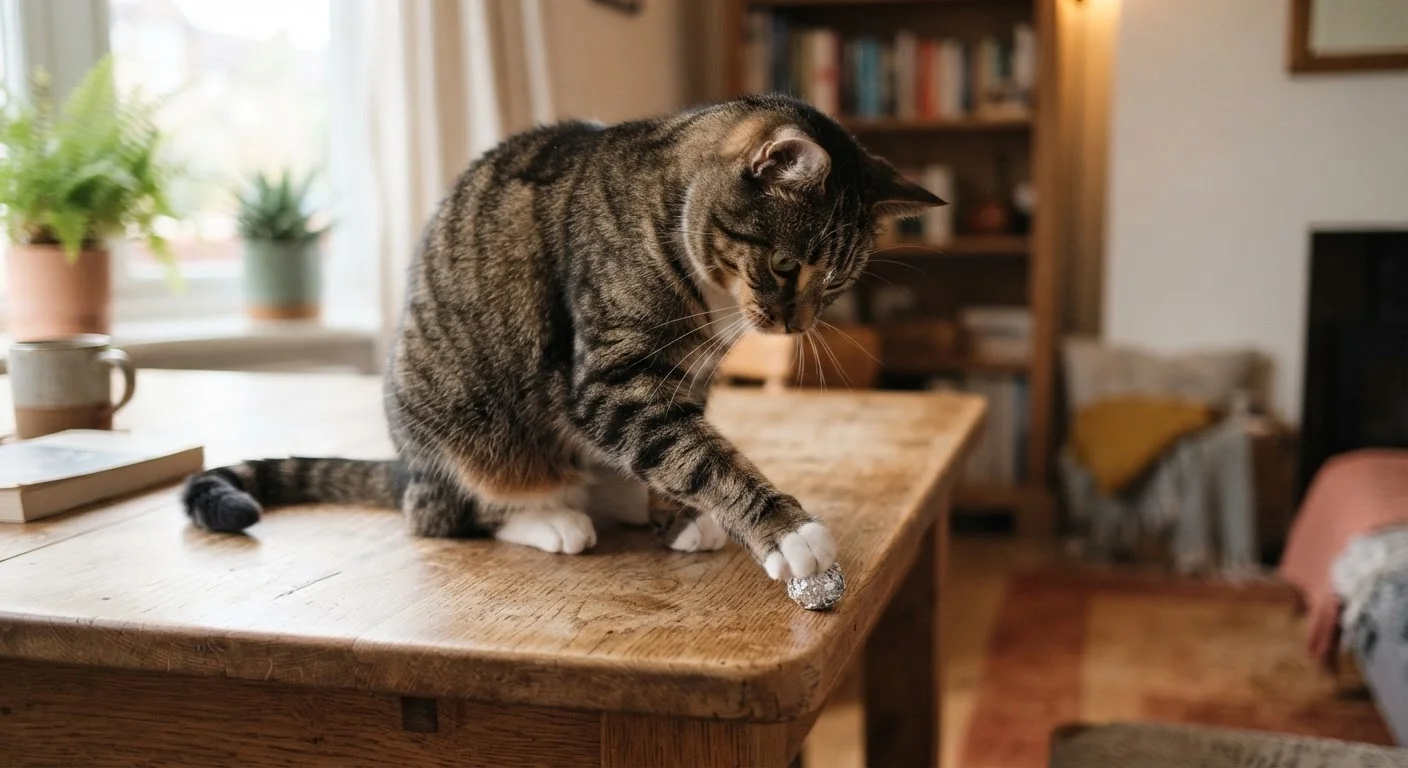
The Predatory Instinct Behind the Paw
Watch a cat interact with a small object on a table and you're watching millions of years of evolution in miniature. Cats are obligate carnivores whose survival once depended on detecting, testing, and subduing prey. That extended paw - the tentative tap, the sideways flick - mimics the exact technique a cat would use to check whether a mouse is still alive or safe to approach.
Household objects trigger the same neural pathways as potential prey. A pen rolling across a desk, a phone vibrating, a crumpled receipt sitting near an edge - all of these register as things worth investigating. The fact that the object then falls and moves unpredictably can actually intensify the interest, reinforcing the behavior through its own reward.
This is also why cats are drawn to objects at table or counter edges rather than the middle of a surface. An edge-positioned object that moves or falls produces the kind of motion feedback a hunting cat finds informative.
“What looks like mischief to us is often highly functional behavior from the cat's perspective. They're testing their environment - figuring out cause and effect - the same way their ancestors tested potential prey.”
— Dr. Mikel Delgado, Cat behavior researcher and certified applied animal behaviorist
When Curiosity Becomes a Conversation
Instinct explains the first push. But many cats quickly graduate to using the behavior as a communication tool - specifically, as a reliable way to get your attention.
Here's how the cycle typically develops: A cat bats something off a surface. The owner reacts - maybe with a startled gasp, laughter, or a firm "no." From the cat's perspective, all of those responses mean the same thing: that worked. The cat filed away that this behavior reliably produces engagement, and it will repeat it whenever it wants interaction and isn't getting it.
This is especially common in households where cats have learned that subtler signals - sitting nearby, slow blinking, soft vocalizations - go unnoticed. Knocking over a glass is hard to ignore, and cats are nothing if not practical. For more on how cats signal their needs through body language, see our guide to feline body language.
Break the Attention Cycle Calmly
If your cat is knocking things over for attention, the most effective response is a neutral one - calmly secure the object and disengage without drama. Reacting with alarm or scolding gives the cat exactly what it was after. Consistency matters: every animated reaction teaches the cat that the strategy works.
Boredom, Understimulation, and the Indoor Cat Problem
Indoor cats lead lives that are, by wild-cat standards, extremely low in stimulation. No hunting, no territorial patrol, no unpredictable encounters with other animals. When a cat's need for mental and physical engagement goes unmet, object manipulation becomes one of the ways it self-stimulates.
Cats that knock things over frequently - especially during the early morning hours when owners are sleeping - are often telling you something important about their enrichment needs. The behavior is a symptom as much as it is a quirk.
~90%
Indoor cats with insufficient daily enrichment
Animal welfare researchers broadly estimate the majority of indoor cats receive less environmental stimulation than is recommended for good behavioral health.
2-3×
Play sessions needed per day for active cats
Veterinary behaviorists commonly recommend at least two to three dedicated interactive play sessions daily for indoor cats to meet their predatory behavioral needs.
Addressing the root cause is more effective than trying to suppress the behavior directly. Puzzle feeders, rotating toys, window perches with outdoor views, and structured daily play sessions can redirect that energy productively. A deeper look at what actually works for indoor cats can be found in enrichment strategies for indoor cats.
When to Pay Closer Attention
For most cats, knocking things over is a normal, harmless behavior that owners can manage with enrichment and by avoiding accidental reinforcement. But a sudden increase in the behavior - especially when paired with other changes - is worth noting.
If your cat seems restless, unusually vocal, is eating or drinking differently, or is showing changes in litter box habits, those combined signals may indicate stress or an underlying health issue. Changes in litter box behavior, in particular, are something veterinarians consistently flag as an underappreciated early warning sign.
It's also worth questioning common assumptions. Many cat owners assume their pets are being "bad" or vindictive, but that framing misses the mark. Persistent myths about cat behavior can make it harder to respond to what your cat is actually communicating. Understanding the real motivation - curiosity, boredom, or a bid for attention - puts you in a much better position to respond effectively.
A cat repeatedly pushes a pen off the kitchen counter every morning, making direct eye contact with its owner before each nudge.
A young indoor cat starts batting objects off shelves in the evening and becomes increasingly restless during the hours its owner is winding down.
A cat that has never shown much interest in knocking things over suddenly begins doing it frequently alongside changes in appetite.
Frequently Asked Questions
Yes and no. Cats are deliberate in their movements, but they aren't acting out of spite or malice. The behavior stems from instinct and curiosity. Whether they understand the consequences - like something breaking - is a separate question that researchers are still exploring.
This is almost certainly attention-seeking behavior. Over time, cats learn that making eye contact and then nudging an object produces a reaction from you. Even scolding counts as a reward in their view - you stopped what you were doing and engaged with them.
Punishment is generally counterproductive with cats and can damage your bond. Since the behavior is often reinforced by attention, the most effective response is usually to calmly remove the object or walk away - then redirect to enrichment activities that meet the cat's underlying needs.
Rarely, but a sudden increase in the behavior - especially paired with other changes like altered eating, litter box habits, or vocalization - could signal stress or a medical issue. If something feels off, a vet visit is a sensible precaution.
Increase enrichment through puzzle feeders, interactive play, and climbing structures. Securing valuables and removing tempting objects also helps. Most importantly, avoid rewarding the behavior with animated reactions, which tend to encourage repetition.
Most cats will knock objects over at some point, though frequency varies widely between individuals. Younger, more active, or understimulated cats tend to do it more often. Personality, energy level, and how much the behavior has been accidentally reinforced all play a role.
The content on this site is provided for informational purposes only and should not be considered a substitute for professional advice. While we strive to provide accurate and up-to-date information, we make no guarantees regarding its completeness or accuracy. Always consult a qualified professional for advice specific to your circumstances before making any decisions.