

Why Indoor Cats Need More Than Food and Shelter
Domestic cats retain the neurological wiring of skilled predators. Even a cat that has never ventured outdoors carries instincts for stalking, pouncing, climbing, and patrolling territory. When those drives have nowhere to go, the result is often a cat that over-grooms, becomes aggressive, or withdraws - behaviors that many owners misread as personality quirks rather than signs of unmet need.
Research in feline behavioral science consistently shows that environmental enrichment - the deliberate design of a living space to encourage species-appropriate activities - is one of the most effective tools for improving indoor cat welfare. It doesn't require expensive setups or constant attention. What it does require is understanding what your cat is actually asking for.
The seven strategies below are grounded in that understanding. Each addresses a specific behavioral need, and most can be implemented with minimal cost or effort.
Use puzzle feeders to activate the hunt-eat cycle
In the wild, cats spend the majority of their waking hours in predatory activity - searching, stalking, and capturing prey - before eating. A bowl of kibble delivered twice a day collapses that entire sequence into seconds. Puzzle feeders, which require a cat to bat, dig, or maneuver food out of a container, restore some of that cognitive and physical effort.
Start with a simple design and increase complexity gradually. Even a muffin tin covered with tennis balls, with kibble tucked in each cup, counts as a puzzle. The goal is mild, satisfying challenge - not frustration.
Puzzle feeders restore the cognitive effort that mealtime in the wild naturally demands.
Maximize vertical space with climbing structures
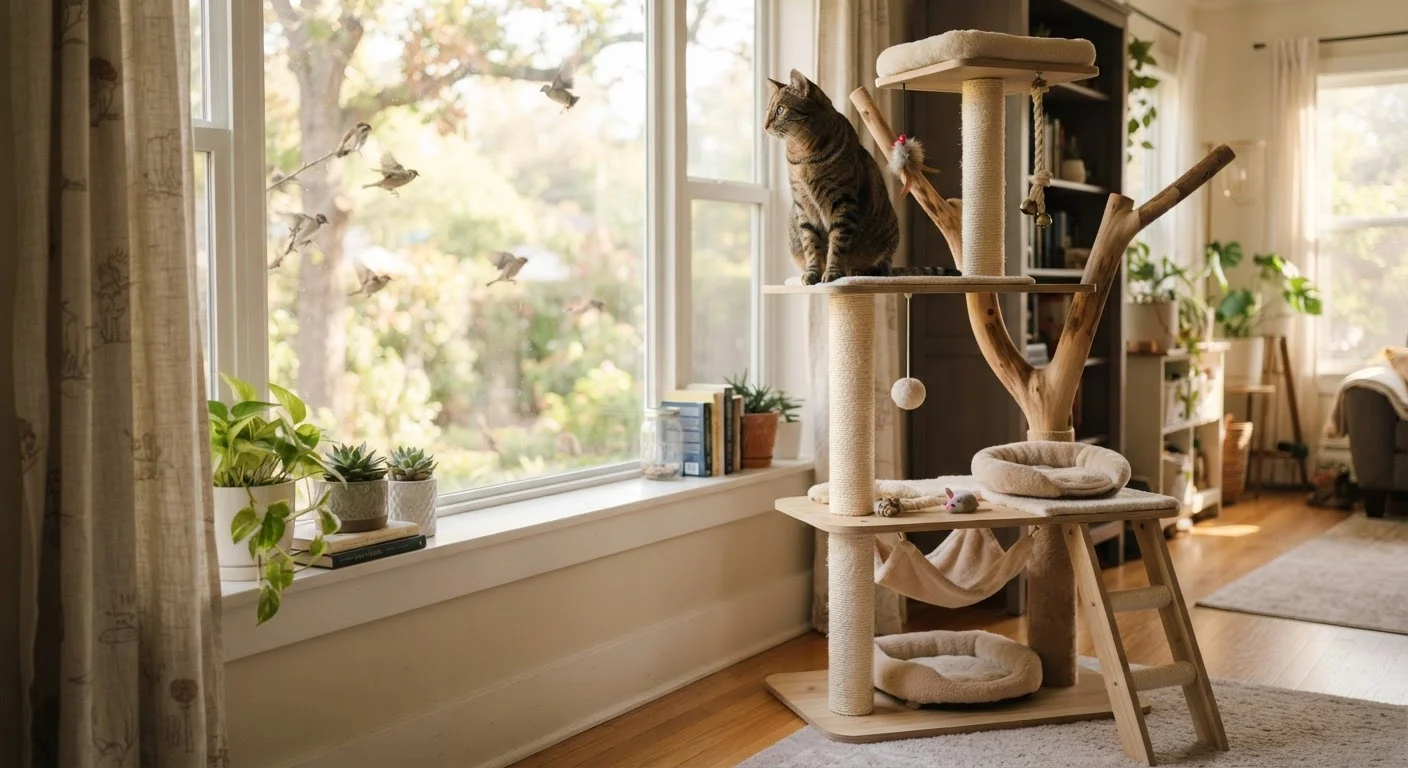
Height is security for cats. Being elevated gives them a vantage point to observe their environment, which reduces anxiety and satisfies the territorial monitoring instinct. Cat trees, wall-mounted shelving systems, and cleared bookshelf ledges all serve this purpose.
In multi-level homes, distributing vertical options across several rooms is more effective than a single tall tower in one location. Cats benefit from being able to move through vertical space, not just occupy it.
Vertical space gives cats the elevated vantage points they instinctively seek for security.
Offer window access with something worth watching
A window can function as live television for a cat - but only if there's something to watch. Positioning a perch at a window that overlooks a garden, bird feeder, or squirrel-frequented tree significantly increases the stimulation value. Many cat owners report that a well-placed bird feeder outside a window reduces restlessness and vocalization noticeably.
If the view is limited, a suction-cup perch near a street-facing window still provides light, warmth, and passing movement - all of which engage a cat's senses meaningfully.
A bird feeder outside a window can function as round-the-clock enrichment for a curious cat.
Rotate toys rather than leaving them all out
Cats habituate quickly. A toy left on the floor for a week becomes invisible. Rotating a small collection of toys - keeping most stored and swapping in two or three at a time - maintains novelty and keeps objects interesting far longer than permanent availability does.
Reintroducing a toy after a week away often triggers the same engaged response as a brand-new item. This strategy costs nothing and requires only a small storage bin and a bit of consistency.
Storing most toys and rotating them weekly maintains novelty without buying anything new.
Schedule short, consistent interactive play sessions
Wand toys and fishing-rod-style toys allow owners to simulate prey movement in ways that solo play cannot replicate. The unpredictability of human-controlled movement - pauses, darts, hides behind furniture - is precisely what keeps a cat locked into the predatory sequence.
Two 10-to-15-minute sessions per day, ideally ending with a small food reward or a toy the cat can "catch" and carry away, mirrors the natural hunt-eat-groom-rest cycle. This structure helps cats wind down rather than escalating into nighttime restlessness. It also builds the kind of trust that makes grooming and veterinary handling easier - for more on that routine, see our guide to low-stress home grooming.
Ending play sessions with a small food reward mirrors the natural hunt-eat-rest cycle.
Introduce scent enrichment through safe plants and materials
Cats process a significant amount of environmental information through smell. Catnip and silver vine are well-documented to produce playful responses in many cats, though roughly 30-50% of cats are genetically unresponsive to catnip specifically. Silver vine tends to elicit a response in a broader proportion of cats.
Beyond these, rotating safe herbs like valerian or offering items that carry outdoor scents - pinecones, dried leaves, untreated wood - gives indoor cats olfactory variety that a static home environment doesn't naturally provide.
Scent variety gives indoor cats olfactory experiences that a static home cannot naturally offer.
Provide hiding spots as well as open play areas
Enrichment is often framed as stimulation, but the ability to withdraw is equally important. Cats need places where they can observe without being observed - covered beds, cardboard boxes, or open shelving cubbies all serve this function. Hiding spots reduce stress during loud events, visitors, or household changes.
A cat that has reliable retreat options is generally less reactive and more willing to engage when it chooses to. Forcing interaction without offering withdrawal options undermines the sense of control that is central to feline well-being.
Reliable hiding spots reduce reactivity and give cats the sense of control they need to feel safe.
Putting It All Together
Enrichment doesn't have to mean a room full of equipment. Start with one or two changes - a puzzle feeder, a perch by the window, a 10-minute wand session before bed - and observe your cat's response. Cats are individuals, and what captivates one may bore another entirely.
If your cat is showing persistent signs of stress despite environmental improvements, a conversation with your veterinarian or a certified applied animal behaviorist can help identify underlying causes. Enrichment complements veterinary care; it doesn't replace it.
Observe Before You Invest
Before adding new equipment or toys, spend a few days noting when your cat is most active, where it tends to rest, and what it gravitates toward during play. Enrichment tailored to observed preferences is consistently more effective than generalized solutions. A cat that ignores a climbing tower but obsessively bats at hanging objects is telling you exactly where to focus.
For owners navigating related decisions - like whether a second cat might ease a solo cat's boredom - our piece on single vs. multi-cat households walks through the temperament and space considerations worth thinking through first. And if you're building a broader care routine, structuring a consistent feeding routine is a natural complement to the enrichment strategies here.
The content on this site is provided for informational purposes only and should not be considered a substitute for professional advice. While we strive to provide accurate and up-to-date information, we make no guarantees regarding its completeness or accuracy. Always consult a qualified professional for advice specific to your circumstances before making any decisions.