

Start here
What Is a Food Taboo?
Build context
The Roots of American Food Avoidance
Go deeper
Common Foods Americans Avoid That Others Embrace
See change
How Taboos Shift Over Time
Apply it
Why Understanding Food Taboos Matters
What Is a Food Taboo?
A food taboo is any culturally enforced rule - written or unwritten - that designates a food as inappropriate, forbidden, or revolting within a particular group. These aren't the same as personal dislikes or allergies. Taboos are collective: they are shared, transmitted across generations, and often tied to a community's deepest values.
Every human society has them. The foods that trigger disgust or refusal in one culture may be celebrated in another. That disconnect isn't random - it's the product of religion, history, local ecology, and the stories a culture tells about itself.
Food taboo
A shared cultural rule that treats a particular food as forbidden, disgusting, or morally off-limits within a specific group or society.
Entomophagy
The practice of eating insects as food. It is common in many parts of the world and increasingly discussed in Western food culture as a sustainable protein source.
Nose-to-tail eating
A cooking philosophy and traditional practice of using every edible part of an animal, including organs, bones, and less common cuts, to reduce waste.
Disgust response
An instinctive emotional reaction that causes a person to reject or avoid something - in the case of food, it is strongly shaped by cultural learning rather than biology alone.
Fermentation
A preservation and flavor-development process in which microorganisms like bacteria or yeast break down food components, producing acids, gases, or alcohol. It underpins foods like yogurt, cheese, kimchi, and beer.
Understanding food taboos is less about judging what's "right" to eat and more about understanding why humans draw lines around food in the first place.
The Roots of American Food Avoidance
American food culture is a layered patchwork, built from European settler traditions, Indigenous foodways, and centuries of immigration. Several forces drive what mainstream American food culture tends to avoid:
- Religious heritage: Many Americans come from Christian, Jewish, or Muslim backgrounds with dietary guidance built in. Even for secular Americans, these traditions have shaped cultural defaults around pork, shellfish, and meat preparation.
- Agricultural history: In American farming culture, horses, dogs, and cats became working animals or companions - not food. That relational role made eating them feel like a moral violation, even without explicit religious sanction.
- Industrialized food supply: As American food production scaled up in the 20th century, whole animal eating largely disappeared from everyday life. Organ meats, bone-in cuts, and unusual animal parts became unfamiliar rather than taboo - but unfamiliarity easily slides into aversion.
- Media and marketing: Advertising shaped American food norms throughout the 20th century, consistently centering certain proteins and cuts while making others invisible.
These forces don't operate in isolation. They reinforce one another, making certain aversions feel natural even when their origins are thoroughly cultural.
Common Foods Americans Avoid That Others Embrace
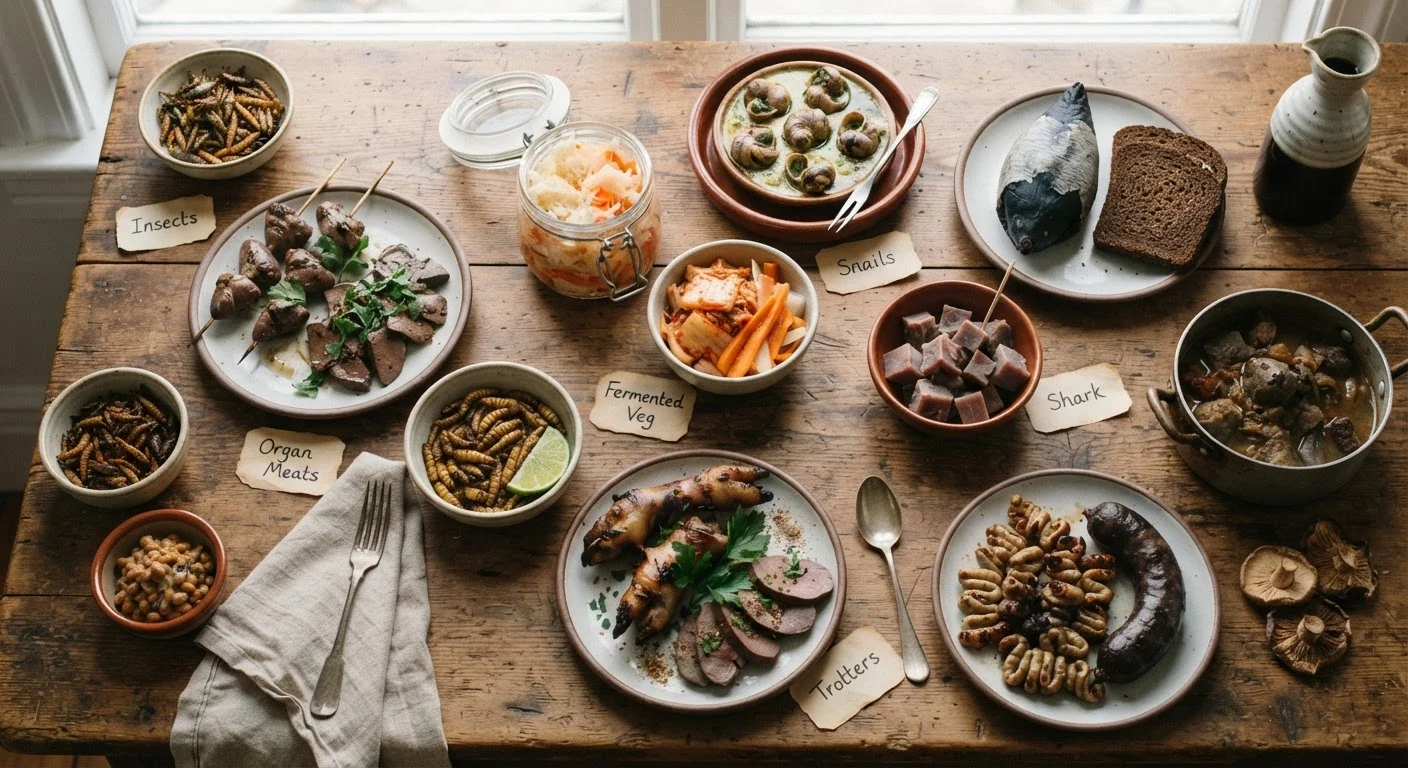
Several categories of food that many Americans find unappealing are considered everyday or even prestigious in other parts of the world:
- Insects
- Crickets, mealworms, and grasshoppers are high-protein staples in parts of Mexico, Southeast Asia, and sub-Saharan Africa. Entomophagy - the practice of eating insects - is practiced by an estimated two billion people globally, according to the Food and Agriculture Organization of the United Nations.
- Organ meats
- Liver, kidneys, tripe, and heart feature prominently in French, Middle Eastern, and Latin American cuisines. In the United States, organ meats were common through the mid-20th century but fell sharply out of fashion as processed foods rose and cultural memory of nose-to-tail eating faded.
- Fermented and pungent foods
- Dishes like surströmming (Sweden), natto (Japan), or century egg (China) carry intense aromas that make many Americans recoil. Yet fermentation is one of humanity's oldest preservation methods and the basis of beloved American staples like cheese and sauerkraut.
- Certain meats
- Horse meat is consumed in parts of Europe and Central Asia. Dog meat, though deeply taboo in the U.S., has a historical and cultural presence in some East Asian and West African food traditions. These taboos are especially strong in America due to pet culture and companion-animal norms.
If you're curious about trying unfamiliar cuisines connected to these traditions, our guide to exploring ethnic cuisine offers a practical starting point.
How Taboos Shift Over Time
Food taboos are not permanent. American food history is full of dramatic reversals.
Lobster, once so abundant it was fed to prisoners and indentured servants in colonial New England, became a luxury item by the 20th century. Raw fish was largely unacceptable to mainstream American diners before the 1970s - today, sushi restaurants operate in nearly every mid-sized American city. Bone broth, tripe, and fermented foods have all experienced notable revivals among younger urban eaters in recent decades.
A Good Way to Test Your Own Assumptions
Next time a food strikes you as unappetizing, pause and ask: Is this reaction based on taste, or is it based on what I was taught? Separating genuine sensory preference from inherited aversion can be surprisingly illuminating - and sometimes leads to a genuinely enjoyable new experience.
What drives these shifts? Immigration consistently introduces new flavor norms. Travel and media expose people to food contexts that make the unfamiliar feel plausible. Economic pressure sometimes makes previously ignored cuts of meat appealing again. And generational turnover means that what felt disgusting to one cohort may feel adventurous - even fashionable - to the next.
To understand how these shifts actually travel through American culture, see our piece on how American dining trends spread.
Why Understanding Food Taboos Matters
Food taboos aren't just culinary trivia - they carry real social weight. When Americans travel abroad, dine with people from other cultures, or sit across from someone whose food background differs from their own, assumptions about what's "normal" to eat can create unnecessary barriers.
Recognizing that your own food avoidances are culturally shaped - not universal - opens the door to more genuine cross-cultural connection. It doesn't mean abandoning your values or pretending disgust isn't real. It means holding your food preferences with a little more curiosity and a little less certainty.
If you dine out frequently and need to navigate dietary restrictions - whether your own or those of guests - our article on food allergy communication at restaurants covers how to have those conversations effectively.
Food is never just food. It is identity, memory, belonging, and negotiation all at once. Understanding taboos - your own and others' - is one of the more honest ways to understand a culture, including the one you grew up in.
Frequently Asked Questions
A food taboo is a cultural, religious, or social rule - formal or informal - that marks a particular food as off-limits. These rules vary widely by community and are rarely about nutrition alone. They reflect deeper values around purity, identity, and belonging.
Western food culture, including American, developed largely without insect-eating as a norm. Disgust responses around insects are heavily shaped by cultural conditioning rather than biology. In contrast, many Asian, African, and Latin American food traditions have long included insects as nutritious, sustainable protein sources.
No - while religion is a major driver (kosher, halal, and Hindu dietary laws are well-known examples), many taboos stem from ecology, economics, historical livestock use, or simple cultural habit. Some foods become taboo simply because they were never part of a regional food supply.
Absolutely. Sushi, raw oysters, and organ meats have all experienced shifting acceptance in American culture. Immigration, global travel, and media exposure consistently erode or transform food taboos across generations.
Context matters enormously. Declining politely and with genuine curiosity about the food is usually well-received. Learning a little about why a dish is meaningful to the host often goes further than forcing yourself to eat something that conflicts with your own values or health needs.
Not at all. America is religiously and ethnically diverse, so food avoidances vary significantly by region, community, and family background. What is taboo in one household may be a Sunday tradition in another.
The content on this site is provided for informational purposes only and should not be considered a substitute for professional advice. While we strive to provide accurate and up-to-date information, we make no guarantees regarding its completeness or accuracy. Always consult a qualified professional for advice specific to your circumstances before making any decisions.