

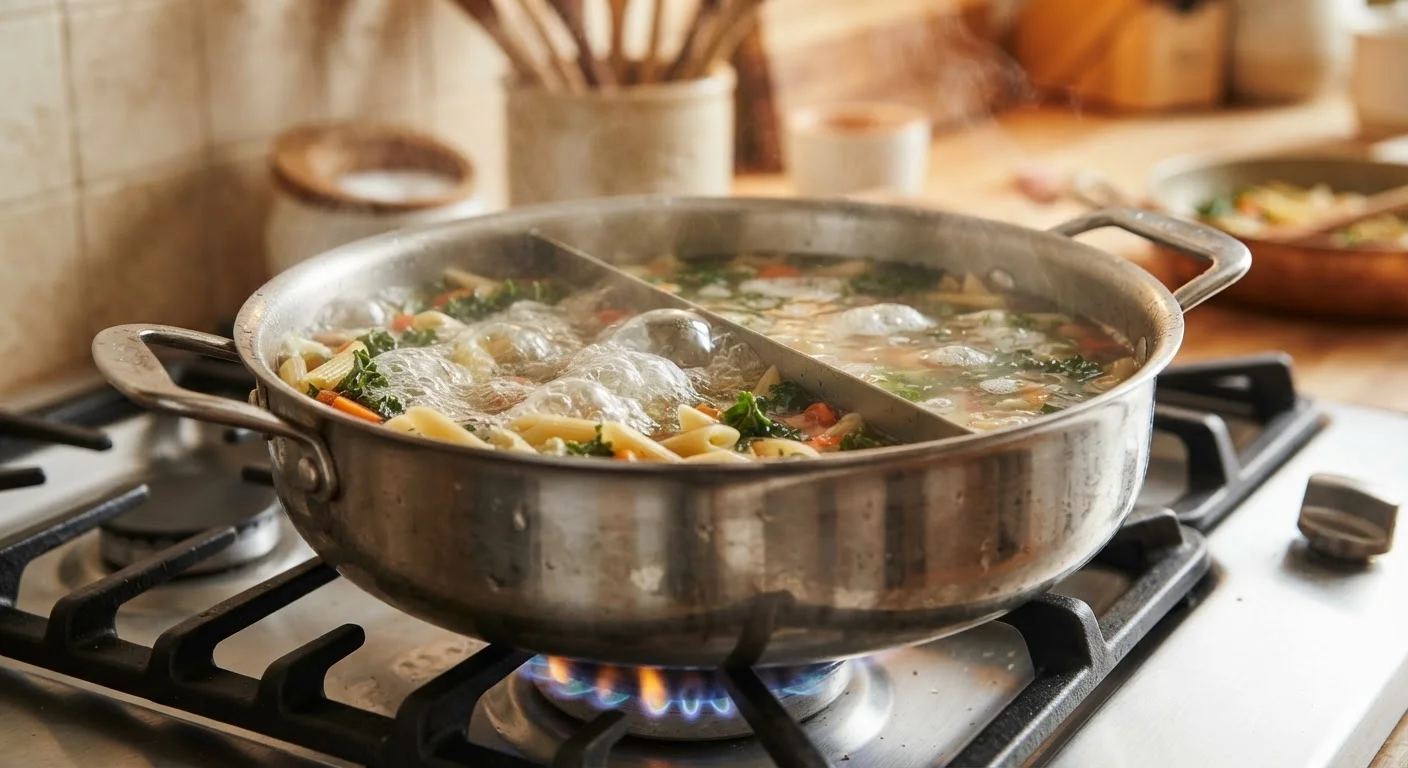
Option A
Boiling
The high-heat, fast-action technique.
Best for: Cooking pasta, blanching vegetables, and any situation where speed and heat tolerance matter.
Option B
Simmering
The low-and-slow approach for depth and tenderness.
Best for: Building soups, braises, sauces, and dishes where gentle, extended heat develops flavor without damaging texture.
What's Actually Happening in the Pot
Both boiling and simmering are moist-heat cooking methods - liquid is doing the work. The critical difference is temperature, and temperature determines how aggressively the liquid moves and, by extension, how it interacts with your food.
A full boil occurs when water reaches 212°F (100°C) at sea level. At this point, large, vigorous bubbles break the surface continuously. The liquid churns actively, and steam rises in earnest. You can't maintain a boil by walking away from the stove - it requires sustained high heat.
A simmer happens at roughly 180°F to 205°F. You'll see small bubbles rising lazily from the bottom of the pot and occasionally breaking the surface. The liquid barely trembles. Some cooks describe it as the pot "breathing." It takes noticeably less energy to sustain, and most stovetops hold it easily on a medium-low or low setting once the liquid is up to temperature.
For a broader look at how heat level shapes different cooking methods, see matching methods to what you're cooking.
| Criterion | Boiling | Simmering |
|---|---|---|
| Temperature range | 212°F (100°C) | 180°F-205°F |
| Bubble activity | Large, vigorous, continuous | Small, lazy, occasional |
| Best for proteins | Not ideal - can toughen | Yes - gentle and tenderizing |
| Best for pasta & starchy veg | Yes - fast and effective | Not recommended |
| Stocks and broths | Produces cloudy, greasy result | Keeps broth clear and clean |
| Sauce reduction | Can scorch or reduce unevenly | Controlled, even evaporation |
| Energy required | High - sustained heat needed | Low to medium-low |
How Each Method Affects Your Food
Proteins are where the difference is most dramatic. Muscle fibers contract when exposed to heat. At a rapid boil, they contract fast and squeeze out moisture, leaving chicken breasts rubbery, shrimp tough, and beef dry. Simmering heats proteins gradually, which lets collagen (the connective tissue in tougher cuts) convert slowly into gelatin - the reason a properly simmered pot roast or beef stew falls apart tenderly rather than shredding into dry strands.
Vegetables respond differently depending on what you want from them. Blanching or boiling green vegetables in well-salted, rapidly boiling water for a short time preserves color and texture. But if a delicate vegetable like spinach or peas sits in a boil for too long, it turns grey and mushy. In a soup, vegetables added to a simmering broth cook more evenly and hold their shape better.
Sauces and stocks almost always want a simmer. A stock held at a vigorous boil emulsifies fat into the liquid rather than letting it rise to the surface, producing a cloudy, greasy result. A stock held at a bare simmer stays clearer, which matters for appearance and for the clean flavor of a well-made broth.
Understanding these distinctions will make recipe instructions feel less arbitrary. When a recipe says "bring to a boil, then reduce to a simmer," it's not just a sequence - it's a deliberate shift in what the heat is doing to your ingredients. For more on decoding those instructions, see reading cooking terminology without getting lost.
Practical Tips for Controlling Your Heat
The most common beginner mistake is leaving the burner too high after bringing a liquid to a boil. Recipes that call for a simmer after the initial boil require you to actively turn the heat down - sometimes considerably - to prevent over-cooking.
- Watch the surface, not the clock. Learn to identify a simmer by sight. If bubbles are breaking rapidly and the liquid is splashing, the heat is too high.
- Use a lid strategically. Covering a pot traps steam, which raises temperature. If your simmer keeps climbing toward a boil, tilt the lid slightly to let steam escape.
- Salt your boiling water generously. When boiling pasta or vegetables, salted water seasons the food from the inside out. The water should taste pleasantly salty, not like ocean water.
- Don't crowd a boil. Adding too much food at once - especially frozen food - drops the water temperature sharply, stopping the boil and leading to uneven cooking. Add in batches when needed.
These fundamentals are part of a larger foundation covered in the cooking fundamentals that make every recipe easier to follow. Once you can recognize and hold the right heat by instinct, you'll spend less time second-guessing recipes and more time actually cooking confidently.
The content on this site is provided for informational purposes only and should not be considered a substitute for professional advice. While we strive to provide accurate and up-to-date information, we make no guarantees regarding its completeness or accuracy. Always consult a qualified professional for advice specific to your circumstances before making any decisions.