

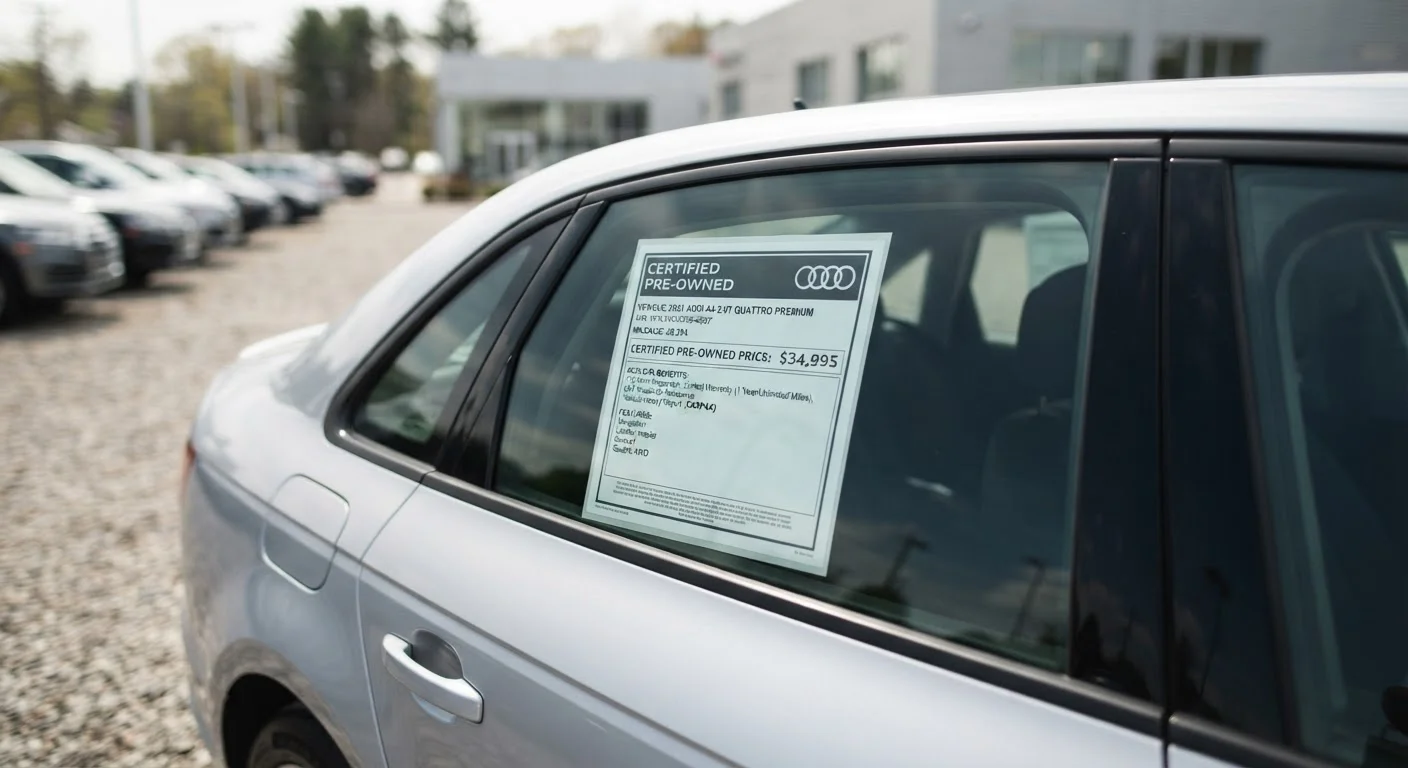
Our Verdict
A certified pre-owned vehicle can offer meaningful peace of mind over a standard used car, particularly when the manufacturer's program includes a robust powertrain warranty and roadside assistance. However, 'certified' is not a universal standard - coverage depth, inspection rigor, and eligibility criteria vary considerably from one automaker to the next. Shoppers who do their homework and compare the specific warranty terms against the price premium will be in the strongest position.
CPO is most worthwhile for buyers who want near-new reliability without new-car depreciation and are willing to verify the specific program terms before committing.
What 'Certified Pre-Owned' Actually Means
The term certified pre-owned (CPO) sounds official, but it isn't regulated by a single federal standard. Each automaker designs and administers its own CPO program, which means the word "certified" carries different weight depending on the brand on the hood.
At a baseline, most manufacturer-backed CPO programs share a few common elements: the vehicle must fall within a certain age and mileage range (often under five to seven years old and under 60,000-80,000 miles), must pass a multi-point inspection - typically 100 to 200 checkpoints - and must have a clean title with no significant accident history. In exchange, the buyer receives an extended warranty that picks up where the original manufacturer's coverage left off, or runs concurrently with whatever remains.
It's worth noting that some dealerships also advertise dealer-certified vehicles. These are not the same as manufacturer-backed CPO programs. Dealer certification is self-defined, often less rigorous, and the warranty behind it is only as reliable as the dealership itself. The distinction matters when you're evaluating what protection you're actually getting. For a broader look at how certification labels work across consumer categories, see how certification labels are defined and enforced.
What CPO Typically Covers
Manufacturer CPO programs generally include three core protections:
- Extended powertrain warranty: This is usually the most substantive coverage - engine, transmission, and drivetrain components - and can extend several years beyond the original warranty period.
- Limited comprehensive coverage: Many programs include a shorter-term "bumper-to-bumper" style warranty covering electrical systems, air conditioning, and other components, though the length varies widely.
- Roadside assistance: Towing, lockout service, and emergency fuel delivery are common inclusions, typically tied to the warranty period.
Some programs also provide complimentary scheduled maintenance for a defined period, satellite radio trial subscriptions, or loaner vehicle provisions during covered repairs. These extras differ by brand and model year, so they're worth asking about specifically rather than assuming they're included.
Extended warranty provides real repair cost protection
A manufacturer-backed powertrain warranty can cover major engine or transmission failures that would otherwise cost thousands out of pocket, offering more financial predictability than a standard used-car purchase.
Multi-point inspection adds a layer of vetting
CPO vehicles have been reviewed against a documented checklist, which can surface issues that a casual test drive or visual inspection would miss - giving buyers a more complete picture of the vehicle's condition.
Manufacturer backing provides more accountability than dealer-only sales
Because the automaker's name is attached to the program, there's a structural incentive to maintain inspection standards - unlike purely dealership-managed used car sales where oversight is self-imposed.
Roadside assistance included in most programs
Towing, fuel delivery, and lockout coverage during the warranty period adds practical value and reduces the immediate need for a separate roadside assistance subscription.
Access to manufacturer financing rates in some cases
Some automakers offer promotional financing rates on CPO vehicles that aren't available on standard used cars, which can reduce the effective cost of borrowing - though terms vary and should be verified directly.
If you're weighing a CPO vehicle against buying new, the real trade-offs between new and used cars - including depreciation curves and warranty gaps - are worth understanding before you decide.
What CPO Doesn't Cover - The Gaps That Catch Buyers Off Guard
CPO warranties are not bumper-to-bumper coverage for the life of the vehicle. They carry exclusions that, if unread, can result in unexpected repair bills.
CPO programs vary widely - the label isn't standardized
What 'certified' means for one brand may be significantly more or less comprehensive than another brand's program. Comparing programs across manufacturers requires reading the fine print, not just taking the badge at face value.
Wear-and-tear items are almost always excluded
Tires, brakes, belts, filters, and other consumables fall outside CPO warranty coverage in virtually every program, meaning these routine but potentially costly items remain the buyer's responsibility from day one.
Price premium may not reflect actual coverage value
The cost difference between a CPO and non-CPO version of the same vehicle doesn't always correlate with the actual warranty value - buyers can end up paying for coverage that's narrower or shorter than assumed.
Pre-existing conditions may still slip through
Inspections are conducted by dealership technicians, not independent auditors. Items within normal wear tolerances or borderline conditions may pass inspection and later develop into problems that aren't covered.
Coverage is tied to specific dealerships or service centers
Warranty repairs often must be performed at an authorized dealership for the brand, which can be inconvenient depending on location and may limit your choice of qualified mechanics.
Vehicle history may still include minor accidents
Some CPO programs permit vehicles with prior minor collision repairs, provided damage fell below a defined threshold. Buyers should always review the vehicle history report independently rather than relying solely on CPO status.
Wear-and-tear items - brake pads, tires, wiper blades, filters, and belts - are almost universally excluded. Pre-existing conditions identified during the inspection but not repaired before sale may also be excluded, depending on how the program documents them. Cosmetic damage, upholstery, glass, and audio systems may fall outside coverage depending on the specific program.
Some programs also exclude repairs needed due to modifications, improper maintenance by the prior owner, or use of non-approved fluids. The warranty documents will specify these clearly, but they tend to be dense reading. Approach them the same way you'd approach any warranty contract - the exclusions section is where the real picture lives. Our guide on what a manufacturer's warranty actually covers walks through typical exclusion patterns in useful detail.
How to Evaluate Whether the Premium Is Worth It
CPO vehicles typically carry a price premium over comparable non-certified used cars - often in the range of a few hundred to a few thousand dollars depending on the vehicle. Whether that premium is justified comes down to three questions:
- How much warranty coverage remains, and for what? A powertrain warranty with two years and 40,000 miles remaining has a different value than one with six months left.
- What does the inspection record show? Ask for the completed inspection checklist. A reputable CPO program will provide it. Review which items were flagged and how they were addressed.
- What's the vehicle history? Request the full vehicle history report. A clean CPO badge doesn't always mean a clean history - some programs allow vehicles with minor accidents if damage was below a certain threshold.
Comparing a CPO vehicle to a non-certified used car of the same make, model, and mileage is the most straightforward way to isolate the cost of the certification itself. The ongoing costs of vehicle ownership - insurance, maintenance, and unexpected repairs - are also part of the equation worth factoring into your total-cost thinking.
Dealer-Certified vs. Manufacturer-Certified: A Key Distinction
When you see 'certified' on a used vehicle, confirm whether it's a manufacturer-backed program or a dealership's own internal designation. Manufacturer CPO programs are governed by the automaker and typically include standardized inspection criteria and warranty backing. Dealer-certified programs are self-defined and vary widely in what they actually guarantee. Always ask which type of certification applies before assigning weight to the label.
The content on this site is provided for informational purposes only and should not be considered a substitute for professional advice. While we strive to provide accurate and up-to-date information, we make no guarantees regarding its completeness or accuracy. Always consult a qualified professional for advice specific to your circumstances before making any decisions.