

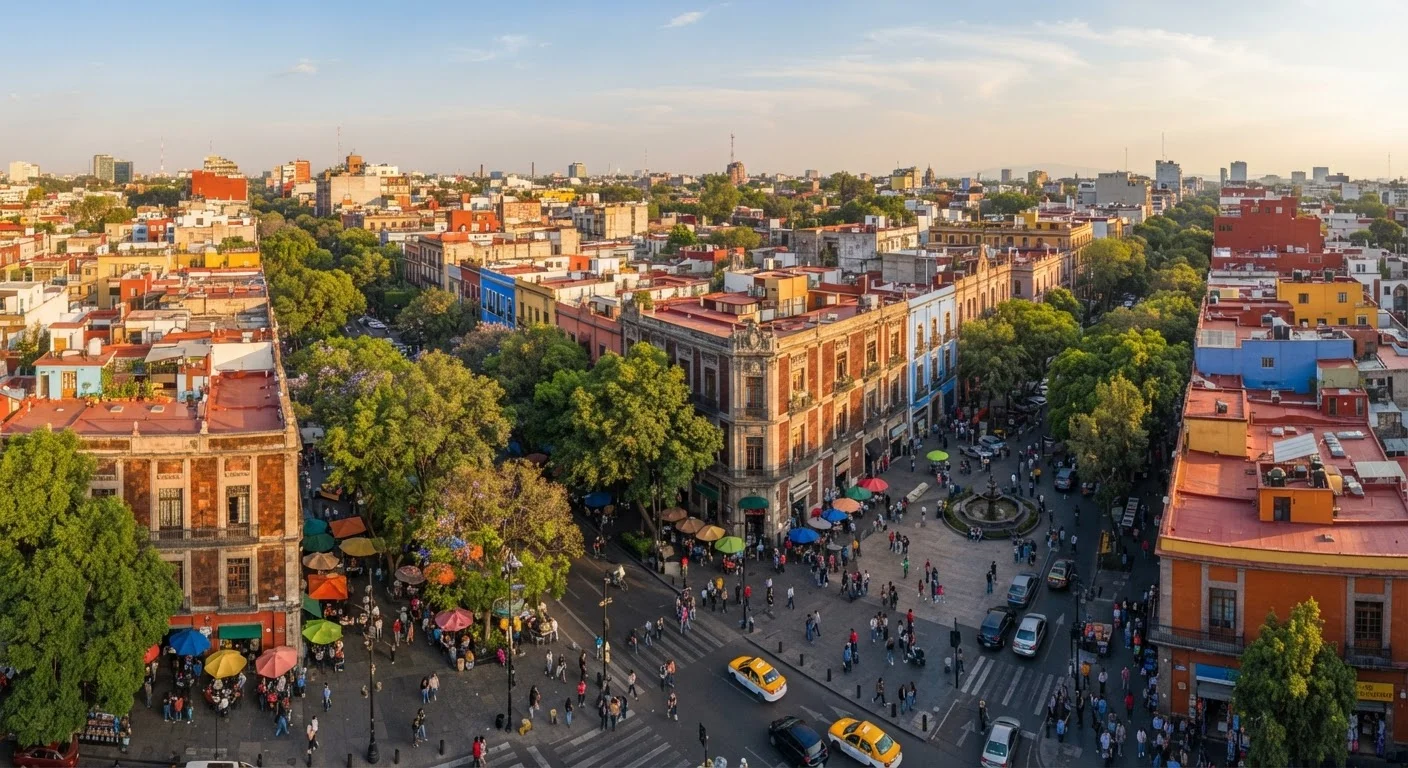
Why Mexico City Is Best Understood by Neighborhood
Mexico City - known locally as CDMX - is one of the largest metropolitan areas in the Western Hemisphere. With over 20 million people across 16 boroughs (alcaldías) and dozens of distinct colonias (neighborhoods), arriving without a mental map can feel overwhelming. The good news: once you understand that CDMX is essentially a city of villages, each with its own character, pace, and strengths, the whole place becomes far more navigable.
Rather than trying to see everything, most travelers find it more rewarding to pick two or three colonias as home bases and explore outward from there. Using neighborhoods as anchors is one of the most reliable strategies for making sense of any big city - and Mexico City rewards that approach especially well.
| Local name for neighborhoods | Colonias |
| City altitude | Approx. 2,240 m (7,350 ft) above sea level |
| Primary transit system | Mexico City Metro (12 lines, 195 stations) |
| Most visited museum | Museo Nacional de Antropología (Polanco) |
| Historic center plaza | The Zócalo - one of the largest urban squares in the world |
| Ancient canal district | Xochimilco - UNESCO World Heritage Site (UNESCO designation) |
The Colonias: A District-by-District Snapshot
Roma Norte & Roma Sur
Roma is probably the most talked-about neighborhood among international visitors right now, and for good reason. Lined with Art Nouveau and Art Deco apartment buildings, its streets are dotted with independent coffee shops, bookstores, mezcalerías, and weekend markets. Roma Norte is the denser, more commercial half; Roma Sur is quieter and slightly more residential. Both are walkable and well-served by the Metro (Line 1, Insurgentes station).
Condesa
Adjacent to Roma, Condesa shares a similar energy but with a stronger emphasis on green space. Parque México - an oval park with shaded walkways and an open-air theater - sits at its heart. The neighborhood is popular with young professionals and long-stay travelers. Expect sidewalk dining, vintage shops, and dog walkers at nearly every turn.
Coyoacán
South of the city center, Coyoacán feels like a small colonial town that Mexico City quietly absorbed. Its central plazas bustle on weekends with street food vendors, artisan markets, and families. The neighborhood is home to the Frida Kahlo Museum (Museo Casa Azul) and offers a noticeably slower pace than Roma or Condesa. It's a reliable choice for travelers who want cultural depth alongside a relaxed atmosphere.
Centro Histórico
The historic center is where Mexico City's layered history is most visible - Aztec ruins beneath a Spanish colonial cathedral, 16th-century palaces housing government offices, and one of the largest urban squares in the world, the Zócalo. It's loud, chaotic, and absolutely essential. Safety conditions vary by block, so it pays to stay aware and stick to main thoroughfares, particularly at night.
Polanco
Polanco sits northwest of Chapultepec Park and is known for upscale dining, international hotels, and the Museo Nacional de Antropología - one of the finest archaeology museums in the Americas. It skews expensive compared to Roma or Coyoacán, but the museum alone justifies a dedicated half-day visit.
Xochimilco
Technically its own borough, Xochimilco is famous for its network of ancient canals - remnants of the Aztec lake city of Tenochtitlán. Brightly painted flat-bottom boats called trajineras carry visitors through the waterways, especially on weekends. It's a festive, distinctly local experience that sits well outside the typical tourist circuit.
Mexico City's food scene threads through all of these neighborhoods, from market-stall tamales in Coyoacán to refined mole in Polanco. If you want to understand how that culinary culture differs from what most Americans know as Mexican food, this breakdown of Tex-Mex versus interior Mexican cuisine offers useful context before you go.
Practical Notes for Getting Between Neighborhoods
Mexico City's Metro system is extensive and inexpensive, making it the most efficient way to travel between distant colonias. Ride-hailing apps are widely available and useful for late-night trips or neighborhoods with limited Metro access. Walking is genuinely pleasant in Roma, Condesa, and Coyoacán - less so in the crowded Centro.
Altitude is worth noting: CDMX sits at roughly 2,240 meters (7,350 feet) above sea level. First-time visitors sometimes experience mild fatigue or shortness of breath in the first day or two. Stay hydrated and ease into your itinerary.
Entry requirements, health recommendations, and travel advisories for Mexico can change. Verify current visa rules, vaccination guidance, and any safety notices with your government's official travel advisory portal and the Mexican embassy or consulate before traveling.
The content on this site is provided for informational purposes only and should not be considered a substitute for professional advice. While we strive to provide accurate and up-to-date information, we make no guarantees regarding its completeness or accuracy. Always consult a qualified professional for advice specific to your circumstances before making any decisions.