

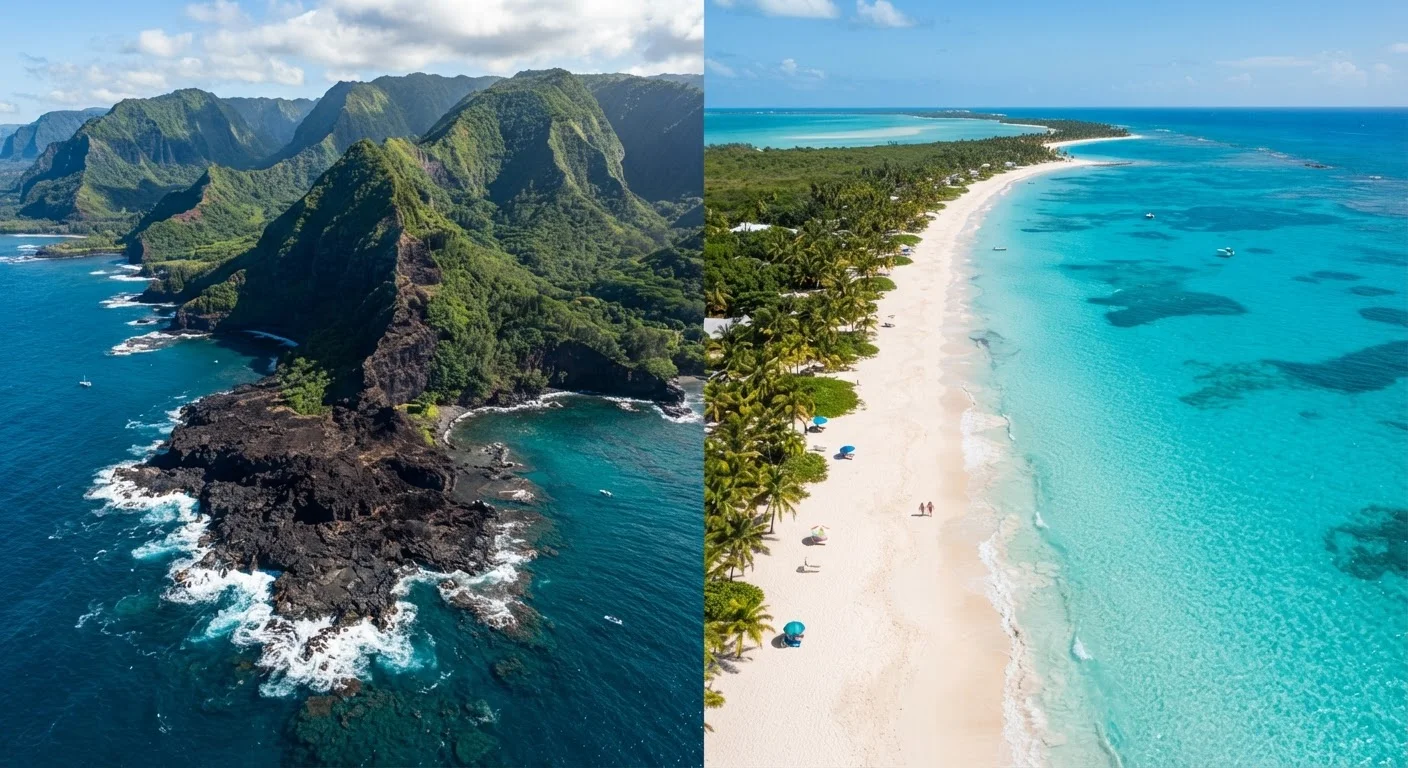
Option A
Hawaii
The dramatic, do-it-all American archipelago.
Best for: Travelers who want volcanic landscapes, diverse outdoor adventures, and no passport required.
Option B
The Caribbean
The sun-soaked, beach-forward island escape.
Best for: Travelers seeking warm shallow water, vibrant nightlife, and a wide range of island cultures and price points.
Getting There: Flights, Passports, and Practicalities
One of the biggest practical differences between these two destinations comes down to logistics before you ever land. Hawaii, as a U.S. state, requires no passport for American citizens - your driver's license and a domestic flight will do. The Caribbean is a patchwork of independent nations, territories, and dependencies, so entry requirements vary widely. U.S. territories like Puerto Rico and the U.S. Virgin Islands don't require a passport, but most other islands - Jamaica, the Bahamas, Barbados, St. Lucia - do.
Flight time matters too. From the West Coast, Hawaii is roughly 5-6 hours and often available as a nonstop. From the East Coast, that same trip stretches to 9-11 hours. Caribbean islands, by contrast, sit 3-5 hours from most East Coast hubs, making them considerably more accessible for shorter trips. If you're weighing time versus destination, check our guide to direct vs. connecting flights - the layover math can shift your calculus.
| Criterion | Hawaii | The Caribbean |
|---|---|---|
| Passport required | No (U.S. citizens) | Varies by island |
| Flight time from East Coast | ~9-11 hours | ~3-5 hours |
| Flight time from West Coast | ~5-6 hours | ~7-10 hours |
| Landscape variety | Exceptional (volcanoes to rainforest) | Moderate per island |
| Cultural diversity | Pacific/multicultural blend | Highly varied across islands |
| Hurricane season risk | Low | June-November |
| U.S. infrastructure familiarity | Full (U.S. state) | Partial (U.S. territories only) |
| Beach variety | Black, green, white sand | Primarily white/pale sand |
Landscape, Climate, and What to Actually Expect
Hawaii's landscape is unlike almost anywhere else on Earth. Maui offers the dormant Haleakalā crater and lush Road to Hāna; the Big Island hosts an active volcanic park and everything from snow-capped peaks to black sand beaches. Kauai's Na Pali Coast is one of the most breathtaking stretches of coastline in the Pacific. The diversity within a single island - or across islands - is genuinely extraordinary.
The Caribbean is more horizontally diverse than vertically dramatic. Most islands are relatively flat and defined by their beaches, reefs, and cultural character rather than by volcanic topography. What you gain is variety in culture and flavor: the Dutch-Caribbean architecture of Curaçao, the French Creole influence in Martinique, the reggae heritage of Jamaica. No single Caribbean island offers Hawaii's geographic range, but the region as a whole offers a breadth of cultural experiences Hawaii can't replicate.
Both regions have seasonal considerations. Hawaii's drier leeward sides are reliably sunny year-round, while windward coasts are wetter. The Caribbean's official hurricane season runs June through November, with peak risk in August and September - worth factoring in when booking. Neither destination guarantees perfect weather, so flexibility in your plans is always wise.
6
Main Hawaiian islands open to visitors
Each island offers a distinct character, from Oahu's urban energy to Molokai's quieter pace.
700+
Islands in the Caribbean region
The Caribbean contains more than 700 islands, islets, and cays, across roughly 30 nations and territories.
~9-11 hrs
Average East Coast to Hawaii flight
Nonstop flights from New York to Honolulu typically run this long, compared to 3-5 hours to most Caribbean islands.
Culture, Cost, and Who Each Destination Suits Best
Hawaii carries a rich Indigenous Hawaiian cultural tradition - hula, lei, the concept of aloha - alongside a complex history of settlement and tourism. Most visitors experience this culture through food, music, and art rather than deep immersion, but the influence is genuine and present. Travelers interested in Indigenous heritage, Pacific history, or diverse food culture (Hawaiian, Japanese, Filipino, Portuguese all shape local cuisine) will find Hawaii genuinely engaging beyond the beach.
The Caribbean's cultural mosaic is equally layered, shaped by Indigenous, African, European, and South Asian histories across dozens of nations. Each island has its own identity, which means a trip to Puerto Rico feels nothing like a trip to Trinidad. That variety is a strength - but it also means you need to do your homework on which island actually fits what you're looking for. Similar to Southeast Asia, treating the Caribbean as one monolithic destination misses the point.
For families, Hawaii's U.S. infrastructure - familiar hospital systems, no currency exchange, domestic travel rules - can simplify logistics considerably. See our family travel planning guide for thinking through what really matters when kids are in the mix.
Travel conditions, visa requirements, entry rules, and flight availability can change. Always verify current requirements with official government sources and your airline before booking.
The content on this site is provided for informational purposes only and should not be considered a substitute for professional advice. While we strive to provide accurate and up-to-date information, we make no guarantees regarding its completeness or accuracy. Always consult a qualified professional for advice specific to your circumstances before making any decisions.