

Our Verdict
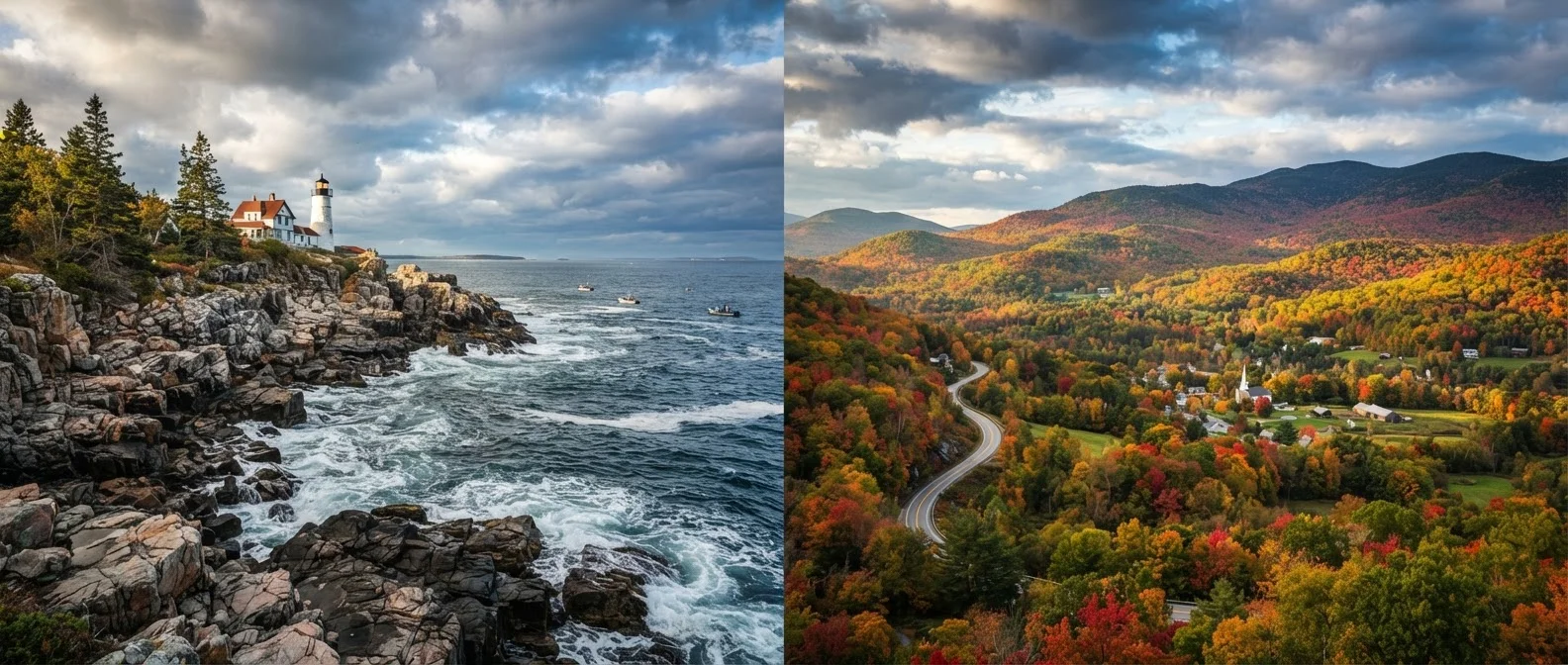
Coastal Maine and Vermont's Green Mountains each deliver a genuinely distinctive New England experience. Maine rewards those drawn to the sea, working harbors, and fresh lobster; Vermont satisfies travelers seeking mountain solitude, outdoor adventure, and pastoral village life. Neither is objectively better - the right choice simply depends on when you're traveling and what you want to feel.
| Best for | Recommended |
|---|---|
| Travelers who love ocean scenery, seafood, and coastal culture | Coastal Maine |
| Outdoor enthusiasts seeking hiking, skiing, or fall foliage | Vermont's Green Mountains |
| Summer family vacationers wanting beaches and harbors | Coastal Maine |
| Winter visitors looking for ski resorts and cozy lodge experiences | Vermont's Green Mountains |
The Case for Coastal Maine
Maine's coastline stretches for roughly 3,500 miles when you account for every cove and inlet - more tidal shoreline than any other state in the Lower 48. That staggering variety means travelers can choose between the bustling waterfront energy of Portland, the wildlife-rich tidal flats of Acadia National Park, or the quiet lobster shacks of the Downeast region.
Portland itself has evolved into one of New England's most compelling small cities. Its Old Port neighborhood packs excellent restaurants, independent bookshops, and a working fishing pier into a compact, walkable grid. If you've ever considered a coastal New England road trip that edges toward maritime Canada, this region makes an ideal springboard - much like the lesser-known Atlantic provinces explored in our piece on Canada's overlooked maritime provinces.
Acadia National Park, centered on Mount Desert Island, is the real anchor for many Maine visitors. Carriage roads wind through birch and spruce forest, while the summit of Cadillac Mountain offers some of the earliest sunrise views in the continental U.S. Peak season runs June through August, when crowds are real but ferry schedules, kayak rentals, and whale-watching tours are all in full operation.
The Case for Vermont's Green Mountains
Vermont's appeal rests on an entirely different sensibility: forested ridgelines, covered bridges, and working dairy farms tucked into river valleys. The Green Mountain range runs the length of the state, anchoring a network of trails, ski areas, and small towns that feel genuinely rooted rather than curated for tourism.
The Long Trail - America's oldest long-distance hiking path, completed in 1930 - follows the spine of the Green Mountains for 272 miles. Day hikers can access dramatic viewpoints from numerous trailheads without committing to a multi-day thru-hike. Towns like Stowe, Woodstock, and Manchester each offer their own personality: Stowe leans into its ski-resort identity, Woodstock is famously picturesque, and Manchester mixes outlet shopping with mountain access.
| Coastal Maine | Vermont's Green Mountains | |
|---|---|---|
| Primary landscape | Rocky shoreline, tidal coves, harbors | Forested ridges, river valleys, farms |
| Peak season | June-August | Late Sept-Oct and Dec-March |
| Top activity | Kayaking, whale watching, Acadia hiking | Skiing, fall foliage drives, Long Trail hiking |
| Food culture | Lobster, chowder, wild blueberries | Maple syrup, artisan cheese, craft beer |
| Nearest major hub | Boston (~2 hrs to Portland) | Boston (~3 hrs to Burlington) |
| Best for families | Summer beach and harbor towns | Ski school, scenic drives, village events |
| Off-season appeal | Quieter, some closures in winter | Strong winter ski draw, quiet in mud season |
Fall foliage typically peaks in Vermont between late September and mid-October, drawing travelers from across the country. If a mountain island escape is more your pace, our comparison of Hawaii versus the Caribbean offers a useful framework for thinking through destination trade-offs.
Practical Considerations: Season, Cost, and Getting There
Both destinations are drivable from Boston in two to four hours, and each has regional airports - Portland International Jetport in Maine and Burlington International Airport in Vermont - served by several major carriers. Neither requires a car-free strategy, though having a vehicle opens up significantly more of each region.
Cost profiles differ somewhat. Maine's coastal lodging prices spike sharply in July and August, especially near Acadia. Vermont's premium seasons are foliage (late September through October) and ski season (December through March), when mountain-area accommodation books up weeks or months in advance. Shoulder seasons - May to early June in Maine, April and early November in Vermont - can offer meaningful savings on lodging, though some seasonal businesses may not yet be open.
Food and drink cultures also diverge. Maine is synonymous with lobster, clam chowder, and blueberries. Vermont's culinary identity centers on maple syrup, artisan cheese, and a thriving craft-beer scene. Neither will disappoint a curious eater.
Travel conditions, prices, and seasonal business hours change regularly. Always verify current information with official tourism boards and individual operators before finalizing your trip.
The content on this site is provided for informational purposes only and should not be considered a substitute for professional advice. While we strive to provide accurate and up-to-date information, we make no guarantees regarding its completeness or accuracy. Always consult a qualified professional for advice specific to your circumstances before making any decisions.