

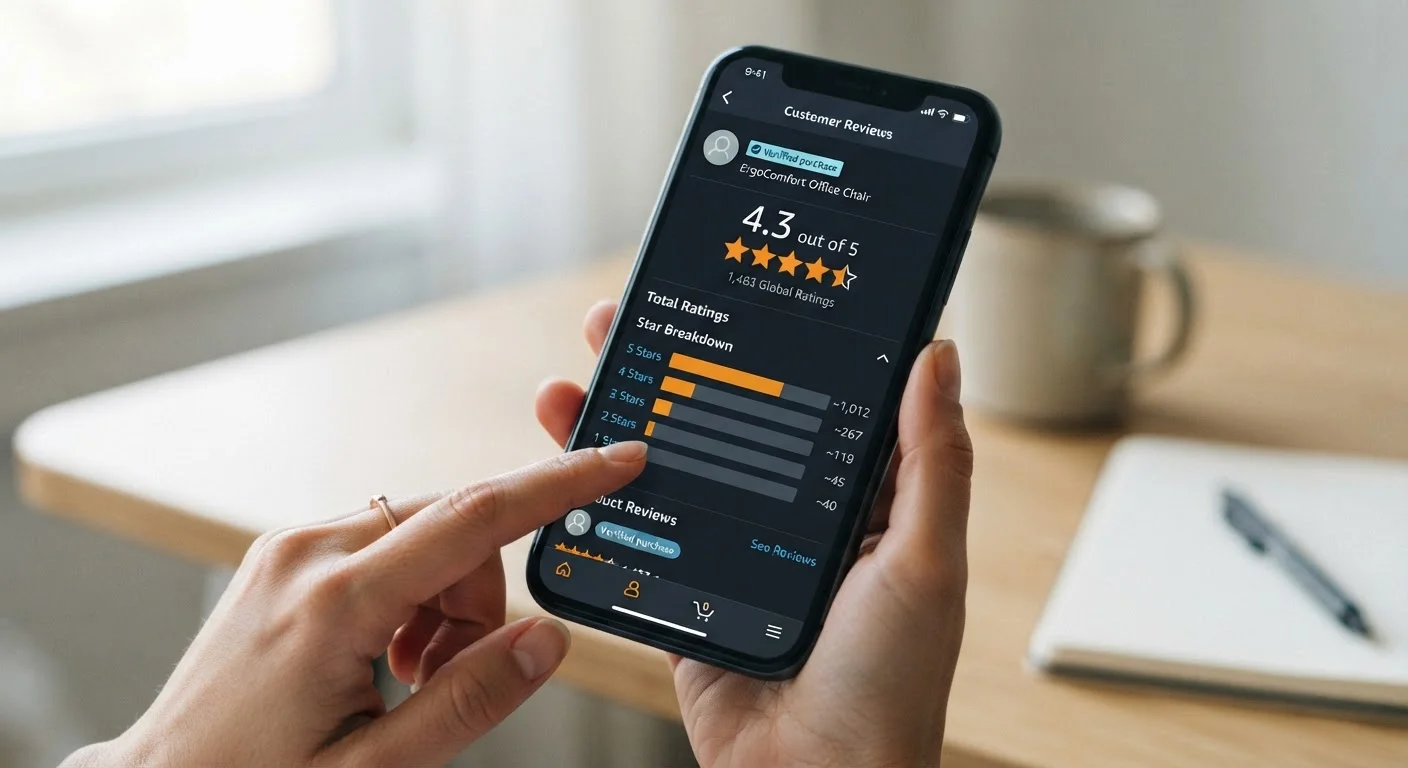
What a Star Rating Is Actually Calculating
When you see a 4.3-star rating, you're looking at a simple arithmetic average of every score submitted - nothing more. The platform adds up the star values and divides by the number of reviews. No weighting for reviewer expertise. No adjustment for how long someone owned the product. No distinction between someone who used it daily for a year and someone who opened the box, gave it two stars because shipping was slow, and moved on.
That average collapses a lot of complexity into one number. A product rated 4.3 stars might have 80% five-star reviews and 15% one-star reviews - a polarized split that suggests the product works brilliantly for some buyers and fails others. Or it might have a tight cluster of four-star reviews suggesting consistent but imperfect satisfaction. You can't tell which from the summary score alone. Always look at the full star distribution, which most major retail platforms display as a histogram alongside the average.
~68%
Shoppers who trust online reviews as much as personal recommendations
According to recurring consumer survey data from BrightLocal's Local Consumer Review Survey, a large majority of consumers treat online reviews similarly to word-of-mouth recommendations.
4.2
Average star threshold consumers consider acceptable
Research from the Spiegel Research Center has indicated consumers are increasingly reluctant to purchase products rated below roughly 4.0-4.2 stars, regardless of review volume.
1 in 5
Online reviews estimated to be fake or incentivized
Various industry analyses, including work cited by the FTC, have estimated that a meaningful share of consumer reviews may not reflect independent, authentic buyer experience.
The Sampling Problem: Who Actually Leaves Reviews
Ratings are only as representative as the people who leave them - and that group is self-selected in predictable ways. Customers who had an unusually good or unusually bad experience are far more motivated to write a review than those who had an ordinary one. This creates what researchers call an "extremity bias," where ratings skew toward the poles relative to true average satisfaction.
There's also a timing effect. Early reviews on a new product are often written by enthusiastic early adopters. Reviews written months later may reflect durability issues or manufacturing changes that earlier buyers never saw. A product's rating history - not just its current score - can reveal these shifts if the platform makes that data visible.
For more on how to read the signals buried in review text, see our guide to reading one-star reviews and how to spot genuine feedback from noise.
What Ratings Structurally Cannot Capture
A single number cannot encode multidimensional experience. When a reviewer rates a blender, they're evaluating some mix of noise level, cleaning ease, motor power, price-to-performance ratio, and how the lid fits. Different buyers weight those factors differently. A rating of 4 stars means different things depending on who gave it and why.
Ratings also can't capture fit. A hiking boot that's perfect for wide feet and terrible for narrow ones might average out to three stars - not because it's a bad boot, but because it's a polarizing fit. That nuance disappears in the aggregate. The same applies to skill level, use case, and expectations shaped by price point. A reviewer who paid full price and one who bought on clearance often have fundamentally different satisfaction thresholds.
This is why reviews that disclose methodology and noted limitations are so much more useful than a numeric score alone.
Volume, Recency, and What to Do With All of It
Review count matters as much as the score. A 4.8-star rating from 11 people is statistically fragile - two bad experiences could push it to 4.2. The same score from 2,400 reviewers is far more stable and meaningful. As a general rule, treat any rating based on fewer than 30 reviews with real caution, especially for products where durability or consistency matters.
Recency matters too. Look for platforms that let you sort reviews by date or show a rating trend over time. A product with a 4.1 average but a string of recent 2-star reviews about a changed formula or quality drop deserves scrutiny, even if the historical average looks solid.
Finally, consider what questions you're actually trying to answer before you look at a rating. Popularity and satisfaction are not the same as reliability or value. As explored in why the most-reviewed product isn't always the most reliable one, high review volume can create a perception of quality that the underlying data doesn't support. Use ratings as one input among several - not as a verdict.
Frequently Asked Questions
Not necessarily. Ratings measure reported satisfaction, which depends heavily on buyer expectations and context. A product can earn high scores by being cheap and meeting low expectations, while a more capable item might rate lower because it attracts more demanding users. Quality and satisfaction are related but not the same thing.
There's no universal threshold, but most consumer research suggests that ratings become meaningfully stable around 30-50 reviews for everyday products. For high-stakes or expensive purchases, look for considerably more. A rating based on fewer than 10 reviews should be treated as anecdotal.
Some platforms flag reviews from verified purchasers, but many do not require purchase verification at all. Even verified-purchase labels don't guarantee a reviewer used the product extensively or is free from bias. Read the review text, not just the label.
Distribution shows whether a rating reflects broad consensus or a polarized split. A 3.5-star average could mean most people thought it was mediocre - or it could mean half loved it and half hated it. Those are very different signals, and only the histogram reveals which is true.
Yes. Paid reviews, review gating (only prompting happy customers to leave feedback), and coordinated posting are known practices. Rapid spikes in review volume, an unusually high proportion of 5-star ratings with generic text, and verified-purchase gaps are all worth noting.
Absence of reviews means absence of data - not absence of quality. New products, niche items, and private-label goods often lack reviews despite being perfectly adequate. In these cases, look for manufacturer specifications, return policies, and independent testing sources where available.
The content on this site is provided for informational purposes only and should not be considered a substitute for professional advice. While we strive to provide accurate and up-to-date information, we make no guarantees regarding its completeness or accuracy. Always consult a qualified professional for advice specific to your circumstances before making any decisions.