

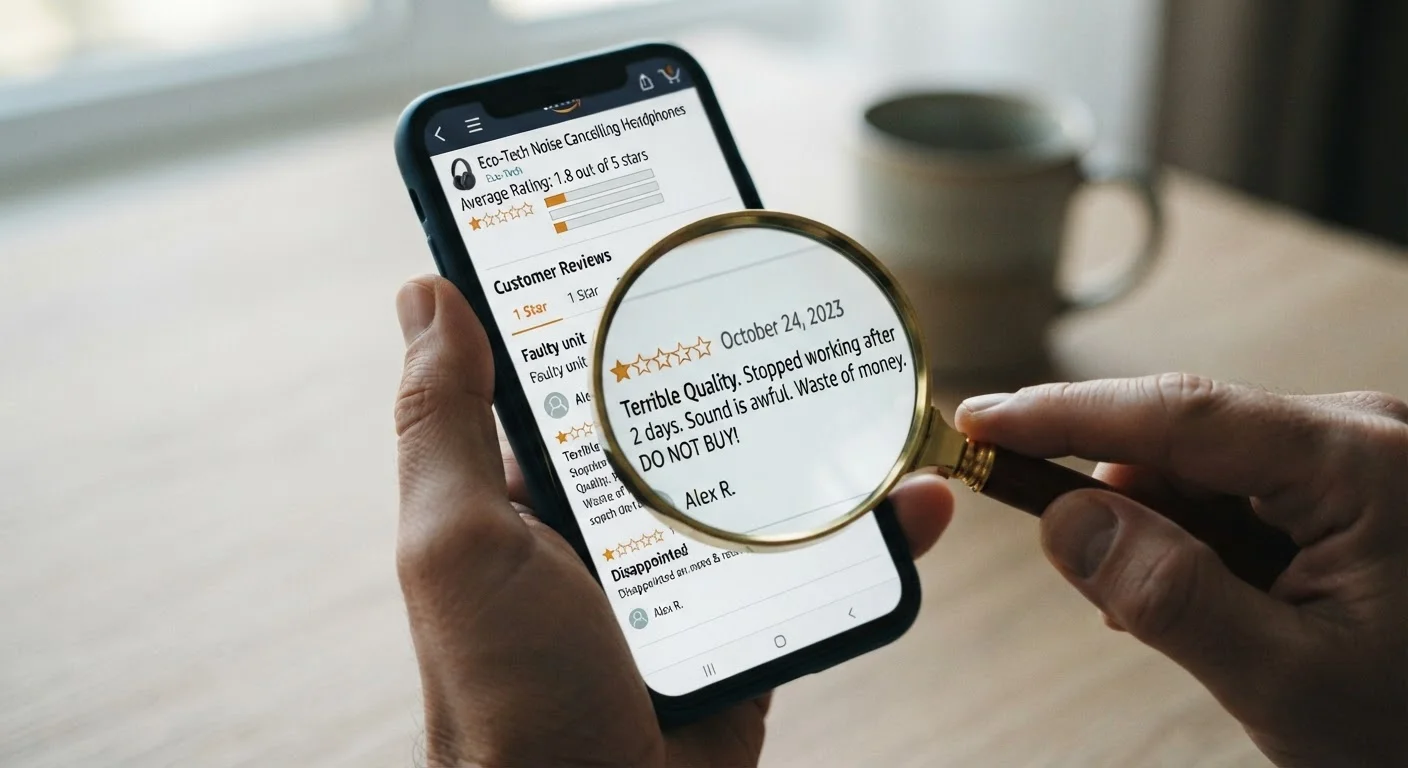
Why One-Star Reviews Deserve a Second Look
Most shoppers instinctively discount one-star reviews as the territory of unusually unlucky buyers or people with an axe to grind. That instinct is understandable - and partially correct. But it also causes shoppers to ignore the rating tier that tends to be the most specific, the most detailed, and the most useful for identifying genuine product weaknesses.
Five-star reviews frequently describe general satisfaction. One-star reviews, by contrast, often describe exactly what went wrong, when it happened, and under what conditions. That specificity - when it's real and repeatable - is exactly the kind of signal worth paying attention to. The challenge is learning to filter signal from frustration.
The steps below give you a repeatable method for reading one-star reviews critically, so you can distinguish legitimate product flaws from irrelevant complaints before you spend money.
One Complaint Is Not a Pattern
A single one-star review - no matter how vivid - is not reliable evidence of a product flaw. Consumer behavior research consistently shows that review populations skew toward extreme experiences. Look for the same specific complaint appearing across multiple independent reviews before treating it as a real product liability.
What You'll Need Before You Start
This process requires only a few minutes and access to a product's review page. No special tools are necessary, though some optional resources can speed up the process.
Product review page (retailer site)
Primary source of customer one-star reviews, sortable by rating and recency.
Keyword search within reviews
Filters reviews by topic so you can find complaints relevant to your specific use case.
Review aggregator or third-party source
Cross-references feedback from multiple retail platforms to identify consistent patterns.
Once you have access to the review section, follow the steps below in order. The process is designed to take 5-15 minutes for any product you're researching seriously.
Sort reviews by lowest rating and check the volume
Navigate to the product's review section and filter to show one-star reviews only. Before reading a single review, note the raw count. A product with 4,000 reviews and 80 one-star ratings (2%) tells a very different story than one with 400 reviews and 80 one-star ratings (20%). Proportion matters as much as presence. Also check what star ratings actually measure to understand what the aggregate score may be hiding.
Separate the complaint type from the complaint itself
As you read, mentally tag each review into one of four categories: product defect (the item broke or malfunctioned), expectation mismatch (the buyer expected something different from what was advertised), user error (the product wasn't used as intended), or fulfillment issue (arrived damaged, wrong item shipped). Only the first category is directly relevant to the product's actual quality. The others reveal either a listing clarity problem or circumstances outside the manufacturer's control.
Check if the reviewer's use case matches yours
Read the context clues in each complaint. A reviewer who gave a compact travel blender one star because it 'can't crush ice for frozen cocktails' is reporting a real limitation - but if you only need it to blend protein shakes, that complaint is irrelevant to your purchase. Ask: does this person's stated purpose match mine? A complaint that doesn't apply to your intended use is data, not a dealbreaker. This is especially useful when extracting real information from review pages.
Look for repeated, specific complaints across multiple reviews
Scroll through enough one-star reviews to identify language patterns. If seven separate reviewers mention the same hinge cracking, the same dial sticking, or the same app disconnecting - that's a genuine signal. Vague complaints ('just didn't work,' 'waste of money') carry very little information. Specific, repeatable complaints about the same component or behavior are the most credible evidence of a real product flaw. This is the core principle behind identifying reviews worth your time.
Check review dates relative to product version or batch
A cluster of one-star reviews from a specific time period may indicate a bad production run or a firmware issue that has since been patched. Check whether more recent reviews mention the same problem or whether the complaint pattern shifts over time. A product that had serious quality-control issues two years ago may have been corrected - or the problem may persist. Recency-filtered reading gives you a more accurate current picture than the aggregate rating alone.
Cross-reference with editorial or professional reviews
Once you've identified the specific complaints that seem credible and relevant, check whether independent testers noticed the same issues. Professional reviewers typically test under controlled conditions and document methodology - their findings either corroborate or contradict the crowd signal. Understanding the difference between these two sources of information is covered in depth in editorial reviews vs. user reviews. When both sources flag the same weakness, treat it as confirmed.
Common Patterns and What They Actually Mean
After working through the steps above, you'll likely find that one-star reviews fall into recognizable patterns. Here's how to interpret the most common ones:
- Widespread complaints about a single component - usually a genuine design or materials flaw worth weighing seriously.
- Complaints that contradict the product listing - often a listing accuracy problem; check whether the description has been updated since those reviews were posted.
- Complaints tied to a specific platform or shipping method - typically outside the manufacturer's control; filter these out.
- One-star reviews that read like a five-star review in disguise - occasionally a reviewer will give one star over a minor gripe and then praise the product extensively. Read the text, not just the star.
Search Within Reviews for Your Use Case
Most major retail platforms allow keyword searches within a product's review section. Before scrolling through dozens of complaints, search terms like 'battery,' 'assembly,' or 'size' to surface only the reviews relevant to your concern. This cuts research time significantly and keeps your reading focused.
Reading one-star reviews analytically is a habit, not a one-time task. Once you develop the filtering instinct, it takes only a few minutes to extract what you actually need - and it's a reliable counterweight to marketing language and curated highlight reviews.
The content on this site is provided for informational purposes only and should not be considered a substitute for professional advice. While we strive to provide accurate and up-to-date information, we make no guarantees regarding its completeness or accuracy. Always consult a qualified professional for advice specific to your circumstances before making any decisions.