

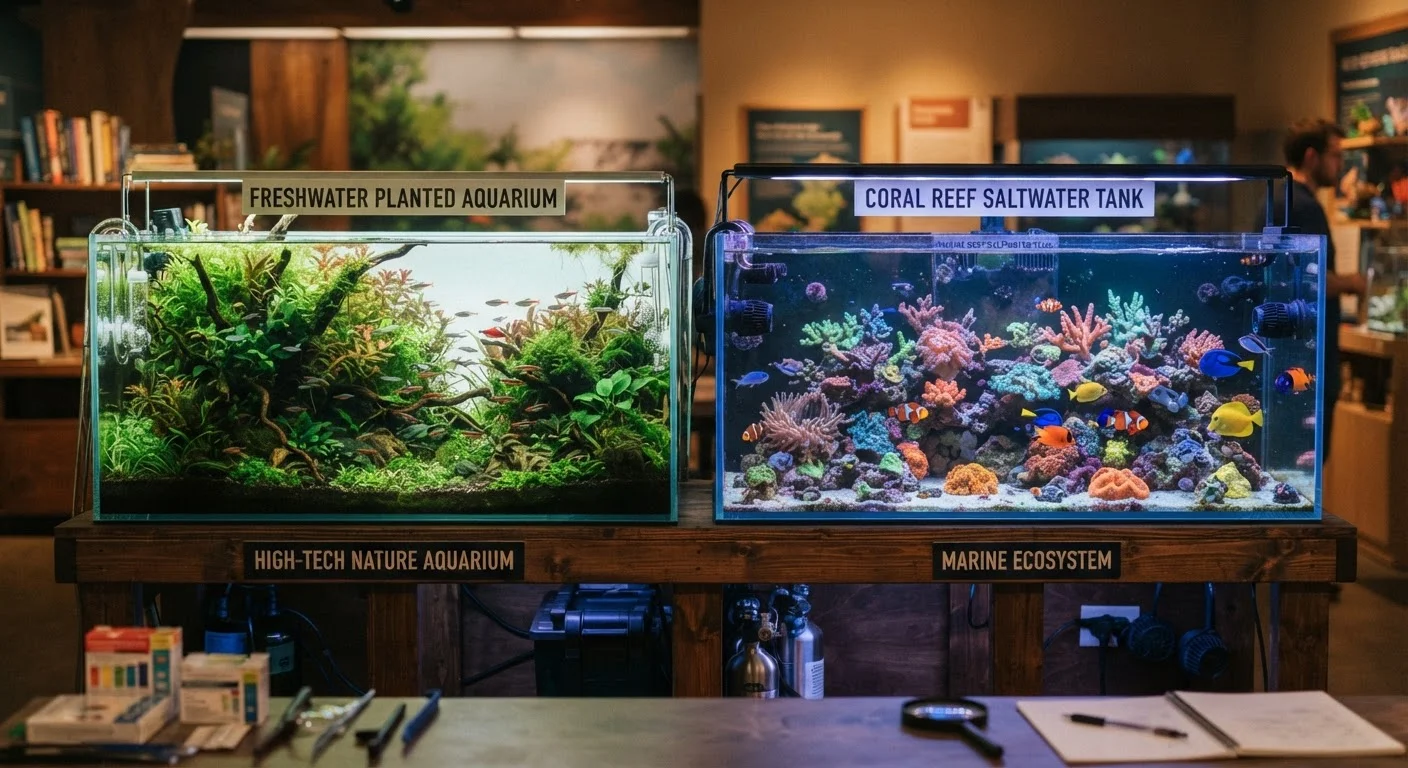
Our Verdict
Freshwater aquariums offer a more forgiving, lower-cost entry point that suits most beginners and busy owners well. Saltwater tanks reward patient, experienced hobbyists with stunning biodiversity, but they demand consistent monitoring, a larger upfront investment, and a genuine willingness to learn marine chemistry.
| Best for | Recommended |
|---|---|
| First-time fishkeepers or those with limited time for daily maintenance | Freshwater Tank |
| Experienced hobbyists seeking a visually dramatic, species-diverse display | Saltwater Tank |
| Owners on a tight setup and ongoing equipment budget | Freshwater Tank |
| Those specifically interested in keeping corals or reef ecosystems | Saltwater Tank |
Setup Costs and Equipment Demands
The financial gap between freshwater and saltwater aquariums is real and worth understanding before you commit. A basic freshwater setup - tank, filter, heater, and lighting - can be assembled for a few hundred dollars. Saltwater, or marine, tanks require the same core components plus a protein skimmer (which removes organic waste before it breaks down), a more powerful circulation pump, and often a sump - a secondary tank that houses equipment and increases total water volume for stability. Live rock, an essential biological filter in marine systems, adds further cost.
For reef tanks that include corals, high-intensity LED lighting designed to support photosynthesis in coral tissue can alone cost several hundred dollars. Altogether, a modest beginner saltwater system typically runs two to four times more than a comparable freshwater setup. That doesn't include salt mix, which is an ongoing consumable.
If you're newer to fishkeeping, our guide on cycling, stocking, and keeping water healthy covers the foundational steps that apply to both tank types.
Water Chemistry: How Precise Do You Need to Be?
Freshwater tanks require monitoring of ammonia, nitrite, nitrate, and pH. These parameters are important, but most freshwater fish tolerate modest fluctuations. A slightly off pH reading won't typically cause an immediate crisis if corrected promptly.
Marine tanks add salinity - measured as specific gravity or salinity in parts per thousand (ppt) - to the monitoring list. The target range is narrow: most marine fish and corals thrive at 1.025-1.026 specific gravity. Evaporation raises salinity daily, so top-offs with fresh RO (reverse osmosis) water are often needed every one to two days. Reef tanks also require stable calcium, alkalinity, and magnesium levels to support coral skeleton growth, adding three more parameters to test regularly.
Water changes in saltwater systems mean mixing and aerating salt water in advance - you can't simply add tap water. This extra preparation time is a meaningful part of routine maintenance.
| Freshwater Tank | Saltwater Tank | |
|---|---|---|
| Startup Cost | Lower (a few hundred dollars) | Higher (often 2-4x more) |
| Equipment Complexity | Filter, heater, basic lighting | Skimmer, sump, RO unit, advanced lighting |
| Water Parameters to Monitor | 4 core parameters | 7+ parameters including salinity, calcium, alkalinity |
| Species Tolerance of Fluctuations | Moderate to good | Low - tight stability required |
| Daily Maintenance Time | Low to moderate | Moderate to high |
| Beginner Friendliness | High | Low to moderate |
Species Sensitivity and Daily Care
Many popular freshwater species - danios, tetras, livebearers, and bettas - were bred in captivity across many generations and tolerate a range of conditions reasonably well. For betta-specific care, see our overview on betta fish tank conditions and health.
Marine fish are mostly wild-caught or first-generation captive-bred, and they reflect the stability of coral reef environments - which change very little naturally. Even short temperature spikes or salinity shifts can trigger stress, disease, or death in sensitive species like mandarin dragonets or seahorses. Corals are similarly unforgiving of parameter swings.
Run the Nitrogen Cycle Before Adding Fish
Whether you choose freshwater or saltwater, never skip the cycling process. Cycling establishes the beneficial bacteria that convert toxic ammonia into less harmful compounds. Rushing this step - typically 4 to 8 weeks - is one of the most common causes of early fish loss. Test your water until ammonia and nitrite readings consistently read zero before introducing any livestock.
Day-to-day, a healthy freshwater tank may need only feeding, a visual check, and a weekly partial water change. A marine tank - especially a reef - typically involves daily top-offs, parameter spot-checks several times a week, equipment inspection, and more involved monthly maintenance like cleaning skimmer cups and checking pump heads.
Which Tank Is Right for You?
Choosing between freshwater and saltwater ultimately comes down to three honest questions: How much time can you reliably dedicate? What is your realistic startup and monthly budget? And how much complexity do you enjoy learning?
Freshwater tanks are not a consolation prize - they support beautiful planted aquascapes, large cichlid displays, and thriving community tanks that are genuinely rewarding to keep. Saltwater tanks, when well-maintained, are among the most visually striking living systems a home can contain, but they require a level of consistency and chemistry knowledge that beginners often underestimate.
Starting with freshwater to build your understanding of the nitrogen cycle, water changes, and fish behavior is a sound strategy. Many experienced reef keepers began exactly that way. Whichever path you choose, the investment of time and care - not just money - determines how well your fish thrive.
This article is for general informational purposes. Consult a knowledgeable aquarium specialist or veterinarian experienced in aquatic animals for guidance specific to your fish's health and tank conditions.
The content on this site is provided for informational purposes only and should not be considered a substitute for professional advice. While we strive to provide accurate and up-to-date information, we make no guarantees regarding its completeness or accuracy. Always consult a qualified professional for advice specific to your circumstances before making any decisions.