

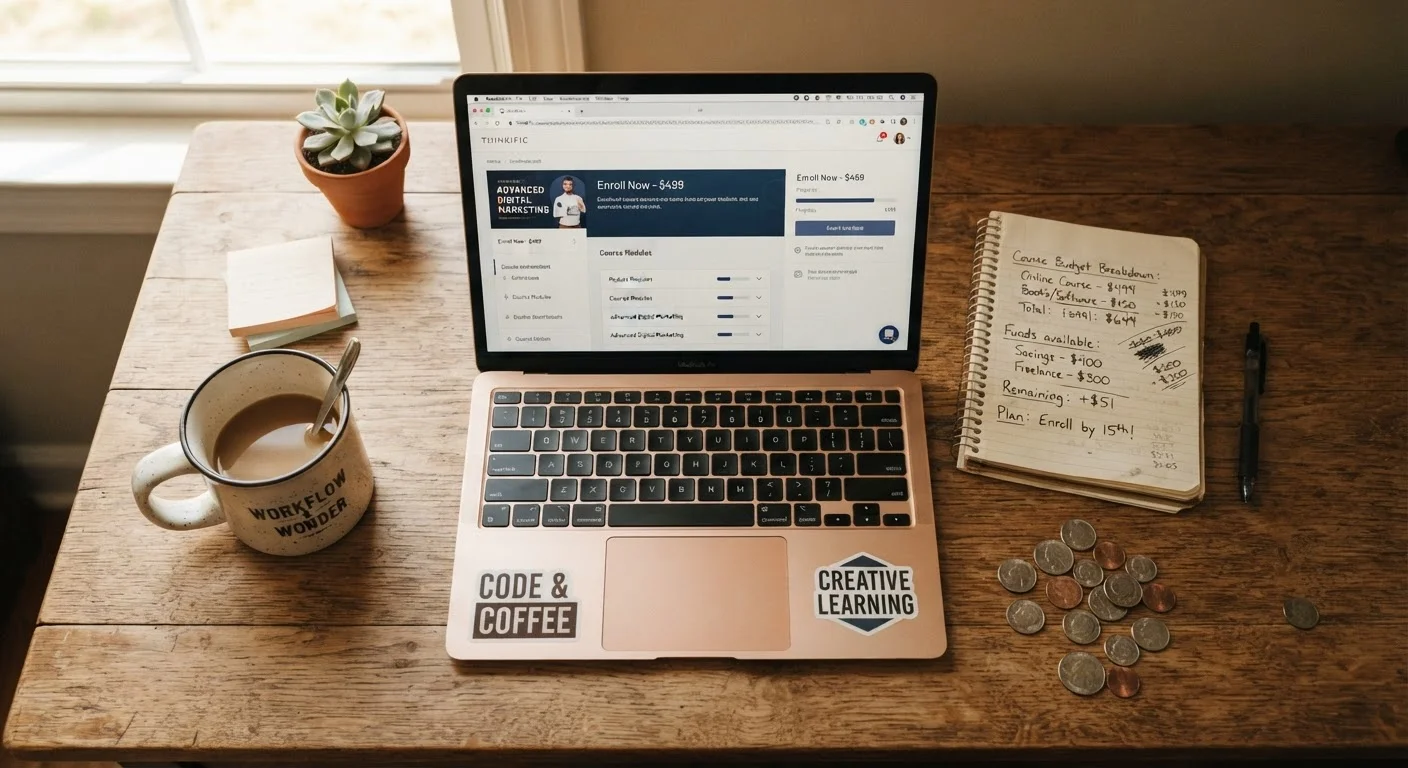
The Advertised Price Is Only the Starting Point
When a course page shows a tuition figure - or even a $0 price tag - that number rarely tells the complete story. Just as a vehicle's sticker price is only the beginning of what ownership actually costs (see our look at the total cost of owning a car for a useful parallel), online learning carries its own layer of downstream expenses that are easy to miss at signup.
Common costs that appear after enrollment include:
- Certificate or credential fees: Many platforms offer free course access but charge $50-$300 or more to receive a verified certificate of completion.
- Proctored exam fees: Programs with monitored assessments often charge per-exam fees, typically $25-$150 each, billed separately.
- Required materials: Textbooks, case-study packs, or proprietary software licenses can add hundreds of dollars to an otherwise modest tuition.
- Platform subscriptions: Some providers require an active monthly or annual subscription to access course content, even after you have enrolled in a specific course.
Before paying for anything, read the full fee schedule and check the pre-enrollment checklist to confirm what is and is not included in the headline price.
Time Is a Cost That Doesn't Show Up on the Invoice
The financial price of a course is measurable, but the time investment is just as real - and far more commonly underestimated. A course listed as "5 hours per week" may assume prior familiarity with the subject, meaning novice learners often spend significantly more time on readings, rewatching lectures, and completing assignments.
Dropping a course midway through is not just a learning setback. Depending on refund policies - which vary widely and are rarely prominent on enrollment pages - you may forfeit some or all of the tuition you paid. Understanding both the time commitment and the refund window before you enroll is one of the most practical ways to protect your investment.
Check the Refund Policy Before You Pay
Most online platforms offer a refund window - often 7 to 30 days - but conditions vary significantly. Some refunds apply only if you have not accessed course materials; others are pro-rated based on time elapsed. Reading the refund terms before enrolling takes five minutes and can save you the full course cost if your schedule or circumstances change.
The format of a course also affects how much time flexibility you actually have. Live session formats with scheduled meetings carry a harder time commitment than self-paced video lectures. See how different online learning formats compare to match a structure to your schedule.
What Online Learning Genuinely Does Not Have to Cost
A meaningful portion of high-quality online education is available at no charge - not as a marketing hook, but as a durable feature of how many universities and public institutions approach open access learning.
70%+
U.S. adults with library card access
According to the American Library Association, a large majority of Americans have access to public library systems that increasingly offer free digital learning platform subscriptions.
$0-$60K+
Range of online learning costs
The cost of online education spans from fully free open courseware to full degree programs exceeding $60,000, depending on the institution, level, and credential type.
~50%
Employees unaware of tuition benefits
Research from education benefits providers suggests that roughly half of employees eligible for employer tuition assistance do not use the benefit, often due to lack of awareness.
Public libraries in most U.S. states provide free access to learning platforms, digital textbooks, and language learning tools using nothing more than a library card. Many accredited universities publish complete course materials - syllabi, lecture videos, problem sets - through open courseware initiatives, with no enrollment or fee required.
For learners who want structured content but not a credential, auditing courses on major platforms costs nothing on many offerings. The trade-off is the absence of a verified certificate - but if your goal is skill-building rather than signaling, audit access often delivers equivalent learning value at zero cost.
It is also worth checking whether your employer offers a tuition assistance program or professional development budget. These benefits are frequently available but go unclaimed - a gap worth closing before spending out of pocket.
Degrees, Certificates, and the Cost Tradeoffs in Between
The cost range across online learning is vast. A single self-paced certificate course might cost nothing (audited) or $300 (with a verified credential). A full online degree from an accredited institution can run from $10,000 to over $60,000 depending on the school and program level.
Understanding where a particular offering sits on that spectrum - and whether the credential it produces is recognized by employers - is essential before committing significant funds. Our comparison of online degrees versus traditional campus degrees walks through the cost, flexibility, and career outcome tradeoffs in detail.
A marketing professional signs up for a free data analytics course, then discovers the certificate she needs for her portfolio costs $199 extra - on top of a required $49/month platform subscription she had not noticed.
A community college student uses his local library card to access a full-featured online learning platform at no charge, completing a project management course that his employer later accepted as professional development training.
A mid-career teacher enrolls in an online graduate certificate program, then learns midway through that her school district's tuition reimbursement benefit would have covered 80% of the cost - a benefit she had never investigated.
A software developer audits a machine learning course from a university's open courseware site - accessing all lectures, readings, and problem sets for free - without receiving a certificate.
If cost is a primary concern, financial aid is not limited to traditional degree programs. Some certificate programs offered through accredited institutions qualify for federal financial aid. Income-share agreements, employer reimbursement, and scholarship programs exist specifically for working adult learners. Exploring these options before defaulting to full out-of-pocket payment is always worthwhile.
The goal is not to avoid spending money on learning - sometimes a credential genuinely earns its price. The goal is to spend with clear eyes, knowing what you are actually buying and what alternatives exist.
Frequently Asked Questions
Free courses from accredited universities and established platforms cover real, substantive content - the same video lectures and readings that paying students access. The primary difference is that you won't receive a verified certificate unless you pay for one. For personal skill-building or exploration, free auditing is often entirely sufficient.
Watch for proctored exam fees, certificate or credential fees charged separately from tuition, required textbook purchases, platform subscription costs, and technology or lab fees. Some programs also charge per-credit fees that are not reflected in headline prices.
Many employers offer tuition assistance or professional development stipends that cover online courses, certificates, or even degree programs. Check your employee handbook or HR portal - these benefits are frequently underutilized by eligible workers.
Online programs often cost less in direct tuition and eliminate commuting and housing expenses, but they are not universally cheaper - some online degrees carry comparable or higher per-credit rates than on-campus equivalents. A careful cost comparison is essential before enrolling.
Auditing a course means accessing the lecture content without submitting assignments for a grade or receiving a certificate. Many platforms offer auditing at no cost. It is ideal for learners who want knowledge rather than a credential.
Research whether employers in your target field recognize the issuing institution or platform. Look at job postings for the role you want and see which credentials are listed. Talking to professionals already in that field is one of the most reliable ways to gauge a certificate's practical value.
The content on this site is provided for informational purposes only and should not be considered a substitute for professional advice. While we strive to provide accurate and up-to-date information, we make no guarantees regarding its completeness or accuracy. Always consult a qualified professional for advice specific to your circumstances before making any decisions.